Many people search for synonyms of “uncommon” because they want better words. The word uncommon is useful, but it can feel plain or overused.
Writers, students, bloggers, and professionals all want fresh language. When you use stronger word choices, your writing feels smarter and more polished.
Word variety matters. In academic essays, you need precise vocabulary. In business writing, tone must be clear and professional.
In casual writing, you want to sound natural and interesting. Using the right synonym can change how your message feels.
If you rely on the same words again and again, your writing becomes dull. But when you choose the right alternative, your ideas stand out.
This guide gives you 16+ uncommon synonyms, plus stronger, softer, and academic options. Each word comes with tone labels and examples so you can use them with confidence.
Let’s begin.
What Does “Uncommon” Mean?
Uncommon means not usual, not seen often, or rare.
It describes something that does not happen regularly or is different from what people expect.
Tone Explanation
The word uncommon is neutral. It works in formal, informal, and academic writing. However, it does not always sound powerful. That is why many writers look for better alternatives.
When It Is Commonly Used
- To describe rare events
- To talk about unique qualities
- To explain unusual behavior
- To highlight something special
Now let’s explore better options.
16+ Best Synonyms for “Uncommon”
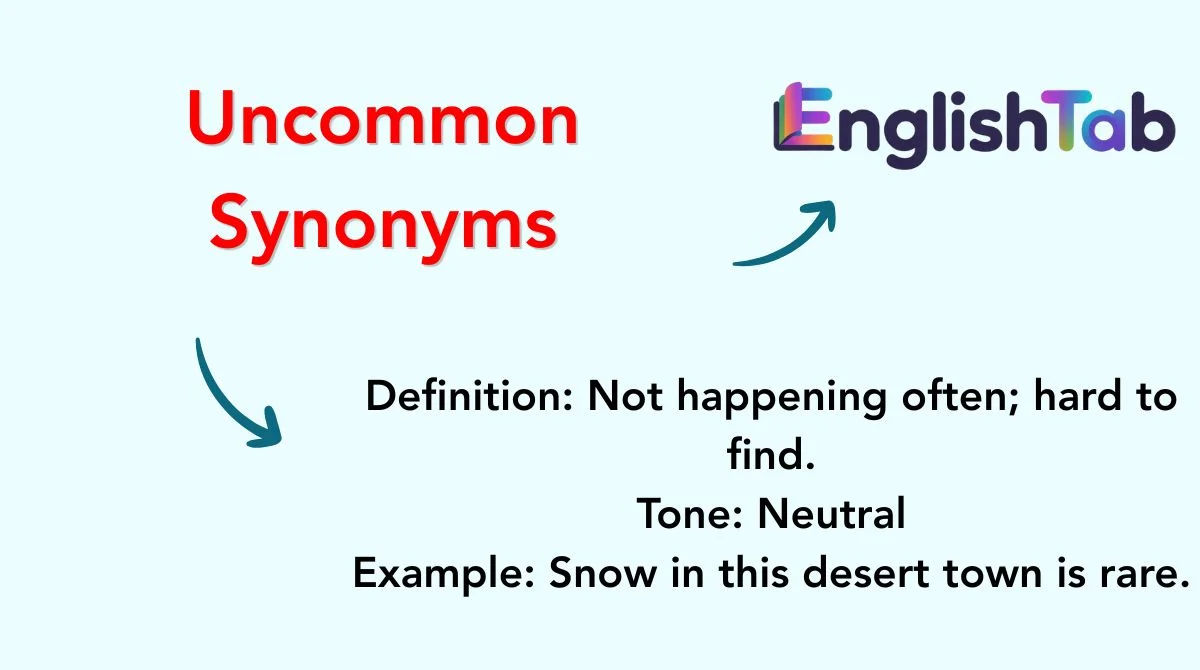
Rare
Definition: Not happening often; hard to find.
Tone: Neutral
Example: Snow in this desert town is rare.
Unusual
Definition: Different from what is normal.
Tone: Neutral
Example: She had an unusual way of solving problems.
Extraordinary
Definition: Very unusual and impressive.
Tone: Formal
Example: His talent for music is extraordinary.
Exceptional
Definition: Better or greater than normal.
Tone: Formal / Academic
Example: She showed exceptional leadership skills.
Atypical
Definition: Not typical; not standard.
Tone: Academic
Example: His response was atypical for someone his age.
Unique
Definition: One of a kind.
Tone: Neutral
Example: Each child has a unique personality.
Scarce
Definition: Limited in amount.
Tone: Formal
Example: Clean water is scarce in some regions.
Distinctive
Definition: Clearly different from others.
Tone: Formal
Example: The artist has a distinctive style.
Unconventional
Definition: Not following common rules or traditions.
Tone: Neutral / Formal
Example: She chose an unconventional career path.
Irregular
Definition: Not even or not consistent.
Tone: Neutral
Example: His heartbeat was irregular.
Infrequent
Definition: Not occurring often.
Tone: Formal
Example: Earthquakes are infrequent in this area.
Singular
Definition: Remarkable or unique.
Tone: Literary
Example: It was a singular moment in history.
Peculiar
Definition: Strange or slightly odd.
Tone: Neutral
Example: There was a peculiar smell in the room.
Odd
Definition: Not usual; strange.
Tone: Casual
Example: That was an odd question to ask.
Out of the ordinary
Definition: Different from what is normal.
Tone: Neutral
Example: The results were out of the ordinary.
Noteworthy
Definition: Worth attention because it is unusual.
Tone: Formal
Example: Her progress this year is noteworthy.
Remarkable
Definition: Worth noticing; unusual in a positive way.
Tone: Formal
Example: He made remarkable improvements.
Stronger Alternatives (More Intense Options)
These words show higher impact. Use them when you want power.
Phenomenal
Use when something is extremely impressive.
Her performance was phenomenal.
Astounding
Best for shocking or surprising facts.
The results were astounding.
Rarefied
Used for something exclusive or elite.
He works in rarefied academic circles.
Unprecedented
For events that never happened before.
The city faced unprecedented flooding.
Exceptional
Stronger when highlighting excellence.
She showed exceptional courage.
Unique
Use carefully when something truly has no equal.
This species is unique to the island.
Singular
For rare and striking moments.
It was a singular achievement.
Softer or Polite Alternatives
Use these when you do not want to sound too strong.
Unusual
Gentle and neutral.
Different
Very soft and simple.
Less common
Clear and polite.
Infrequent
Professional and mild.
Irregular
Best for patterns or schedules.
Distinct
Calm and factual.
Special
Friendly and positive tone.
Academic & IELTS-Friendly Alternatives
These words work well in essays and exams.
Atypical
Common in research writing.
Anomalous
Means different from expected results.
The data showed anomalous patterns.
Scarce
Used in economic or environmental topics.
Exceptional
Formal and strong.
Unconventional
Useful in social or cultural essays.
Irregular
Good for statistics and patterns.
Rare
Simple but effective.
Distinctive
Helpful in descriptive analysis.
Notable
Good for highlighting key findings.
Singular
Adds depth in literary essays.
Infrequent
Professional and clear.
Synonyms You Should Avoid (Context Warning)
Some words may confuse readers if misused.
Weird
Too informal for academic writing.
Freakish
Sounds negative or offensive.
Consider
May feel insensitive when describing people.
Bizarre
Implies something very strange, not just uncommon.
Unique (when overused)
Do not use for common things. It means one of a kind.
Always match the word to the situation.
How to Choose the Right Synonym in Writing
1. Consider Context
Is it about people, data, events, or objects?
For research, use atypical or anomalous.
For daily talk, use rare or unusual.
2. Think About Tone
Formal writing needs polished words like exceptional.
Casual writing allows odd or different.
3. Know Your Audience
Teachers expect academic words.
Blog readers prefer simple language.
4. Keep Clarity First
Never choose a complex word if it confuses readers.
Clear writing is always better than fancy writing.
Example Paragraph Rewritten Using Synonyms
Original:
It is uncommon for this bird to appear in winter.
Rewrite 1:
It is rare for this bird to appear in winter.
Rewrite 2:
Winter sightings of this bird are infrequent.
Rewrite 3:
This bird’s winter appearance is unusual.
Rewrite 4:
Such winter visits are exceptional events.
Each version changes tone slightly.
FAQs
What is a better word for uncommon?
“Rare” is the most common replacement, but “exceptional” or “atypical” may fit better depending on tone.
Is uncommon formal or informal?
It is neutral and works in most writing styles.
What is the strongest synonym for uncommon?
“Unprecedented” or “phenomenal” are stronger options.
What is an academic synonym for uncommon?
“Atypical” and “anomalous” work well in essays.
Can I use unique instead of uncommon?
Only if something is truly one of a kind.
What is a casual synonym for uncommon?
“Odd” or “different” are good casual options.
Why should I avoid weird in formal writing?
Because it sounds informal and unprofessional.
Conclusion
The word uncommon is useful, but it should not limit your writing. Strong vocabulary gives your ideas more power. Whether you are writing an academic essay, a blog post, or a business report, choosing the right synonym improves clarity and impact.
Use strong words like exceptional when you want emphasis. Choose softer terms like infrequent when you need balance. In academic work, prefer precise options like atypical or anomalous.
The key is simple: match the word to your purpose, audience, and tone. When you do that, your writing becomes clearer, sharper, and more professional in 2026 and beyond.

Dorian Hale is an English language enthusiast and content creator dedicated to making vocabulary and grammar learning simple, engaging, and accessible for everyone.