Clear writing depends on contrast. When readers understand what something is not, they better understand what it is. Opposites sharpen meaning. They create precision. They build stronger arguments.
The word monologue is common in literature, theater, communication studies, and academic writing. But knowing its antonyms helps writers avoid confusion and choose the right term for each situation.
In this detailed academic guide, we explore 21+ monologue antonyms, examine their contextual differences, compare tone and emotion, and analyze how they function in real writing.
Definition and Core Meaning of “Monologue”
A monologue is an extended speech delivered by one person without interruption from others.
It appears in:
- Theater (a character speaking alone)
- Literature (internal reflection)
- Public speaking (one-directional communication)
- Film (dramatised speech)
Core characteristics of a monologue:
- Single speaker
- Continuous speech
- No direct response
- Often introspective or persuasive
Because a monologue centers on one voice, its antonyms usually involve interaction, exchange, or multiple voices.
Direct Opposites (Clear Contrasts)
The strongest antonyms directly oppose the idea of one person speaking alone. These words emphasize shared communication or multiple speakers.
Here are 21 powerful direct opposites:
Dialogue
Conversation
Discussion
Debate
Exchange
Interaction
Conference
Forum
Panel
Symposium
Roundtable
Interview
Chat
Colloquy
Discourse (interactive sense)
Consultation
Negotiation
Group discussion
Open floor
Question-and-answer session
Multilateral talk
All of these contrast with monologue because they involve more than one voice.
Contextual Opposites
Some words act as antonyms depending on context. They do not always oppose monologue, but they can when communication structure changes.
These include:
Collaboration
Teamwork
Brainstorming
Participation
Feedback
Dialogue-driven narrative
Interactive session
Group reflection
For example, a brainstorming session is not always the opposite of a monologue, but if it replaces one-person speech with group contribution, it functions as an antonym.
Emotional & Tone-Based Opposites
Monologues often feel:
- Intense
- Isolated
- Reflective
- Controlling
- Dramatic
Emotionally opposite forms of communication may feel:
- Inclusive
- Dynamic
- Responsive
- Balanced
- Open
Tone-based opposites include:
- Collaborative exchange
- Mutual discussion
- Shared storytelling
- Conversational dialogue
The emotional difference matters in academic and literary analysis.
21+ Antonyms Explained in Detail
Below are 21 carefully selected antonyms explained with meaning, context, examples, and nuance differences.
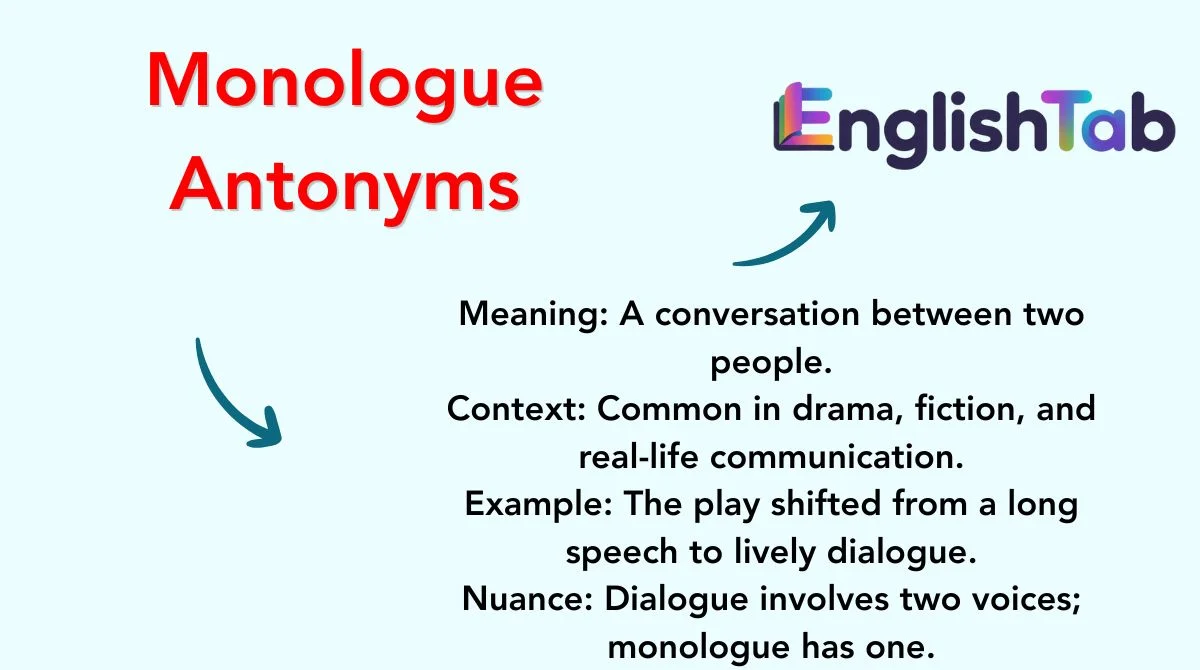
Dialogue
Meaning: A conversation between two people.
Context: Common in drama, fiction, and real-life communication.
Example: The play shifted from a long speech to lively dialogue.
Nuance: Dialogue involves two voices; monologue has one.
Conversation
Meaning: Informal spoken exchange.
Context: Everyday communication.
Example: Their conversation replaced his long speech.
Nuance: Conversation is natural and balanced; monologue is structured and one-sided.
Discussion
Meaning: A focused exchange of ideas.
Context: Academic and professional settings.
Example: The class held a discussion instead of listening to a lecture.
Nuance: Discussion invites multiple opinions.
Debate
Meaning: Formal argument between opposing sides.
Context: Academic, political, competitive settings.
Example: The debate allowed both candidates to respond.
Nuance: Debate emphasizes contrast and response.
Exchange
Meaning: Mutual giving and receiving of ideas.
Context: General communication.
Example: The exchange lasted two hours.
Nuance: Implies reciprocity.
Interaction
Meaning: Action between participants.
Context: Social and educational contexts.
Example: The workshop encouraged interaction.
Nuance: Focuses on mutual involvement.
Conference
Meaning: Formal meeting for discussion.
Context: Professional and academic.
Example: The conference replaced individual presentations with panels.
Nuance: Larger group format.
Forum
Meaning: Public meeting for open discussion.
Context: Civic and online spaces.
Example: The forum allowed audience participation.
Nuance: Open and inclusive.
Panel
Meaning: Group of experts discussing a topic.
Context: Conferences, media.
Example: The panel shared different viewpoints.
Nuance: Multiple authoritative voices.
Symposium
Meaning: Academic gathering for presenting ideas.
Context: Scholarly environment.
Example: The symposium featured collaborative discussion.
Nuance: Structured but multi-speaker.
Roundtable
Meaning: Equal-level group discussion.
Context: Policy and business.
Example: The roundtable promoted shared decision-making.
Nuance: Implies equality among speakers.
Interview
Meaning: Structured conversation between interviewer and subject.
Context: Journalism, research.
Example: The interview replaced the prepared speech.
Nuance: Guided but interactive.
Chat
Meaning: Informal conversation.
Context: Casual settings.
Example: They had a quick chat instead of a speech.
Nuance: Light and relaxed.
Colloquy
Meaning: Formal conversation or dialogue.
Context: Literary or academic writing.
Example: The colloquy was more dynamic than his speech.
Nuance: Elevated tone.
Consultation
Meaning: Seeking advice or discussion.
Context: Professional decision-making.
Example: The team held a consultation before acting.
Nuance: Emphasizes shared decision.
Negotiation
Meaning: Discussion to reach agreement.
Context: Legal, diplomatic.
Example: Negotiation replaced unilateral declaration.
Nuance: Goal-oriented interaction.
Group Discussion
Meaning: Multiple participants discussing one topic.
Context: Classroom, workplace.
Example: The group discussion encouraged participation.
Nuance: Structured interaction.
Question-and-Answer Session
Meaning: Audience asks, speaker responds.
Context: Lectures and conferences.
Example: The Q&A session followed the speech.
Nuance: Turns monologue into dialogue.
Multilateral Talk
Meaning: Communication among several parties.
Context: Diplomacy.
Example: Multilateral talks replaced the announcement.
Nuance: Involves many perspectives.
Collaborative Exchange
Meaning: Joint sharing of ideas.
Context: Creative and academic work.
Example: The project relied on collaborative exchange.
Nuance: Emphasizes teamwork.
Interactive Session
Meaning: Meeting where participants actively engage.
Context: Workshops, education.
Example: The interactive session kept everyone involved.
Nuance: Dynamic and responsive.
Antonym Comparison Table
| Antonym | Formality | Number of Speakers | Emotional Tone | Purpose |
|---|---|---|---|---|
| Dialogue | Medium | Two | Balanced | Exchange |
| Conversation | Informal | Two+ | Relaxed | Social |
| Debate | Formal | Two+ | Competitive | Persuasion |
| Discussion | Medium | Two+ | Neutral | Exploration |
| Panel | Formal | Multiple | Expert-driven | Insight |
| Interview | Structured | Two | Focused | Information |
| Forum | Formal/Public | Many | Open | Participation |
| Negotiation | Formal | Two+ | Strategic | Agreement |
Academic Writing Examples
Instead of:
“The novel includes a long monologue.”
You may write:
“The novel shifts from solitary speech to active dialogue between characters.”
Instead of:
“The leader delivered a monologue.”
You may write:
“The leader engaged in a public discussion.”
Academic writing benefits from precise structural description. If the focus is interaction, avoid monologue.
When Not to Replace the Word
Do not replace monologue when:
- Analyzing theatrical structure
- Discussing internal psychological speech
- Examining narrative technique
- Referring to dramatic soliloquy
- Describing uninterrupted presentation format
Each antonym changes structural meaning. Precision matters.
Practice Exercises
- Identify whether the communication is monologue or dialogue.
- Replace monologue with a suitable antonym in context.
- Explain tone differences between monologue and debate.
- Compare emotional impact of monologue versus conversation.
- Rewrite a speech description using an interactive antonym.
FAQs
What is the strongest antonym of monologue?
Dialogue is the clearest and most direct opposite because it involves two speakers.
Is conversation always the opposite of monologue?
Usually yes, but context matters. A recorded conversation without response could resemble monologue structure.
Can debate replace monologue?
Yes, when the focus shifts from one-sided speech to argumentative exchange.
Is interview the opposite of monologue?
It can function as one because it requires two participants.
Are collaborative discussions antonyms?
Yes, when they replace solitary speech with shared participation.
Conclusion
Understanding 21+ monologue antonyms improves clarity in writing, analysis, and communication studies.
Monologue represents singular voice and uninterrupted speech. Its opposites introduce interaction, balance, and multiple perspectives.
Whether you choose dialogue, debate, discussion, or negotiation, each word reshapes meaning and tone.
Writers who understand contrast write with sharper precision.

Dorian Hale is an English language enthusiast and content creator dedicated to making vocabulary and grammar learning simple, engaging, and accessible for everyone.