Strong writing depends on contrast. Opposites clarify meaning, refine tone, and strengthen argument structure.
When a writer understands not only what a word means—but also what it does not mean—the result is sharper expression and deeper analytical control.
The verb anticipate is widely used in academic, professional, and everyday language.
Yet many writers struggle to select the right opposite when constructing arguments, comparisons, or critical analyses. Choosing the wrong antonym can weaken logic or distort nuance.
This comprehensive guide explores 16+ anticipate antonyms, examining their meanings, contextual applications, emotional tone, and subtle distinctions.
Whether you are writing research papers, essays, or analytical reports, mastering these contrasts will significantly improve clarity and rhetorical precision.
Definition and Core Meaning of “Anticipate”
To anticipate means:
- To expect something to happen
- To predict or foresee an event
- To prepare for something in advance
- To look forward to something (emotionally)
Core semantic elements include:
- Future orientation
- Mental projection
- Preparedness
- Expectation (neutral, positive, or cautious)
Example:
Researchers anticipate a rise in urban migration over the next decade.
Here, anticipate suggests prediction based on evidence.
Understanding this foundation is essential before exploring its opposites.
Direct Opposites (Clear Contrasts)
The strongest antonyms directly oppose expectation, preparation, or foresight. These include:
- Doubt
- Disregard
- Ignore
- Overlook
- Forget
- Misjudge
- Mistrust
- Fear
- Dread
- Avoid
- Neglect
- Dismiss
- Underestimate
- Disbelieve
- Reject
- Oppose
Each of these counters anticipation in a distinct way—through disbelief, lack of preparation, emotional resistance, or conscious refusal.
Contextual Opposites
Some words function as antonyms only in certain contexts:
- React (instead of preparing in advance)
- Postpone
- Delay
- Hesitate
- Withdraw
- Abandon
- Ignore warnings
- Be surprised
For example:
The company anticipated market shifts.
The company reacted to market shifts.
Here, react implies no prior expectation—only response after the fact.
Emotional & Tone-Based Opposites
Emotion significantly influences antonym choice.
If anticipate suggests positive expectation:
- Dread
- Fear
- Resist
If it suggests confident prediction:
- Doubt
- Disbelieve
- Question
If it implies preparation:
- Neglect
- Ignore
- Overlook
Tone matters. “Dread” carries emotional weight, while “dismiss” carries intellectual judgment.
16+ Antonyms Explained in Detail
Below are carefully analyzed opposites, including meaning, context, example, and nuance distinction.
Doubt
Meaning: To question the likelihood of something happening.
Context: Used when belief in a future outcome is weak.
Example:
Economists doubt the policy will reduce inflation.
Nuance: Doubt opposes confident anticipation but does not imply hostility.
Disbelieve
Meaning: To refuse to accept something as true.
Context: Stronger than doubt; implies rejection of expectation.
Example:
Many disbelieve the forecasted economic recovery.
Nuance: Disbelief suggests stronger rejection than mere uncertainty.
Ignore
Meaning: To pay no attention to something.
Context: Failure to anticipate due to indifference.
Example:
The firm ignored warning signs of recession.
Nuance: Unlike anticipate, ignore shows absence of awareness or concern.
Overlook
Meaning: To fail to notice.
Context: Accidental lack of anticipation.
Example:
Officials overlooked early signs of conflict.
Nuance: Less intentional than ignore.
Neglect
Meaning: To fail to care for properly.
Context: Failure to prepare for future consequences.
Example:
The government neglected infrastructure planning.
Nuance: Suggests responsibility and fault.
Dismiss
Meaning: To treat something as unworthy of consideration.
Context: Active rejection of anticipated outcome.
Example:
Critics dismissed the projected benefits.
Nuance: Implies conscious rejection rather than passive oversight.
Underestimate
Meaning: To judge something as less important or severe than it is.
Context: Opposes accurate anticipation.
Example:
Leaders underestimated the crisis.
Nuance: Suggests miscalculation rather than absence of expectation.
Misjudge
Meaning: To form an incorrect opinion.
Context: Faulty anticipation.
Example:
Analysts misjudged market volatility.
Nuance: Implies error in prediction.
Fear
Meaning: To feel anxiety about a possible outcome.
Context: Emotional opposite when anticipation is positive.
Example:
Investors fear economic instability.
Nuance: Fear anticipates negatively; differs in emotional direction.
Dread
Meaning: To anticipate with intense anxiety.
Context: Strong emotional contrast.
Example:
Students dread final examinations.
Nuance: High emotional intensity.
Avoid
Meaning: To stay away from.
Context: Refusal to engage with expected outcome.
Example:
Leaders avoided discussing the looming issue.
Nuance: Active distancing.
Reject
Meaning: To refuse to accept.
Context: Direct opposition to expecting something.
Example:
The board rejected predictions of failure.
Nuance: Suggests evaluation and refusal.
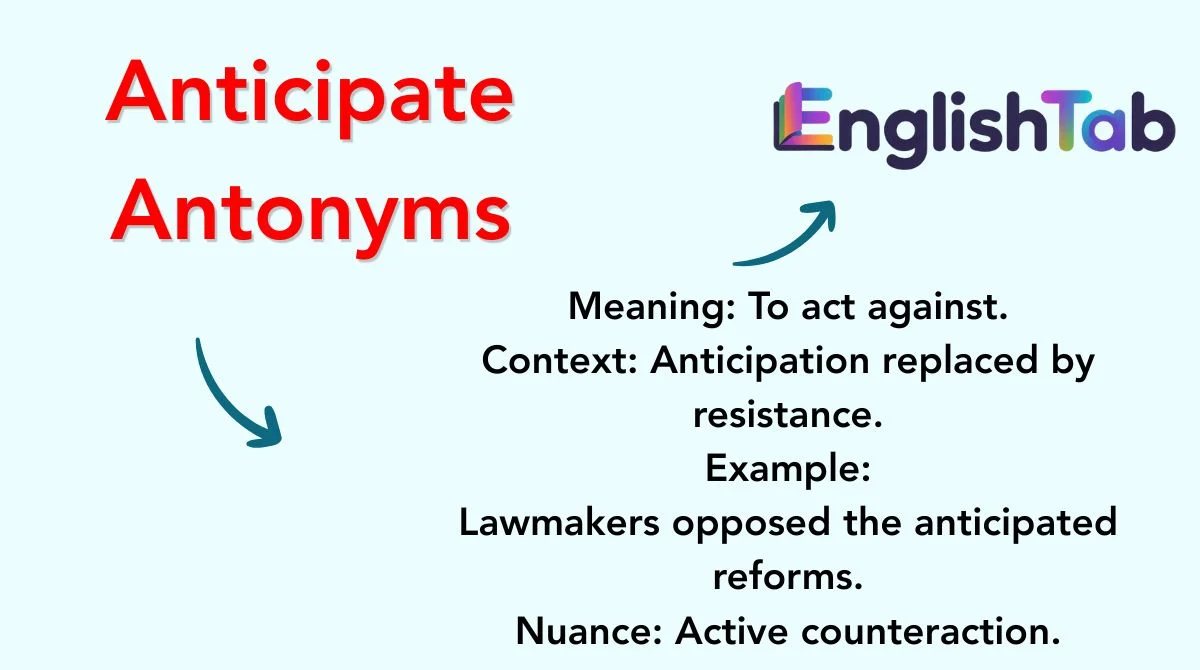
Oppose
Meaning: To act against.
Context: Anticipation replaced by resistance.
Example:
Lawmakers opposed the anticipated reforms.
Nuance: Active counteraction.
Disregard
Meaning: To ignore intentionally.
Context: Conscious lack of anticipation.
Example:
The warnings were disregarded.
Nuance: More deliberate than overlook.
Hesitate
Meaning: To pause due to uncertainty.
Context: Delay instead of forward-looking preparation.
Example:
Investors hesitated before committing funds.
Nuance: Implies indecision rather than denial.
React
Meaning: To respond after something happens.
Context: Opposite of preparing in advance.
Example:
The company reacted to declining sales.
Nuance: Reactive vs proactive contrast.
Antonym Comparison Table
| Word | Level of Opposition | Emotional Tone | Intentional? | Key Distinction |
|---|---|---|---|---|
| Doubt | Moderate | Neutral | Yes | Questions likelihood |
| Disbelieve | Strong | Firm | Yes | Rejects truth |
| Ignore | Strong | Neutral | Often | No attention given |
| Overlook | Moderate | Neutral | No | Accidental |
| Neglect | Strong | Negative | Yes | Fails responsibility |
| Dread | Strong | Emotional | Yes | Fearful expectation |
| Underestimate | Moderate | Neutral | Yes | Miscalculates scale |
| React | Contextual | Neutral | Yes | No advance planning |
Academic Writing Examples
- Instead of: Scholars anticipate policy resistance. Contrast with: Scholars doubt policy acceptance.
- Instead of: The committee anticipated objections. Contrast with: The committee overlooked potential objections.
- Instead of: Researchers anticipated climate shifts. Contrast with: Policymakers ignored climate warnings.
Using precise antonyms strengthens argumentative contrast sections in essays and journal articles.
When Not to Replace the Word
Do not substitute an antonym when:
- The original meaning involves neutral prediction rather than emotional expectation.
- The context concerns preparation rather than belief.
- The sentence requires forward-looking structure.
- The antonym changes the logical structure of argument.
Example:
Incorrect shift:
Scientists anticipated rainfall.
Scientists feared rainfall.
If the original meaning was neutral prediction, “feared” distorts tone.
Practice Exercises
Exercise 1: Replace “anticipate” with an appropriate antonym.
- Economists anticipate inflation.
- The board anticipated resistance.
- Engineers anticipated system failure.
Exercise 2: Choose the stronger opposite.
- Doubt or Disbelieve
- Ignore or Overlook
- Fear or Dread
Exercise 3: Rewrite with contrast.
Original:
Leaders anticipated economic growth.
Rewrite using an antonym and explain tone shift.
FAQs
What is the strongest antonym of anticipate?
“Disbelieve” and “reject” are among the strongest intellectual opposites. “Dread” is the strongest emotional opposite.
Is fear an antonym of anticipate?
It can be, depending on context. If anticipation implies positive expectation, fear serves as a tonal opposite.
What is the difference between overlook and ignore?
Overlook is accidental; ignore is intentional.
Can react replace anticipate?
Yes, when contrasting proactive versus reactive behavior.
Is underestimate a full opposite?
Not entirely. It suggests faulty anticipation rather than absence of expectation.
Conclusion
Mastering 16+ anticipate antonyms enhances academic clarity and argumentative precision. Each opposite carries its own semantic weight, emotional tone, and contextual nuance. Some negate expectation entirely.
Others distort prediction, reject belief, or shift emotional orientation.
Effective writers do not rely on simple binary opposites. They select words that precisely match logical structure, tone, and intention.
Understanding the full contrast spectrum surrounding anticipate empowers more refined academic expression and deeper analytical writing.

Dorian Hale is an English language enthusiast and content creator dedicated to making vocabulary and grammar learning simple, engaging, and accessible for everyone.