Clear writing depends on contrast. When readers understand what something is not, they better understand what it is. Opposites sharpen meaning.
They refine tone. They prevent exaggeration. They add balance.
The word arrogant carries a strong emotional charge. It signals superiority, pride, and dismissiveness. But academic and professional writing often requires precision.
Replacing arrogant with a more accurate opposite can completely shift tone—from hostile to respectful, from judgmental to analytical.
Understanding antonyms of arrogant allows writers to:
- Moderate criticism
- Improve character descriptions
- Refine psychological analysis
- Create persuasive contrast
- Avoid emotional exaggeration
This article provides a deep contrast analysis of 16+ arrogant antonyms, explaining not just what they mean, but how and when to use them with nuance and authority.
Definition and Core Meaning of “Arrogant”
The adjective arrogant describes a person who:
- Displays an exaggerated sense of self-importance
- Believes they are superior to others
- Dismisses or undervalues others’ opinions
- Acts with condescension
Core semantic components include:
- Superiority
- Pride
- Disrespect
- Overconfidence
Arrogance is not merely confidence. It implies imbalance. It includes a relational element—how one treats others. Therefore, its antonyms must reverse not only self-perception but interpersonal attitude.
Direct Opposites (Clear Contrasts)
These are the strongest and most straightforward antonyms of arrogant. They clearly reverse the central idea of superiority.
- Humble
- Modest
- Meek
- Unassuming
- Respectful
- Courteous
- Considerate
- Polite
- Self-effacing
- Submissive
- Deferential
- Reverent
- Lowly
- Down-to-earth
- Gentle
- Gracious
Each of these directly contradicts arrogance either in attitude, tone, or social posture.
Contextual Opposites
Some words oppose arrogant only in specific contexts. Their contrast depends on situation and tone.
- Confident (balanced self-belief without superiority)
- Secure (emotionally stable without ego inflation)
- Open-minded (willing to listen rather than dismiss)
- Collaborative (values group contribution)
- Approachable (invites interaction rather than intimidation)
- Empathetic (values others’ feelings)
These words do not imply weakness. Instead, they reflect strength without dominance.
Emotional & Tone-Based Opposites
Arrogance has emotional heat. It feels sharp, elevated, dismissive. Tone-based opposites reduce intensity.
High-contrast emotional reversal:
- Meek
- Submissive
Balanced emotional contrast:
- Humble
- Modest
Warm tonal contrast:
- Gracious
- Kind
- Considerate
Professional tonal contrast:
- Respectful
- Courteous
- Deferential
Understanding emotional intensity helps you choose the correct replacement depending on context.
16+ Antonyms Explained in Detail
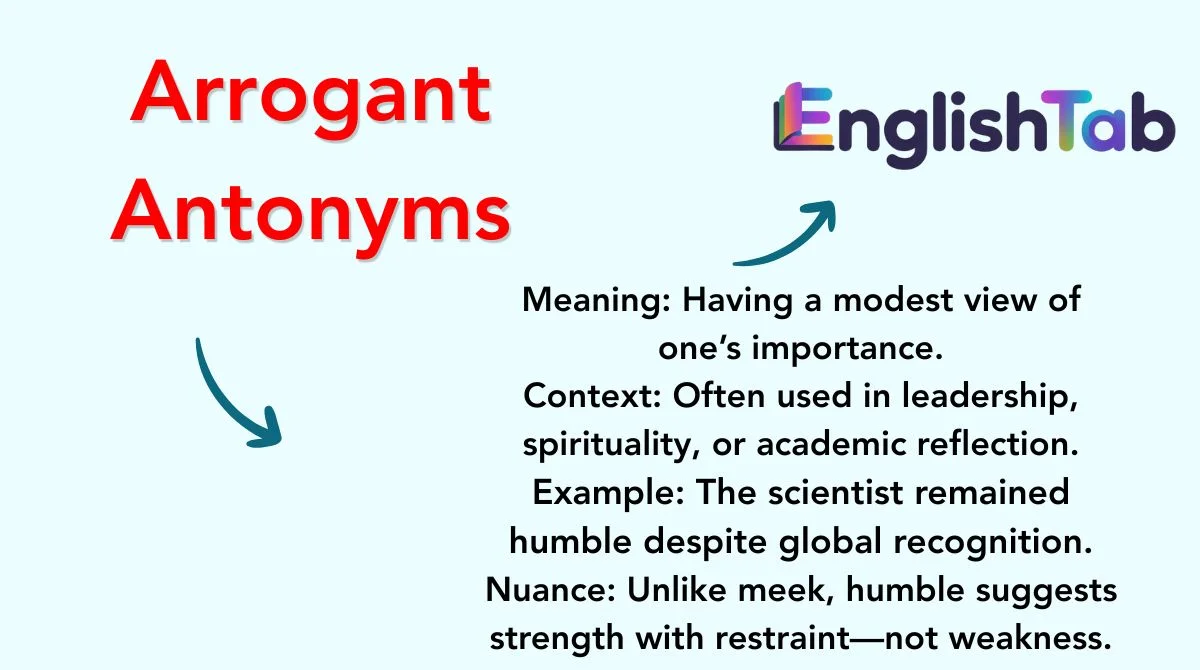
Humble
Meaning: Having a modest view of one’s importance.
Context: Often used in leadership, spirituality, or academic reflection.
Example: The scientist remained humble despite global recognition.
Nuance: Unlike meek, humble suggests strength with restraint—not weakness.
Modest
Meaning: Not excessively proud; moderate in self-assessment.
Context: Suitable for professional and academic writing.
Example: She offered a modest evaluation of her achievements.
Nuance: Modesty often relates to presentation, while humility relates to internal character.
Meek
Meaning: Quiet, gentle, and easily imposed upon.
Context: Religious or moral discussions.
Example: His meek response surprised the critics.
Nuance: Meek can imply passivity, unlike humble, which suggests controlled confidence.
Unassuming
Meaning: Not pretentious or arrogant.
Context: Character descriptions.
Example: The CEO was unassuming in manner and dress.
Nuance: Focuses on outward simplicity rather than internal belief.
Respectful
Meaning: Showing regard for others.
Context: Academic debate and workplace conduct.
Example: She remained respectful during the disagreement.
Nuance: Directly contrasts the dismissive nature of arrogance.
Courteous
Meaning: Polite and well-mannered.
Context: Formal writing and professional environments.
Example: He gave a courteous reply to criticism.
Nuance: Emphasizes behavior rather than mindset.
Considerate
Meaning: Thoughtful about others’ needs.
Context: Social and interpersonal analysis.
Example: A considerate leader listens before speaking.
Nuance: Adds empathy dimension absent in arrogance.
Polite
Meaning: Demonstrating good manners.
Context: General communication.
Example: The student remained polite throughout the discussion.
Nuance: Surface-level opposite; does not guarantee humility.
Self-effacing
Meaning: Modest to the point of minimizing oneself.
Context: Literary or psychological analysis.
Example: His self-effacing humor softened tension.
Nuance: Stronger humility than modesty.
Submissive
Meaning: Yielding to authority or control.
Context: Power-dynamic analysis.
Example: The submissive tone contrasted sharply with earlier dominance.
Nuance: Can imply lack of agency; not always positive.
Deferential
Meaning: Showing respectful submission.
Context: Formal hierarchies.
Example: She adopted a deferential posture before the panel.
Nuance: Structured respect within authority systems.
Reverent
Meaning: Deeply respectful.
Context: Religious or ceremonial writing.
Example: The crowd grew reverent during the address.
Nuance: Emotional respect, not merely behavioral.
Lowly
Meaning: Of humble rank or status.
Context: Historical or literary settings.
Example: He described himself as a lowly servant.
Nuance: Refers to status rather than personality.
Down-to-earth
Meaning: Practical and realistic.
Context: Informal or descriptive writing.
Example: Her down-to-earth leadership style built trust.
Nuance: Combines humility with relatability.
Gentle
Meaning: Mild in temperament.
Context: Personality analysis.
Example: His gentle approach reduced conflict.
Nuance: Soft emotional contrast to harsh arrogance.
Gracious
Meaning: Courteous and kind.
Context: Public speaking and diplomacy.
Example: She was gracious in accepting criticism.
Nuance: Combines humility with dignity.
Antonym Comparison Table
| Word | Focus | Strength Level | Social Dimension | Risk of Misuse |
|---|---|---|---|---|
| Humble | Internal attitude | Moderate | High | Low |
| Modest | Self-presentation | Moderate | Medium | Low |
| Meek | Personality softness | Strong | Low | Can imply weakness |
| Respectful | Treatment of others | Moderate | High | Safe |
| Courteous | Manners | Light | Medium | Surface-level |
| Self-effacing | Self-minimizing | Strong | Medium | Overly negative |
| Deferential | Authority response | Strong | High | Context-specific |
| Down-to-earth | Relatability | Moderate | High | Informal tone |
Academic Writing Examples
Instead of:
The executive delivered an arrogant speech.
Use:
The executive adopted a dismissive tone that contrasted with expectations of humble leadership.
Instead of:
Her arrogant remarks alienated colleagues.
Use:
Her lack of consideration undermined what could have been a more respectful exchange.
In scholarly tone:
Leadership models that emphasize humility outperform those rooted in arrogance.
When Not to Replace the Word
Do not replace arrogant when:
- The psychological trait itself is under analysis
- Legal or historical documentation requires precision
- Character studies depend on strong evaluative language
- The emotional tone is intentionally critical
Replacing it with confident may distort meaning.
Replacing it with bold may remove moral judgment.
Replacing it with assertive may misrepresent personality traits.
Precision matters more than softness.
Practice Exercises
- Replace arrogant with the most appropriate antonym:
The professor’s arrogant tone discouraged discussion.
- Choose the best antonym:
A. Humble
B. Deferential
C. Polite
D. Meek - Rewrite:
The athlete appeared arrogant during interviews. - Identify nuance difference:
Humble vs Modest - Create a sentence using gracious that contrasts arrogance.
FAQs
What is the strongest antonym of arrogant?
Humble is generally the strongest balanced opposite because it reverses both internal pride and external superiority.
Is confident an antonym of arrogant?
Not directly. Confidence can exist without arrogance. It depends on tone and behavior.
Can polite replace arrogant?
Only in surface-level contexts. Politeness does not guarantee humility.
Is meek always positive?
No. Meek may imply weakness, unlike humble which suggests strength under control.
What antonym works best in academic writing?
Humble, respectful, or modest are safest and most precise in scholarly contexts.
Conclusion
Understanding 16+ arrogant antonyms allows writers to control tone with precision. Arrogance signals superiority and dismissal. Its opposites signal balance, restraint, and respect.
Choosing the correct antonym depends on:
- Emotional intensity
- Social context
- Power dynamics
- Intended tone
Mastery of opposites is mastery of clarity. When writers control contrast, they control interpretation. And in 2K26, precision is power.

Dorian Hale is an English language enthusiast and content creator dedicated to making vocabulary and grammar learning simple, engaging, and accessible for everyone.