Strong writing depends on contrast. When we understand not only what a word means but also what it does not mean, we gain control over clarity, tone, and precision.
Opposites sharpen ideas. They help readers grasp scale, intensity, and emotional weight.
The verb vanquish carries dramatic force. It suggests total defeat, overwhelming power, and final victory. But what if you want the opposite effect?
What if you need to express survival, resistance, surrender, support, or coexistence instead of domination?
This comprehensive guide explores 21+ vanquish antonyms, analyzing them from semantic, contextual, emotional, and academic perspectives.
By the end, you will not only recognize strong opposites of vanquish but also understand when and why to use each one.
Definition and Core Meaning of “Vanquish”
To build strong contrasts, we must first clarify the original term.
Vanquish means:
- To defeat thoroughly
- To overcome completely
- To subdue decisively
- To overpower in battle, competition, or struggle
It implies finality, dominance, and often intensity. The word frequently appears in:
- Literature (heroes vanquish villains)
- Academic writing (a theory vanquishes an opposing view)
- Motivational contexts (vanquish fear)
Unlike a simple “win,” vanquish suggests overwhelming and decisive triumph.
Therefore, its antonyms must express one of the following:
- Loss
- Survival
- Resistance
- Support
- Protection
- Coexistence
- Empowerment of the opposing side
Direct Opposites (Clear Contrasts)
These are the strongest and most straightforward antonyms of vanquish. They reverse the idea of total defeat:
Lose
Surrender
Submit
Yield
Capitulate
Forfeit
Succumb
Fall
Fail
Relinquish
Retreat
Withdraw
Concede
Abandon
Bow
Crumble
Collapse
Be defeated
Be overcome
Be overpowered
Be conquered
Each word presents a clear inversion of dominance.
Contextual Opposites
Some words oppose vanquish only in specific situations. They may not always mean “the opposite,” but in certain contexts, they clearly counter the idea of defeat.
Resist
Defend
Protect
Preserve
Support
Strengthen
Empower
Sustain
Uphold
Encourage
For example:
- If a hero vanquishes evil, the opposite may be to protect it.
- If one theory vanquishes another, the opposite may be to support the competing argument.
Context determines meaning.
Emotional & Tone-Based Opposites
Vanquish carries emotional intensity. It is dramatic and forceful. Some antonyms differ primarily in emotional tone rather than literal meaning.
Endure (quiet survival rather than defeat)
Withstand (resistance under pressure)
Survive (persistence instead of elimination)
Tolerate (accept without destroying)
Forgive (release conflict instead of crushing it)
These words shift the emotional atmosphere from aggression to resilience or reconciliation.
21+ Antonyms Explained in Detail
Below are detailed analyses of key antonyms. Each entry includes meaning, context, example, and nuance difference.
Lose
Meaning: To fail to win or succeed.
Context: Common in competitions or arguments.
Example: The team lost the championship match.
Nuance: Unlike vanquish, which implies dominance, lose may involve a narrow margin and lacks dramatic force.
Surrender
Meaning: To give up resistance.
Context: Military, emotional, or metaphorical situations.
Example: The army surrendered after days of battle.
Nuance: Surrender emphasizes voluntary submission rather than being crushed.
Submit
Meaning: To accept authority or yield.
Context: Formal, legal, or hierarchical contexts.
Example: The rebels submitted to the ruler.
Nuance: Less dramatic than vanquish; implies acceptance rather than forceful defeat.
Yield
Meaning: To give way under pressure.
Context: Negotiations or physical force.
Example: The material yielded under heat.
Nuance: Suggests flexibility rather than overwhelming defeat.
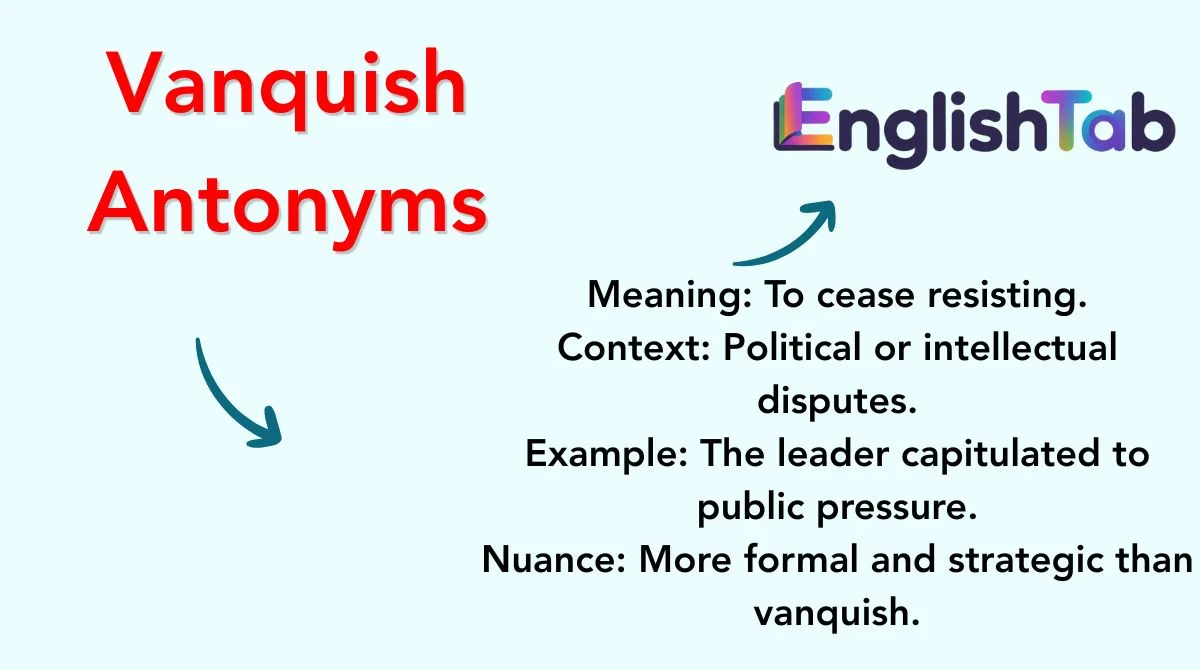
Capitulate
Meaning: To cease resisting.
Context: Political or intellectual disputes.
Example: The leader capitulated to public pressure.
Nuance: More formal and strategic than vanquish.
Forfeit
Meaning: To lose by penalty or choice.
Context: Sports or legal matters.
Example: The player forfeited the match.
Nuance: Does not imply being overpowered—often procedural.
Succumb
Meaning: To fail to resist pressure or illness.
Context: Health, stress, temptation.
Example: He succumbed to exhaustion.
Nuance: Emotional or physical weakness rather than combat.
Fail
Meaning: To be unsuccessful.
Context: Academic or performance settings.
Example: The plan failed.
Nuance: Much weaker than vanquish in intensity.
Retreat
Meaning: To withdraw from danger.
Context: Military or strategic movement.
Example: The troops retreated at sunset.
Nuance: Strategic repositioning, not total defeat.
Withdraw
Meaning: To remove oneself from engagement.
Context: Formal or procedural.
Example: She withdrew her proposal.
Nuance: Neutral tone, lacking aggression.
Concede
Meaning: To admit defeat or accept a point.
Context: Debate or elections.
Example: The candidate conceded the race.
Nuance: Intellectual acceptance rather than forceful loss.
Abandon
Meaning: To leave behind.
Context: Emotional or physical departure.
Example: They abandoned the project.
Nuance: Implies choice, not defeat.
Crumble
Meaning: To break apart or weaken.
Context: Structures or morale.
Example: His confidence crumbled.
Nuance: Suggests internal collapse, not external domination.
Collapse
Meaning: To fall suddenly.
Context: Systems or bodies.
Example: The economy collapsed.
Nuance: Often structural rather than competitive.
Resist
Meaning: To oppose actively.
Context: Defense against force.
Example: She resisted the pressure.
Nuance: Prevents vanquishing; does not imply victory.
Defend
Meaning: To protect from attack.
Context: Legal or physical contexts.
Example: He defended his position.
Nuance: Focuses on protection rather than counterattack.
Protect
Meaning: To keep safe from harm.
Context: Caregiving or policy.
Example: Laws protect citizens.
Nuance: Preventative rather than combative.
Preserve
Meaning: To maintain intact.
Context: Culture or environment.
Example: The law preserves traditions.
Nuance: Opposes destruction rather than defeat.
Support
Meaning: To uphold or back.
Context: Arguments or causes.
Example: She supported the proposal.
Nuance: Opposes vanquish in debate contexts.
Empower
Meaning: To give strength or authority.
Context: Social or political discourse.
Example: Education empowers communities.
Nuance: Instead of crushing opposition, it builds strength.
Survive
Meaning: To continue living despite hardship.
Context: Crisis or trauma.
Example: The species survived extinction.
Nuance: Quiet endurance contrasts dramatic conquest.
Antonym Comparison Table
| Word | Intensity | Voluntary? | Emotional Tone | Typical Context |
|---|---|---|---|---|
| Lose | Low | No | Neutral | Sports, debate |
| Surrender | Medium | Yes | Serious | War, conflict |
| Succumb | Medium | No | Weakness | Illness, stress |
| Retreat | Medium | Yes | Strategic | Military |
| Concede | Low | Yes | Formal | Debate |
| Resist | Medium | No | Strong | Defense |
| Protect | Low | Yes | Caring | Safety |
| Collapse | High | No | Dramatic | Systems |
| Empower | Medium | Yes | Positive | Social change |
Academic Writing Examples
- Instead of: “The new theory vanquished previous models.”
Use: “The new theory challenged previous models.” - Instead of: “The regime vanquished dissent.”
Use: “The regime suppressed dissent.” - Instead of: “She vanquished her fear.”
Use: “She overcame her fear.”
Academic writing often favors measured language over dramatic verbs like vanquish.
When Not to Replace the Word
Avoid replacing vanquish when:
- Writing epic or literary analysis
- Describing decisive historical victories
- Emphasizing total and final triumph
- Creating strong emotional emphasis
For example, in fantasy literature, “vanquish” carries stylistic power that simpler antonyms cannot replicate.
Practice Exercises
- Replace vanquish with a softer antonym in:
“The company vanquished its competitors.” - Choose the best antonym:
“The army decided to ______ rather than face annihilation.”
(Retreat / Empower / Support) - Rewrite:
“She vanquished doubt.” - Identify tone difference between “succumb” and “surrender.”
- Write a sentence using “concede” as an antonym.
FAQs
What is the strongest antonym of vanquish?
“Surrender” and “be defeated” are the most direct opposites because they clearly reverse victory.
Is “resist” a true antonym?
Yes, in contexts where vanquish implies defeating resistance. If resistance succeeds, vanquishing fails.
Can “protect” be an antonym?
Contextually, yes. Protecting something prevents it from being vanquished.
Is “fail” too weak?
In many contexts, yes. It lacks the dramatic contrast that vanquish implies.
Why does nuance matter in antonyms?
Because tone, intensity, and agency shift meaning significantly in academic and literary writing.
Conclusion
Understanding 21+ vanquish antonyms strengthens precision in writing.
While vanquish signals overwhelming triumph, its opposites range from quiet endurance to formal concession to strategic retreat.
Not all antonyms are equal. Some reverse power. Others soften tone. Some change emotional direction entirely.
Mastery lies not in memorizing opposites—but in recognizing which contrast fits your rhetorical purpose.
Precise contrast creates clarity. And clarity strengthens authority.

Dorian Hale is an English language enthusiast and content creator dedicated to making vocabulary and grammar learning simple, engaging, and accessible for everyone.