Opposites play a central role in language precision. In academic writing, persuasive essays, business communication, and even literary analysis, selecting the correct antonym can significantly sharpen contrast and clarify meaning.
When a writer chooses an exact opposite instead of a vague alternative, the argument becomes stronger, the tone more deliberate, and the message more impactful.
The word value is especially complex. It can refer to worth, importance, morality, numerical quantity, price, or personal belief.
Because it carries multiple meanings, its opposites vary widely depending on context. A financial discussion requires different antonyms than an ethical debate. A mathematical setting demands yet another.
This comprehensive guide explores more than 18 value antonyms in depth, examining direct contrasts, contextual variations, emotional opposites, and academic usage.
Each antonym is analyzed with nuance, examples, and contextual explanation to ensure clarity and precision.
Definition and Core Meaning of “Value”
The word value functions as both a noun and a verb. Its core meanings include:
- The monetary worth of something
- The importance or significance of something
- A moral principle or belief
- A numerical quantity in mathematics
- To regard something highly (verb form)
Because the semantic range is broad, the opposite of value depends heavily on how the word is used. For example:
- Financial context: value ↔ worthlessness
- Moral context: value ↔ immorality
- Emotional context: value ↔ indifference
- Numerical context: value ↔ zero or null
Understanding this semantic flexibility is crucial before selecting an antonym.
Direct Opposites (Clear Contrasts)
The strongest and most widely accepted antonyms of value include:
- Worthlessness
- Uselessness
- Insignificance
- Triviality
- Disregard
- Neglect
- Devaluation
- Depreciation
- Cheapness
- Poverty
- Loss
- Inferiority
- Futility
- Meaninglessness
- Emptiness
- Contempt
- Rejection
- Irrelevance
These words provide strong semantic contrast across financial, emotional, ethical, and intellectual contexts.
Contextual Opposites
Some antonyms shift depending on how value is used:
- In economics: inflation, overpricing, or loss may oppose stable value.
- In ethics: corruption or immorality may oppose moral values.
- In relationships: neglect or indifference may oppose valuing someone.
- In mathematics: null or zero may oppose a specific value.
- In philosophy: nihilism may oppose belief in values.
Context determines which antonym delivers accurate contrast.
Emotional & Tone-Based Opposites
The emotional weight of antonyms varies significantly:
- Insignificance is neutral and analytical.
- Worthlessness carries harsh emotional judgment.
- Contempt introduces hostility.
- Neglect suggests passive dismissal.
- Rejection implies active refusal.
Tone matters in academic writing. A historian may describe cultural “insignificance,” while a critic might argue that a policy demonstrates “reckless disregard.”
18+ Antonyms Explained in Detail
Worthlessness
Meaning: Lack of any value or usefulness.
Context: Often financial or moral.
Example: The damaged artwork was reduced to worthlessness.
Nuance: Strong and absolute; implies total absence of value.
Uselessness
Meaning: Inability to serve a purpose.
Context: Functional or practical settings.
Example: The broken tool demonstrated complete uselessness.
Nuance: Focuses on function rather than moral worth.
Insignificance
Meaning: Lack of importance.
Context: Academic and analytical writing.
Example: The minor error had statistical insignificance.
Nuance: Less emotional; more objective.
Triviality
Meaning: Lack of seriousness or importance.
Context: Argumentative writing.
Example: The debate centered on triviality instead of substance.
Nuance: Suggests something is minor rather than entirely worthless.
Disregard
Meaning: Failure to consider or respect.
Context: Social or ethical discussions.
Example: The policy showed disregard for human dignity.
Nuance: Implies conscious neglect.
Neglect
Meaning: Failure to give proper attention.
Context: Relationships or responsibilities.
Example: Environmental neglect leads to long-term damage.
Nuance: Passive rather than aggressive.
Devaluation
Meaning: Reduction in worth.
Context: Economics and currency discussions.
Example: Currency devaluation affected global markets.
Nuance: Implies gradual decline.
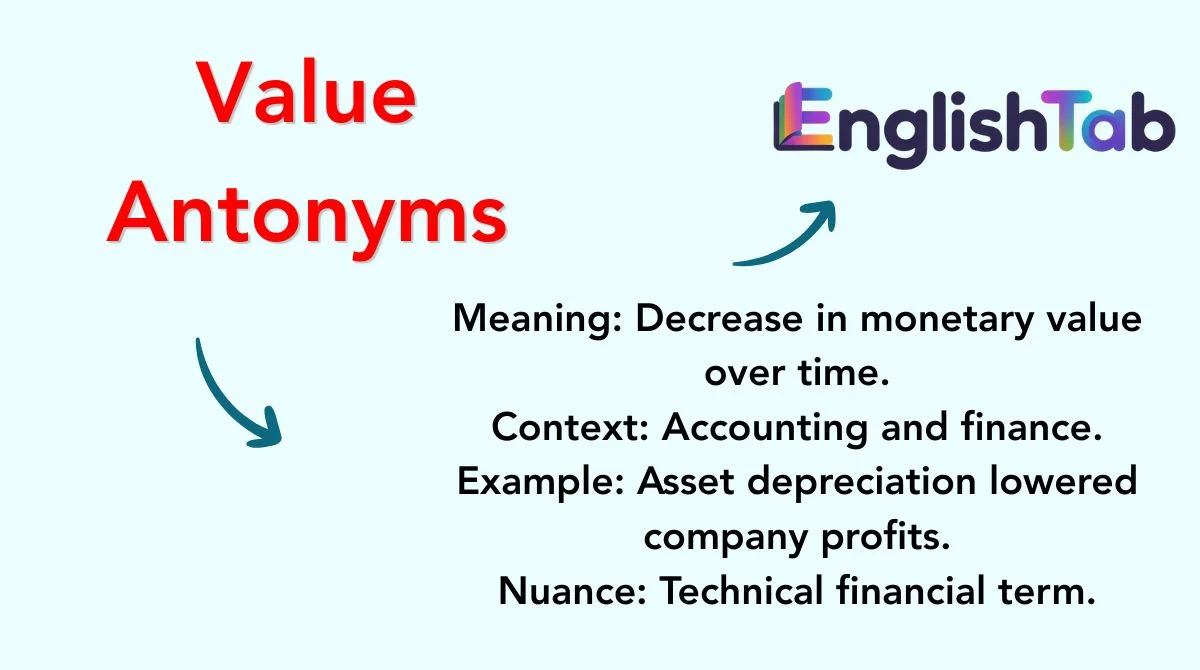
Depreciation
Meaning: Decrease in monetary value over time.
Context: Accounting and finance.
Example: Asset depreciation lowered company profits.
Nuance: Technical financial term.
Cheapness
Meaning: Low cost or poor quality.
Context: Consumer goods.
Example: The product’s cheapness reflected inferior materials.
Nuance: Can imply poor quality rather than just low price.
Poverty
Meaning: Lack of material wealth.
Context: Socioeconomic analysis.
Example: Poverty reduces access to educational value.
Nuance: Broader social condition.
Loss
Meaning: Absence of something once possessed.
Context: Financial and emotional.
Example: The loss of value occurred after the market crash.
Nuance: Focuses on decline rather than absence.
Inferiority
Meaning: Lower status or quality.
Context: Comparative writing.
Example: The inferior product lacked durability.
Nuance: Relative contrast.
Futility
Meaning: Pointlessness.
Context: Philosophical or argumentative writing.
Example: The attempt proved futile.
Nuance: Emphasizes outcome failure.
Meaninglessness
Meaning: Lack of meaning or purpose.
Context: Existential discussions.
Example: The theory collapsed into meaninglessness.
Nuance: Strong philosophical tone.
Emptiness
Meaning: Lack of substance or content.
Context: Emotional or literary.
Example: The speech carried emotional emptiness.
Nuance: Abstract and metaphorical.
Contempt
Meaning: Deep disrespect.
Context: Social or rhetorical.
Example: His contempt for tradition was evident.
Nuance: Strong emotional hostility.
Rejection
Meaning: Refusal to accept.
Context: Social, academic, political.
Example: The proposal faced immediate rejection.
Nuance: Active denial.
Irrelevance
Meaning: Lack of connection or importance.
Context: Academic argumentation.
Example: The evidence was dismissed for irrelevance.
Nuance: Logical exclusion rather than emotional dismissal.
Antonym Comparison Table
| Antonym | Strength | Emotional Tone | Context Type | Absolute or Relative |
|---|---|---|---|---|
| Worthlessness | Very High | Harsh | Moral/Financial | Absolute |
| Insignificance | Moderate | Neutral | Academic | Relative |
| Neglect | Moderate | Mild | Social | Relative |
| Contempt | High | Hostile | Emotional | Relative |
| Devaluation | Moderate | Neutral | Economic | Gradual |
| Futility | High | Philosophical | Argumentative | Absolute |
| Irrelevance | Moderate | Analytical | Academic | Relative |
| Cheapness | Low–Moderate | Critical | Consumer | Relative |
| Loss | Moderate | Neutral | Financial | Transitional |
Academic Writing Examples
- The study emphasizes the economic devaluation of rural labor markets.
- Critics argue that the reform demonstrates disregard for ethical standards.
- The statistical insignificance of the data limits its explanatory power.
- The rejection of classical values signals a broader cultural shift.
- Persistent neglect of infrastructure reduces national competitiveness.
Each example demonstrates contextual precision rather than simple substitution.
When Not to Replace the Word
Replacing value with its antonym is inappropriate when:
- The meaning shifts from financial to moral unintentionally.
- Emotional intensity becomes exaggerated.
- The antonym introduces bias in neutral research.
- Technical financial writing requires precise terminology.
- Mathematical contexts require numerical clarity rather than abstract terms.
For example, replacing “decline in value” with “worthlessness” exaggerates meaning.
Practice Exercises
- Replace value with the most precise antonym:
The asset lost its value after the crash. - Choose between insignificance or irrelevance:
The minor detail added little to the central argument. - Identify the tone difference between neglect and contempt in a social context.
- Rewrite:
The theory no longer holds value in modern scholarship. - Select the correct antonym in a financial context:
The currency experienced rapid ______.
FAQs
What is the strongest antonym of value?
Worthlessness is typically the most absolute and forceful opposite.
Is “zero” an antonym of value?
In mathematics, zero can function as an opposite of numerical value, but not in moral or financial contexts.
Are devaluation and depreciation interchangeable?
Not always. Devaluation often refers to currency policy, while depreciation refers to asset decline over time.
Which antonym is best for academic writing?
Insignificance and irrelevance are safest in scholarly contexts due to neutral tone.
Can value have emotional opposites?
Yes. Contempt, indifference, and rejection can function as emotional contrasts.
Conclusion
The word value is multidimensional, and its antonyms reflect that complexity.
Strong opposites such as worthlessness provide absolute contrast, while contextual alternatives like insignificance or devaluation offer nuanced precision.
Effective writing requires selecting the antonym that aligns with tone, field, and purpose.
Understanding emotional intensity, contextual fit, and semantic nuance allows writers to craft sharper arguments and clearer analysis.
By mastering these 18+ value antonyms, academic and professional communicators can achieve greater linguistic authority and precision in 2K26 and beyond.

Dorian Hale is an English language enthusiast and content creator dedicated to making vocabulary and grammar learning simple, engaging, and accessible for everyone.