Many writers search for “than synonyms” because they use the word than too often. It shows up in comparisons like “bigger than,” “better than,” or “more than.”
While the word is simple, repeating it again and again can make writing sound flat.
Word variety makes writing stronger. It helps essays sound smarter, emails feel polished, and stories flow better. In academic work, using the right comparison words improves clarity.
In professional settings, precise language builds trust. Even in casual writing, better word choices make your message clearer and more interesting.
If you are preparing for IELTS, writing blog posts, or improving daily communication, knowing alternatives to than is useful.
This guide explains what than means, when to replace it, and which synonyms work best in formal, informal, and academic writing.
What Does “Than” Mean?
The word than is used to compare two things. It shows difference.
For example:
- She is taller than her sister.
- This phone is cheaper than that one.
It often follows comparative words like more, less, better, worse, bigger, and smaller.
Tone Explanation
Than is neutral. It works in:
- Academic writing
- Professional communication
- Casual conversation
It is simple and clear. However, in formal or advanced writing, replacing it with stronger or more specific words can improve style and precision.
When It Is Commonly Used
- Comparing numbers
- Showing preference
- Highlighting difference
- Ranking items
- Expressing inequality
Now let’s explore better alternatives.
22+ Best Synonyms for “Than”
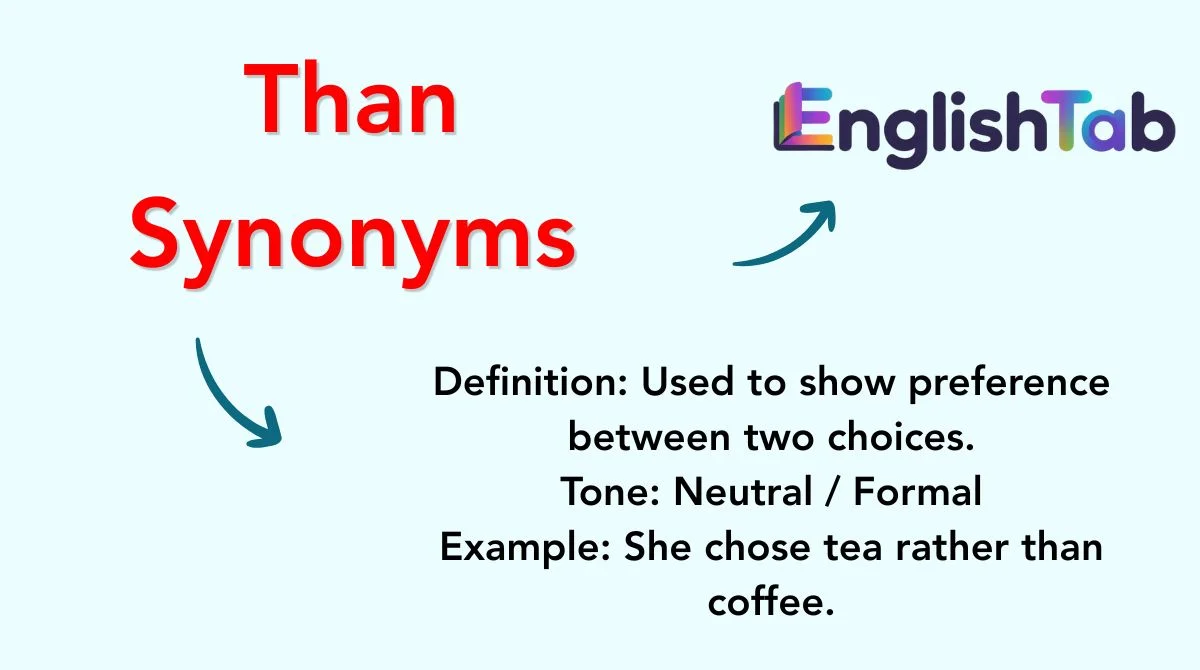
1. Rather Than
Definition: Used to show preference between two choices.
Tone: Neutral / Formal
Example: She chose tea rather than coffee.
2. Instead of
Definition: Used to replace one option with another.
Tone: Neutral
Example: He stayed home instead of going out.
3. In Comparison To
Definition: Used to compare two subjects.
Tone: Formal
Example: Sales improved in comparison to last year.
4. Compared With
Definition: Shows difference or similarity between two items.
Tone: Academic
Example: This model performs better compared with older versions.
5. As Opposed To
Definition: Highlights contrast between two ideas.
Tone: Formal
Example: She works remotely as opposed to in an office.
6. In Contrast To
Definition: Shows strong difference.
Tone: Academic
Example: In contrast to summer, winter is very cold here.
7. Over
Definition: Indicates preference or greater value.
Tone: Informal / Neutral
Example: I prefer coffee over tea.
8. Above
Definition: Higher in number or level.
Tone: Neutral
Example: The temperature is above average.
9. Below
Definition: Lower in number or level.
Tone: Neutral
Example: His score was below mine.
10. More Than
Definition: Greater in amount or degree.
Tone: Neutral
Example: She earns more than her brother.
11. Less Than
Definition: Smaller in amount or degree.
Tone: Neutral
Example: The task took less than an hour.
12. Other Than
Definition: Except for.
Tone: Neutral
Example: I have no hobbies other than reading.
13. Beyond
Definition: Greater or further than.
Tone: Formal / Literary
Example: The result was beyond expectations.
14. Superior To
Definition: Better in quality or rank.
Tone: Formal
Example: This product is superior to the previous model.
15. Inferior To
Definition: Lower in quality or status.
Tone: Formal
Example: The copy is inferior to the original.
16. Exceeding
Definition: Going beyond a limit.
Tone: Formal
Example: Demand is exceeding supply.
17. Surpassing
Definition: Going beyond in performance or level.
Tone: Academic
Example: Her results are surpassing expectations.
18. In Excess Of
Definition: More than a specific amount.
Tone: Formal
Example: The project cost is in excess of $10,000.
19. Short Of
Definition: Less than expected.
Tone: Neutral
Example: We fell short of our goal.
20. Greater Than
Definition: Larger in number or size.
Tone: Academic / Mathematical
Example: Five is greater than three.
21. Lower Than
Definition: Smaller in value or rank.
Tone: Neutral
Example: This year’s rate is lower than last year’s.
22. Aside From
Definition: In addition to or except for.
Tone: Neutral
Example: Aside from cost, the plan is perfect.
Stronger Alternatives (More Intense Options)
Sometimes you need power and emphasis. These words add force.
- Far exceeds – Use when the difference is large.
Example: Profits far exceed last year’s results. - Drastically outperforms – For performance comparisons.
Example: The new system drastically outperforms the old one. - Significantly surpasses – Academic tone.
Example: The data significantly surpasses previous findings. - Outranks – Used in hierarchy or authority.
Example: A manager outranks a supervisor. - Outshines – Creative or marketing tone.
Example: Her design outshines the competition. - Overshadows – When one thing makes another seem small.
Example: His success overshadows earlier failures.
Use these when you want strong impact, not simple comparison.
Softer or Polite Alternatives
Gentler language works well in professional or diplomatic writing.
- Slightly higher than
- Marginally lower than
- Not as much as
- Just above
- Just below
- Somewhat greater than
- A bit more than
These phrases reduce harsh comparison and sound balanced.
Academic & IELTS-Friendly Alternatives
If you are preparing for exams or writing research papers, use these advanced options:
- Comparatively
- Relatively
- In relation to
- In proportion to
- Contrary to
- Disproportionate to
- Exceeds by a margin of
- Falls below
- Outweighs
- Is exceeded by
Example:
The urban population is comparatively larger than the rural population.
These words show control of academic vocabulary.
Synonyms You Should Avoid (Context Warning)
Some words seem similar but can cause confusion.
1. Then
This shows time, not comparison.
Wrong: She is taller then her sister.
2. Like
It shows similarity, not difference.
3. Unlike
It shows contrast but cannot replace than directly.
4. Versus
Used mainly in competition or legal context.
5. Equal To
Means the same, not greater or smaller.
Always check meaning before replacing than.
How to Choose the Right Synonym in Writing
Choosing the best word depends on four things:
1. Context
Are you comparing numbers, people, ideas, or performance?
Use mathematical terms for data and expressive terms for storytelling.
2. Tone
Formal writing needs words like superior to or in contrast to.
Casual writing allows over or rather than.
3. Audience
Academic readers expect precise language.
General readers prefer simple words.
4. Clarity
Never replace a word just to sound smart.
Choose the synonym that keeps meaning clear.
Example Paragraph Rewritten Using Synonyms
Original:
This phone is better than the older model and costs less than other brands.
Rewrite 1:
This phone is superior to the older model and costs less than competing brands.
Rewrite 2:
This phone outperforms the older model and is priced below other brands.
Rewrite 3:
This phone surpasses the older version while remaining more affordable compared with competitors.
Notice how each version changes tone slightly but keeps the meaning.
FAQs
What can I use instead of “than” in a sentence?
You can use phrases like rather than, in comparison to, superior to, or compared with depending on context.
Is “rather than” the same as “than”?
No. Rather than shows preference. Than shows comparison.
Can I replace “than” in academic writing?
Yes. Words like in contrast to, exceeds, or is inferior to are common in academic texts.
Is “over” a correct synonym for “than”?
Yes, in casual usage. Example: I prefer tea over coffee.
What is a stronger word than “better than”?
You can use superior to, surpasses, or outperforms.
What is the difference between “than” and “then”?
Than compares. Then shows time.
How do I avoid repeating “than” in writing?
Rewrite the sentence structure or use comparison phrases like compared with or in contrast to.
Conclusion
The word than is small but powerful. It helps us compare ideas, numbers, and choices. However, repeating it too often can weaken your writing.
By learning strong, soft, and academic alternatives, you gain more control over tone and clarity.
Whether you are writing essays, business emails, blog posts, or preparing for IELTS, choosing the right synonym improves readability and professionalism.
The key is simple: match the word to the context, audience, and purpose.
With these 22+ than synonyms, your writing in 2026 can be clearer, sharper, and more engaging.

Dorian Hale is an English language enthusiast and content creator dedicated to making vocabulary and grammar learning simple, engaging, and accessible for everyone.