Many people search for synonyms for tide because this simple word carries many meanings. It can describe the ocean’s rise and fall. It can also show change, movement, or emotion. Writers often want fresh ways to express these ideas.
Using strong word variety makes your writing clearer and more engaging. In academic work, better vocabulary improves grades and clarity. In professional writing, it builds authority and trust. In casual writing, it adds color and personality.
Instead of repeating tide again and again, smart writers choose words that fit the tone and context. Some synonyms feel formal. Others sound poetic or dramatic. A few are softer and more neutral.
This guide gives you more than 19 powerful synonyms for tide, with clear meanings, tone labels, and examples. You will also learn which words to avoid and how to choose the best one for your audience.
What Does “Tide” Mean?
The word tide has two main meanings.
First, it refers to the natural rise and fall of the sea caused by the moon’s gravity. This is the literal meaning.
Second, it can describe a strong flow, movement, or change. For example, people say “a tide of emotions” or “the tide is turning.” In this sense, it suggests force, motion, or shifting direction.
Tone:
- Neutral in everyday speech
- Literary when used metaphorically
- Academic in environmental or scientific contexts
People commonly use tide in discussions about nature, politics, trends, emotions, and social change.
19+ Best Synonyms for “Tide”
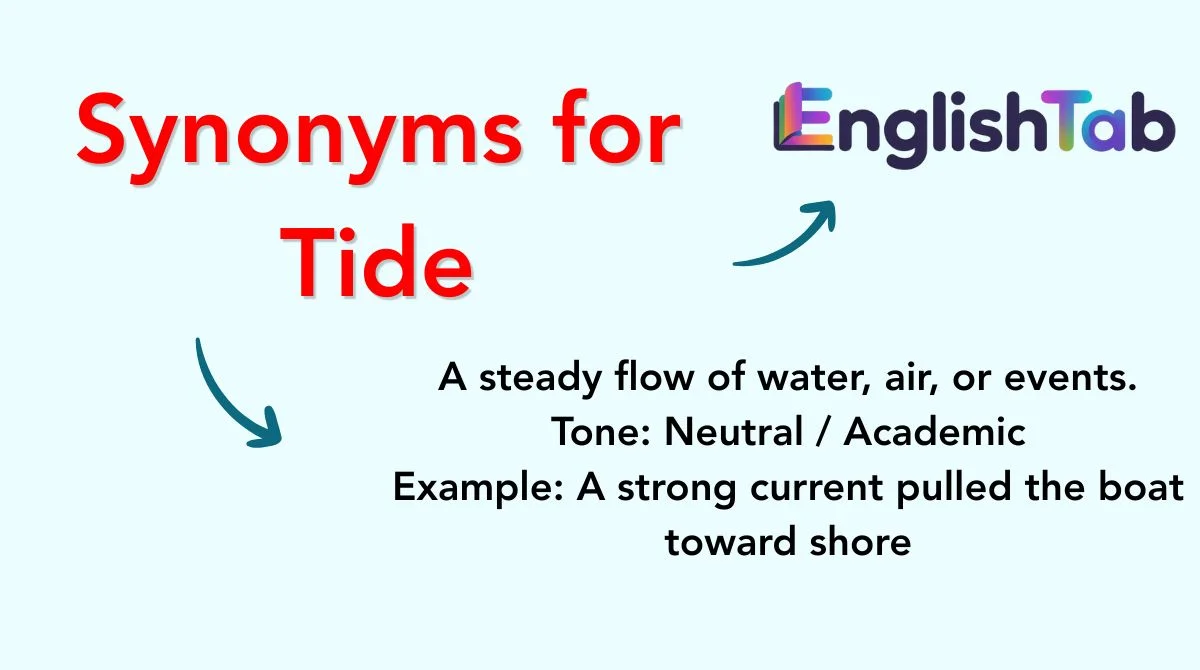
1. Current
A steady flow of water, air, or events.
Tone: Neutral / Academic
Example: A strong current pulled the boat toward shore.
2. Wave
A moving swell of water or a sudden increase of something.
Tone: Neutral / Casual
Example: A wave of excitement spread through the crowd.
3. Surge
A sudden and powerful forward movement.
Tone: Formal / News
Example: There was a surge in demand after the announcement.
4. Flow
A smooth and continuous movement.
Tone: Neutral
Example: The flow of traffic slowed during the storm.
5. Flood
An overwhelming amount of something.
Tone: Dramatic
Example: The office received a flood of emails.
6. Stream
A small, steady movement or supply.
Tone: Neutral
Example: A steady stream of visitors entered the museum.
7. Drift
Slow and gentle movement.
Tone: Literary
Example: The boat drifted with the evening tide.
8. Movement
A general shift or change.
Tone: Formal / Academic
Example: The movement toward remote work continues.
9. Swell
A gradual rise or increase.
Tone: Literary
Example: A swell of pride filled her heart.
10. Flux
Continuous change.
Tone: Academic
Example: The market is in constant flux.
11. Rush
Fast and forceful movement.
Tone: Informal
Example: A rush of adrenaline hit him.
12. Torrent
A violent or fast flow.
Tone: Dramatic
Example: The speech triggered a torrent of criticism.
13. Influx
A large arrival of people or things.
Tone: Formal
Example: The city saw an influx of tourists.
14. Ebb
The retreat or decline after growth.
Tone: Literary
Example: The excitement began to ebb.
15. Undercurrent
A hidden feeling or influence.
Tone: Literary / Formal
Example: There was an undercurrent of tension in the room.
16. Rising
An upward movement or growth.
Tone: Neutral
Example: The rising support surprised everyone.
17. Swing
A change in direction or opinion.
Tone: Casual / News
Example: There was a swing in public opinion.
18. Upsurge
A sharp increase.
Tone: Formal
Example: The country experienced an upsurge in innovation.
19. Deluge
A sudden heavy outpouring.
Tone: Dramatic
Example: A deluge of complaints followed the delay.
20. Swell-up
A growing increase.
Tone: Casual
Example: The swell-up of support changed the outcome.
Stronger Alternatives (More Intense Options)
These words carry more power than tide. Use them when you want strong impact:
- Torrent – For intense emotional or verbal release
- Deluge – When something feels overwhelming
- Surge – For sudden dramatic growth
- Flood – When quantity is extreme
- Upsurge – For sharp, upward spikes
- Onslaught – When the flow feels aggressive
- Avalanche – When events pile up quickly
Use these in headlines, persuasive writing, or dramatic storytelling.
Softer or Polite Alternatives
When you need a gentle tone, try these:
- Flow – Calm and steady
- Drift – Slow and peaceful
- Stream – Light and continuous
- Movement – Neutral and safe
- Shift – Mild change
- Gradual rise – Non-dramatic growth
- Change – Simple and clear
These work well in business emails, reports, or polite discussions.
Academic & IELTS-Friendly Alternatives
For essays, research papers, and exams, consider these:
- Flux
- Influx
- Trend
- Escalation
- Transition
- Progression
- Transformation
- Shift
- Expansion
- Acceleration
- Fluctuation
These words sound precise and formal. They improve vocabulary scores in IELTS and academic writing.
Synonyms You Should Avoid (Context Warning)
Some words look similar but can confuse readers.
- Storm – Refers to weather, not steady movement
- Hurricane – Too specific and extreme
- Explosion – Sudden burst, not flow
- River – Physical object, not motion
- Ocean – Place, not movement
Always match the word to the context. A wrong synonym weakens your message.
How to Choose the Right Synonym in Writing
Choosing the right word depends on four key factors:
1. Context
Are you writing about the sea, emotions, data, or politics? Pick a word that fits the topic.
2. Tone
Formal writing needs words like flux or influx. Casual writing works better with rush or wave.
3. Audience
Academic readers expect precision. Blog readers prefer clarity.
4. Clarity
Never choose a word just because it sounds smart. The meaning must stay clear.
Strong writing is not about big words. It is about the right words.
Example Paragraph Rewritten Using Synonyms
Original:
A tide of support helped the campaign succeed.
Rewritten Versions:
A surge of support helped the campaign succeed.
A wave of support helped the campaign succeed.
An influx of support helped the campaign succeed.
A swell of support helped the campaign succeed.
A growing current of support helped the campaign succeed.
Each sentence shifts the tone slightly. That is the power of vocabulary choice.
FAQs
What is the best synonym for tide?
The best synonym depends on context. Surge works for strong growth, while flow suits calm movement.
Can tide mean emotion?
Yes. It often describes strong feelings, like a tide of anger or joy.
Is surge stronger than tide?
Yes. Surge suggests sudden power, while tide can be gradual.
What is a formal word for tide?
Influx, flux, and upsurge are formal options.
What is a softer word than tide?
Flow or stream are softer alternatives.
Is flux academic?
Yes. Flux is commonly used in academic and scientific writing.
Can tide be used metaphorically?
Yes. It often describes political change, emotions, or social trends.
Conclusion
The word tide is simple but powerful. It can describe ocean movement, emotional waves, or social change. Yet repeating it weakens writing.
Using strong synonyms improves clarity, tone, and reader engagement. Formal contexts benefit from words like influx and flux. Dramatic writing shines with torrent and deluge. Softer communication works better with flow or stream.
The key is not to use complex words. The key is to use the right word.
Expand your vocabulary with intention, and your writing will feel sharper, clearer, and more professional in 2026 and beyond.

Dorian Hale is an English language enthusiast and content creator dedicated to making vocabulary and grammar learning simple, engaging, and accessible for everyone.