Many people search for synonyms for third graders when writing lesson plans, school reports, academic papers, blog posts, or educational content. Teachers want variety.
Parents want clearer descriptions. Writers want fresh wording that doesn’t sound repetitive.
Using different words for the same group helps your writing feel natural and professional. It also improves SEO, avoids repetition, and makes content more engaging for readers.
Whether you’re writing in an academic setting, preparing professional educational documents, or simply describing children in a casual conversation, choosing the right alternative matters.
The tone can shift depending on whether you’re speaking formally, casually, or academically.
This guide gives you carefully selected, context-appropriate synonyms for third graders, explained clearly and simply. Each option includes tone guidance and examples so you can choose the best word for your purpose.
What Does “Third Graders” Mean?
Third graders are students who are in the third year of primary or elementary school. In most education systems, they are usually 8–9 years old.
Tone Explanation
The phrase is:
- Neutral
- Educational
- Widely used in schools
It is common in:
- School communication
- Academic research
- Curriculum planning
- Parenting discussions
Because it is straightforward, writers sometimes look for alternatives to avoid repetition or match a specific tone.
19+ Best Synonyms for “Third Graders”
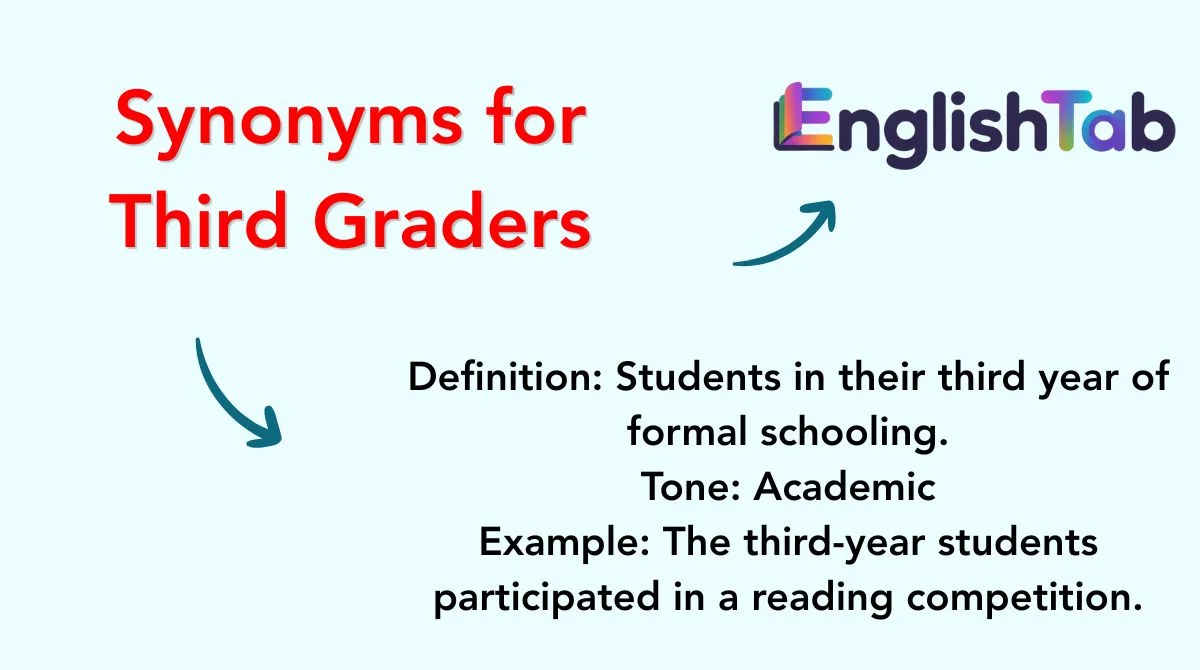
Third-Year Students
Definition: Students in their third year of formal schooling.
Tone: Academic
Example: The third-year students participated in a reading competition.
Grade Three Students
Definition: Students enrolled in Grade 3.
Tone: Formal
Example: Grade Three students must complete a science project this term.
Year Three Pupils
Definition: Students in the third school year (common in the UK).
Tone: Academic / British English
Example: Year Three pupils are learning multiplication tables.
Primary Three Students
Definition: Students in Primary 3 (common in some international systems).
Tone: Formal
Example: Primary Three students attended the field trip.
Elementary Students (Grade 3)
Definition: Elementary-level learners in third grade.
Tone: Neutral
Example: The program supports elementary students in Grade 3.
Young Learners
Definition: Children in early stages of schooling.
Tone: Educational
Example: The curriculum is designed for young learners.
Junior Students
Definition: Younger-level students within a school.
Tone: Neutral
Example: Junior students performed at the school assembly.
Lower Primary Students
Definition: Students in early primary years.
Tone: Academic
Example: Lower primary students benefit from interactive lessons.
Eight- to Nine-Year-Old Students
Definition: Students typically aged 8–9.
Tone: Descriptive
Example: Eight- to nine-year-old students enjoy hands-on activities.
Intermediate Primary Students
Definition: Students in mid-primary years.
Tone: Academic
Example: The workshop was designed for intermediate primary students.
Elementary-Level Children
Definition: Children studying at elementary level.
Tone: Neutral
Example: The book targets elementary-level children.
Third-Year Pupils
Definition: Pupils in their third academic year.
Tone: Formal
Example: Third-year pupils demonstrated strong reading skills.
Primary School Children (Grade 3)
Definition: Primary children in third grade.
Tone: Neutral
Example: The contest was open to primary school children in Grade 3.
Junior Elementary Students
Definition: Younger students in elementary school.
Tone: Neutral
Example: Junior elementary students require guided instruction.
Early-Stage Students
Definition: Students in early academic development.
Tone: Academic
Example: Early-stage students need structured literacy programs.
Lower Grade Students
Definition: Students in lower school grades.
Tone: Informal / General
Example: Lower grade students joined the art competition.
Third-Level Primary Students
Definition: Students at the third primary level.
Tone: Formal
Example: Third-level primary students are learning fractions.
Foundational-Level Students
Definition: Students building basic academic skills.
Tone: Academic
Example: Foundational-level students require reading support.
Basic Education Learners
Definition: Students in compulsory early education.
Tone: Formal / Academic
Example: Basic education learners attended the literacy workshop.
Stronger Alternatives (More Intense Options)
These options emphasize development or responsibility rather than just grade level:
- Developing Scholars – Highlights academic growth.
- Emerging Academics – Suggests intellectual progress.
- Young Achievers – Positive and motivational.
- Rising Learners – Implies forward movement.
- Future Leaders (Elementary Level) – Inspirational tone.
- Academic Beginners – Focuses on foundational learning.
Use these when writing motivational material, school promotions, or inspirational educational content.
Softer or Polite Alternatives
These feel warmer and more child-friendly:
- Young Minds
- Little Learners
- Growing Students
- Bright Beginners
- School-Age Children
- Junior Kids
- Young Scholars
These are best for parenting blogs, classroom newsletters, and informal communication.
Academic & IELTS-Friendly Alternatives
For essays, research papers, or formal reports, use:
- Primary-level learners
- Lower elementary cohort
- Early primary participants
- Junior academic group
- Foundational education cohort
- Basic-level pupils
- Entry-stage learners
- Intermediate primary cohort
- Compulsory education students
- Early academic-stage students
These terms work well in academic writing because they sound precise and professional.
Synonyms You Should Avoid (Context Warning)
Some alternatives can confuse readers:
Adolescents
Too old. Third graders are not teenagers.
Toddlers
Too young. Refers to preschool-aged children.
Teenagers
Incorrect age group.
Preschoolers
Refers to children before kindergarten.
High School Students
Completely different education level.
Always match the age and education stage accurately.
How to Choose the Right Synonym in Writing
1. Consider Context
If you’re writing a formal school document, choose “Grade Three students.” For casual content, “young learners” works better.
2. Match the Tone
Academic writing requires precision. Parenting blogs allow warmer language.
3. Think About Your Audience
Teachers prefer specific grade labels. General readers may prefer age-based terms.
4. Prioritize Clarity
Never choose a synonym that confuses the reader about age or school level.
The best synonym is clear, accurate, and natural.
Example Paragraph Rewritten Using Synonyms
Original:
Third graders are learning multiplication and reading chapter books this year.
Rewritten Versions:
- Grade Three students are learning multiplication and reading chapter books this year.
- Year Three pupils are developing stronger math and reading skills.
- Young learners in primary school are exploring advanced literacy concepts.
- Foundational-level students are building essential math skills.
Each version fits a different tone while keeping the meaning clear.
FAQs
What is another word for third graders?
You can say Grade Three students, Year Three pupils, or primary-level learners.
What do you call third graders in the UK?
They are usually called Year Three pupils.
What age are third graders?
Most third graders are 8 to 9 years old.
Is “junior students” correct for third graders?
Yes, but it is broader and may include other lower grades.
Can I say “young learners” instead of third graders?
Yes, especially in casual or educational writing.
What is a formal term for third graders?
Primary-level learners or Grade Three students are formal options.
Are third graders elementary students?
Yes, they are elementary or primary school students.
Conclusion
Finding the right synonyms for third graders improves clarity, tone, and engagement in your writing.
Whether you’re preparing academic material, professional documents, or casual content, choosing varied and accurate language makes your work stronger.
Always consider context, audience, and tone before replacing the term. The best synonym is one that keeps your meaning precise while enhancing readability.
With these 19+ carefully selected alternatives, you now have a complete toolkit to write naturally, professionally, and confidently in 2026 and beyond.

Dorian Hale is an English language enthusiast and content creator dedicated to making vocabulary and grammar learning simple, engaging, and accessible for everyone.