Many writers search for synonyms for “said” in writing because the word appears too often in stories, essays, emails, and reports.
When dialogue repeats “said” again and again, it can feel flat or boring. Readers may notice the repetition, even if they do not know why the writing feels weak.
Using better word variety helps your writing sound fresh and natural. It adds tone, emotion, and clarity. The right synonym can show if someone is angry, calm, nervous, excited, or unsure — without long explanations.
This matters in every type of writing. Students need stronger verbs for academic essays. Professionals want clear and polished language in reports or emails.
Creative writers use varied dialogue tags to bring characters to life. Even casual writing, like blog posts or social media, benefits from better word choice.
In this 2026 guide, you’ll learn over 20 strong alternatives to “said,” when to use them, and which ones to avoid.
What Does “Said” Mean?
“Said” is the past tense of “say.” It means to speak words out loud or to express something in writing.
It is neutral. It does not show emotion. It simply reports speech.
Because it is simple and clear, it works in almost all situations:
- Stories and novels
- Essays and reports
- News articles
- Emails
- Everyday conversation
Writers often use “said” because it is safe and easy. But overusing it can make dialogue feel repetitive. That is why many people look for better options.
20+ Best Synonyms for “Said”
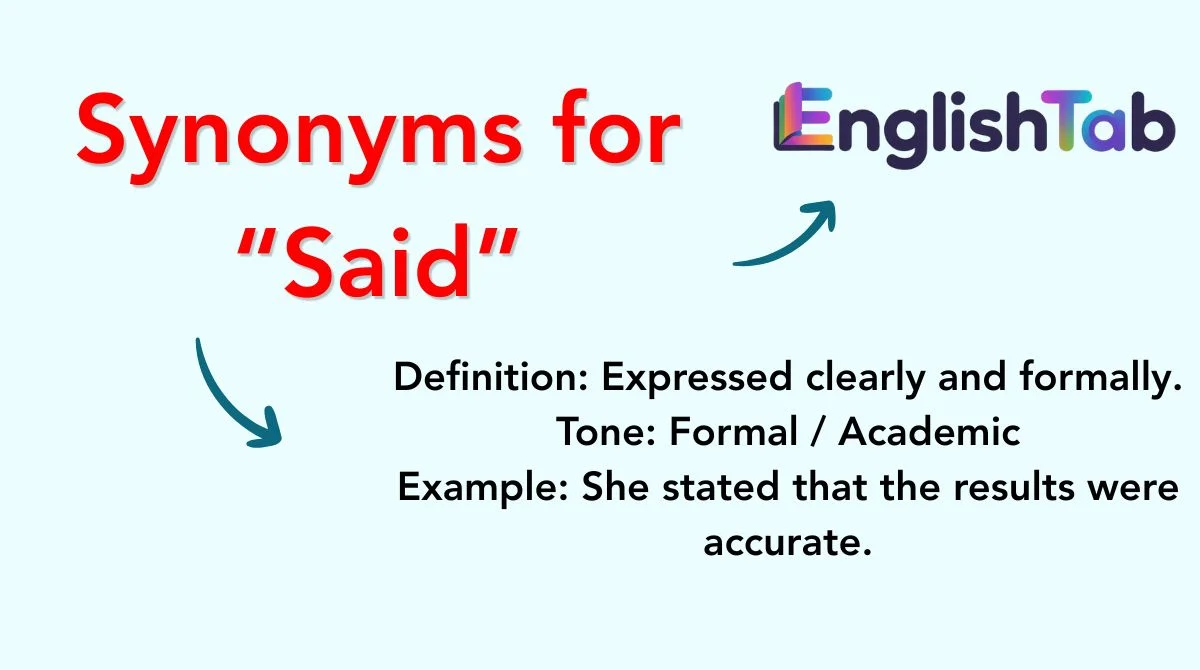
Stated
Definition: Expressed clearly and formally.
Tone: Formal / Academic
Example: She stated that the results were accurate.
Mentioned
Definition: Briefly referred to something.
Tone: Neutral / Casual
Example: He mentioned the meeting during lunch.
Explained
Definition: Made something clear by giving details.
Tone: Neutral / Academic
Example: The teacher explained the rule again.
Replied
Definition: Answered someone.
Tone: Neutral
Example: She replied with a smile.
Responded
Definition: Gave an answer or reaction.
Tone: Neutral / Professional
Example: The manager responded quickly to the email.
Added
Definition: Gave extra information.
Tone: Neutral
Example: He added that the plan might change.
Commented
Definition: Gave an opinion.
Tone: Professional / Neutral
Example: She commented on the design.
Noted
Definition: Pointed out something important.
Tone: Academic / Professional
Example: The report noted several risks.
Claimed
Definition: Said something without clear proof.
Tone: Formal
Example: The company claimed the product was safe.
Suggested
Definition: Proposed an idea.
Tone: Neutral
Example: She suggested a new strategy.
Whispered
Definition: Spoke very softly.
Tone: Literary
Example: He whispered her name.
Shouted
Definition: Spoke loudly.
Tone: Emotional
Example: She shouted across the room.
Asked
Definition: Requested information.
Tone: Neutral
Example: He asked a simple question.
Answered
Definition: Gave a response.
Tone: Neutral
Example: She answered politely.
Declared
Definition: Announced strongly and clearly.
Tone: Formal / Dramatic
Example: He declared his decision.
Announced
Definition: Shared important news publicly.
Tone: Formal
Example: The CEO announced the merger.
Admitted
Definition: Accepted something, often reluctantly.
Tone: Emotional / Formal
Example: She admitted her mistake.
Argued
Definition: Presented reasons strongly.
Tone: Academic / Strong
Example: The lawyer argued the case.
Insisted
Definition: Said something firmly and repeatedly.
Tone: Strong
Example: He insisted he was right.
Confirmed
Definition: Verified as true.
Tone: Professional
Example: The office confirmed the appointment.
Stronger Alternatives (More Intense Options)
Sometimes you need a word that carries emotion or power. These verbs show stronger feeling than “said.”
Demanded – Use when someone speaks with authority or anger.
Warned – Use when alerting someone about danger.
Protested – Use when someone disagrees strongly.
Exclaimed – Use for surprise or excitement.
Boasted – Use when someone speaks with pride.
Swore – Use when promising seriously.
Threatened – Use when expressing harm or pressure.
These words add tension and emotion. Use them carefully. Too many strong verbs can make writing feel dramatic or unrealistic.
Softer or Polite Alternatives
When tone matters, softer verbs help your writing sound calm and respectful.
Shared – Friendly and open tone.
Suggested – Gentle idea or advice.
Offered – Polite proposal.
Mentioned – Casual reference.
Murmured – Quiet and soft.
Noted – Calm and professional.
Observed – Thoughtful comment.
These work well in emails, workplace writing, or reflective essays.
Academic & IELTS-Friendly Alternatives
For essays, research papers, and formal exams, stronger academic verbs improve clarity.
Asserted – Stated firmly as fact.
Contended – Argued a point logically.
Proposed – Suggested formally.
Maintained – Continued to believe strongly.
Indicated – Pointed to evidence.
Reported – Presented findings.
Outlined – Summarized key points.
Emphasized – Gave special importance to.
Highlighted – Drew attention to.
Demonstrated – Showed clearly with proof.
These verbs are powerful in academic writing because they show analysis and evidence.
Synonyms You Should Avoid (Context Warning)
Not all alternatives are safe. Some can confuse readers.
Uttered – Sounds negative or strange in normal dialogue.
Pronounced – Usually refers to word pronunciation.
Articulated – Better for skills, not simple speech.
Vocalized – Sounds technical or medical.
Expressed – Often refers to feelings, not spoken words.
Using the wrong verb can distract readers or change meaning.
How to Choose the Right Synonym in Writing
Context
Ask yourself: What is happening? Is the speaker calm, angry, excited, or formal? The situation decides the verb.
Tone
Match your verb to the mood. A business report needs “stated” or “confirmed.” A story scene may need “whispered” or “shouted.”
Audience
Academic readers expect precise verbs like “argued” or “asserted.” Casual readers prefer simple words like “said” or “mentioned.”
Clarity
Never replace “said” just to sound fancy. If the synonym feels forced, keep “said.” Clear writing is always better than complicated writing.
Example Paragraph Rewritten Using Synonyms
Original:
“I don’t agree,” she said. “This plan will fail,” he said. “We need more time,” she said.
Rewritten Version:
“I don’t agree,” she argued. “This plan will fail,” he warned. “We need more time,” she insisted.
The new verbs show emotion and intention. The meaning becomes clearer without adding extra sentences.
FAQs
What are the best synonyms for said in writing?
Strong options include stated, explained, replied, noted, declared, and suggested. The best choice depends on tone and context.
Should I always replace “said” in dialogue?
No. “Said” is invisible to readers and often the best choice. Replace it only when emotion or clarity requires it.
What is a formal synonym for said?
“Stated,” “declared,” and “asserted” are formal alternatives.
What word can I use instead of said in an essay?
Use academic verbs like “argued,” “claimed,” “maintained,” or “demonstrated.”
Is it wrong to repeat said?
Not always. In fiction, repetition of “said” is often better than using dramatic verbs too often.
What are emotional synonyms for said?
“Shouted,” “whispered,” “insisted,” “warned,” and “exclaimed” show emotion.
What synonyms for said improve IELTS writing?
Use verbs like “contended,” “asserted,” “proposed,” “emphasized,” and “indicated.”
Conclusion
Finding better synonyms for “said” in writing helps your work sound polished, clear, and engaging.
While “said” is simple and useful, overusing it can weaken dialogue and reduce impact. The right alternative adds tone, emotion, and precision without making sentences heavy.
Strong writing is not about replacing every “said.” It is about choosing the right word for the right moment. Academic essays need formal verbs. Professional emails need clarity. Stories need emotion and rhythm.
Use this 2026 guide as a reference whenever you edit your work. Better word choice leads to stronger communication — and stronger communication always leaves a lasting impression.

Dorian Hale is an English language enthusiast and content creator dedicated to making vocabulary and grammar learning simple, engaging, and accessible for everyone.