Many people search for 21+ synonyms for nonfiction because they want better word choices in essays, books, articles, or even daily conversations.
The word nonfiction is clear, but it can feel repetitive when used too often. Writers, students, bloggers, and professionals all need fresh vocabulary to keep their writing strong and engaging.
Using varied language improves clarity and shows confidence. In academic work, the right synonym can make your argument sound precise.
In professional settings, it helps you communicate clearly. In casual writing, it keeps your tone natural and interesting.
This guide gives you more than simple replacements. You will learn when to use each synonym, what tone it carries, and how it fits different contexts.
Whether you’re preparing for IELTS, writing a research paper, or creating content online, this 2026 guide will help you choose the best alternative to nonfiction with ease.
What Does “Nonfiction” Mean?
Nonfiction refers to writing based on real facts, real events, and real people. It includes biographies, essays, textbooks, news articles, memoirs, and research papers.
Unlike fiction, nonfiction does not invent stories. Its goal is to inform, explain, document, or analyze reality.
Tone of the Word
The word nonfiction is neutral and widely accepted. It works well in academic, professional, and publishing contexts. However, in creative discussions or marketing, it may sound plain or technical.
When It Is Commonly Used
- Academic writing
- Publishing categories
- Library classification
- Book marketing
- Research discussions
21+ Best Synonyms for “Nonfiction”
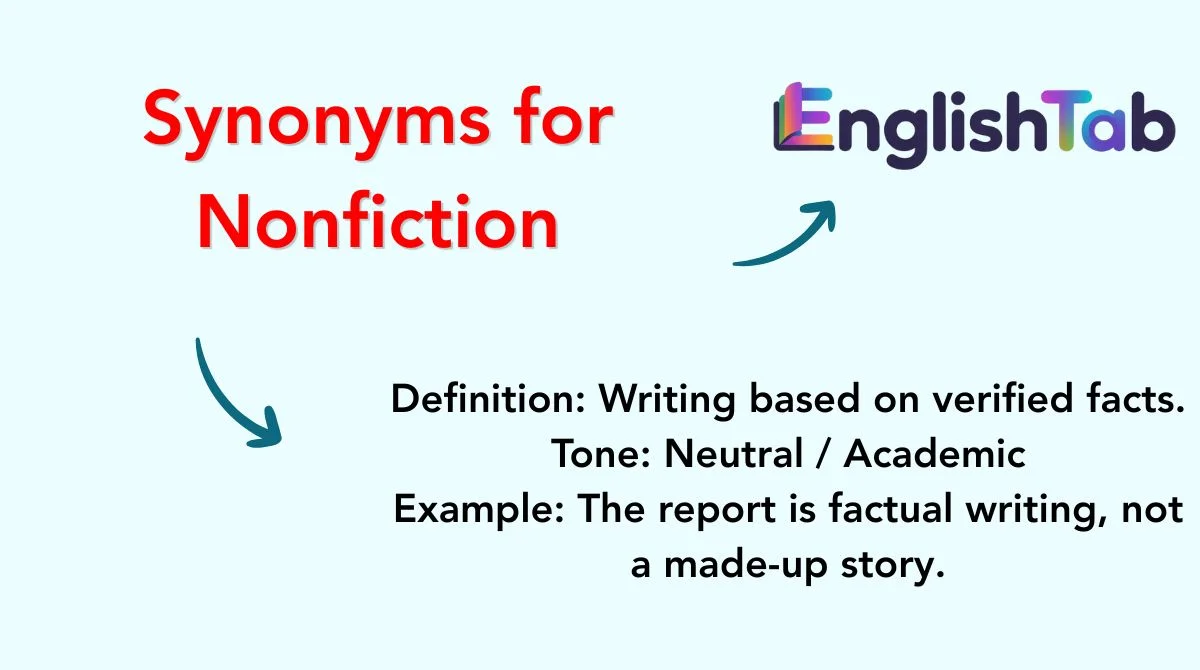
1. Factual Writing
Definition: Writing based on verified facts.
Tone: Neutral / Academic
Example: The report is factual writing, not a made-up story.
2. Informational Writing
Definition: Writing that aims to teach or explain.
Tone: Educational
Example: Informational writing helps students understand history.
3. Documentary Literature
Definition: Written work that documents real events.
Tone: Formal
Example: The book reads like documentary literature about war.
4. Biographical Writing
Definition: Writing about real people’s lives.
Tone: Academic
Example: She enjoys biographical writing about scientists.
5. Autobiographical Work
Definition: A real-life story written by the person themselves.
Tone: Formal
Example: His autobiographical work became a bestseller.
6. Memoir
Definition: Personal memories written as a true account.
Tone: Literary
Example: Her memoir tells the story of growing up abroad.
7. Reportage
Definition: Detailed reporting of events.
Tone: Journalistic
Example: The article uses strong reportage techniques.
8. True Account
Definition: A story based entirely on real events.
Tone: Neutral
Example: The film is based on a true account.
9. Real-Life Narrative
Definition: A structured story drawn from real life.
Tone: Casual / Literary
Example: It’s a real-life narrative about survival.
10. Historical Record
Definition: A documented record of past events.
Tone: Academic
Example: The diary serves as a historical record.
11. Case Study
Definition: Detailed analysis of a real situation.
Tone: Academic / Professional
Example: The book includes a case study of climate change.
12. Analytical Writing
Definition: Writing that examines real data or events.
Tone: Academic
Example: Analytical writing requires evidence.
13. Expository Writing
Definition: Writing that explains facts clearly.
Tone: Academic
Example: Expository writing is common in textbooks.
14. Journalistic Work
Definition: Reporting based on facts and interviews.
Tone: Professional
Example: His journalistic work uncovered corruption.
15. Realistic Prose
Definition: Writing that reflects real-life situations.
Tone: Literary
Example: The author is known for realistic prose.
16. Educational Text
Definition: Writing designed to teach.
Tone: Academic
Example: This educational text explains biology basics.
17. Research-Based Writing
Definition: Writing supported by studies and data.
Tone: Academic
Example: Research-based writing strengthens arguments.
18. Verified Account
Definition: A story supported by evidence.
Tone: Formal
Example: The article provides a verified account.
19. Fact-Based Narrative
Definition: A narrative built on real facts.
Tone: Neutral
Example: It’s a fact-based narrative about space travel.
20. Documentary Writing
Definition: Writing that documents real events carefully.
Tone: Formal
Example: Documentary writing requires accuracy.
21. True Story
Definition: A real event told as a story.
Tone: Casual
Example: This is a true story of courage.
22. Real-World Account
Definition: Writing focused on real experiences.
Tone: Neutral
Example: The article is a real-world account of poverty.
Stronger Alternatives (More Intense Options)
Sometimes you need a more powerful phrase than nonfiction.
- Investigative journalism – Use when the writing exposes hidden truths.
- Eyewitness testimony – Ideal for legal or dramatic real-life accounts.
- Authoritative report – Best for official or expert-backed content.
- Definitive study – Use when the work is considered final or highly respected.
- Evidence-based analysis – Strong for academic or scientific papers.
- In-depth documentary account – When detail and depth matter.
These options suggest depth, authority, and seriousness.
Softer or Polite Alternatives
In casual or friendly contexts, softer options work better.
- True story
- Real-life tale
- Personal account
- Life story
- Honest narrative
- Based on real events
- Personal reflections
These phrases sound warm and accessible.
Academic & IELTS-Friendly Alternatives
If you are preparing for IELTS, TOEFL, or academic writing, use these:
- Empirical writing
- Scholarly analysis
- Documentary evidence
- Research documentation
- Academic discourse
- Case-based study
- Objective reporting
- Data-driven narrative
- Historical documentation
- Critical examination
These terms increase precision and demonstrate advanced vocabulary.
Synonyms You Should Avoid (Context Warning)
Some words seem similar but may confuse readers.
1. Realistic Fiction
This is still fiction. It is not the same as nonfiction.
2. Novel
A novel is fictional, even if based on real events.
3. Mythology
Myths are traditional stories, not verified facts.
4. Legend
Legends may contain truth but are not proven accounts.
5. Fantasy
Fantasy is completely imaginative.
Avoid these when you truly mean factual writing.
How to Choose the Right Synonym in Writing
1. Consider Context
Are you writing a research paper or a blog post? Academic work needs formal vocabulary.
2. Match the Tone
A children’s book review should not use “empirical documentation.” Keep tone natural.
3. Know Your Audience
Experts expect precision. General readers prefer simple language.
4. Keep Clarity First
Never replace nonfiction with a word that changes the meaning.
5. Avoid Overcomplication
Using advanced words only helps if readers understand them.
Example Paragraph Rewritten Using Synonyms
Original:
She prefers reading nonfiction because it teaches her about real events.
Rewritten Versions:
- She prefers factual writing because it teaches her about real events.
- She enjoys documentary literature that explores historical records.
- She likes research-based writing that explains true stories.
- She reads real-life narratives to understand the world better.
- She chooses evidence-based analysis to learn from verified accounts.
Each version slightly shifts tone while keeping meaning clear.
FAQs
What is another word for nonfiction?
Common alternatives include factual writing, documentary literature, true account, and research-based writing.
Is memoir the same as nonfiction?
Yes, a memoir is a type of nonfiction focused on personal experiences.
What is the academic term for nonfiction?
Academic terms include empirical writing, scholarly analysis, and documentary evidence.
Can nonfiction include opinions?
Yes, but opinions must be based on real facts or experiences.
Is a biography nonfiction?
Yes, biographies are nonfiction because they tell real-life stories.
What is the opposite of nonfiction?
The opposite is fiction, which includes imagined stories.
Why should writers use synonyms for nonfiction?
Using synonyms improves readability, avoids repetition, and strengthens vocabulary.
Conclusion
Finding the right word matters. While nonfiction is accurate and widely accepted, many alternatives can better match your tone, purpose, and audience.
Whether you need a strong academic phrase like evidence-based analysis, a softer option like true story, or a professional term like documentary writing, choosing carefully improves your writing.
Strong vocabulary builds trust. It shows confidence. And it keeps readers engaged. Use this 2026 guide whenever you need smarter, clearer alternatives to nonfiction.

Dorian Hale is an English language enthusiast and content creator dedicated to making vocabulary and grammar learning simple, engaging, and accessible for everyone.