Language works best when meaning is precise. One of the most powerful tools for clarity in writing is contrast.
When readers understand what something is not, they better understand what it is. This is why antonyms—words with opposite meanings—play a central role in academic, professional, and creative communication.
A strong writer does more than use synonyms to avoid repetition. A strong writer also uses antonyms to sharpen arguments, highlight differences, and create logical balance.
In essays, reports, and research papers, contrast builds clarity. It separates strong ideas from weak ones, accurate claims from false ones, and positive outcomes from negative consequences.
This comprehensive guide presents an 18+ synonyms and antonyms list with deep analysis.
Instead of giving simple word pairs, we will examine meaning, context, tone, and nuance. You will learn not just what the opposite word is—but when and why to use it.
Definition and Core Meaning of “Synonyms and Antonyms”
Before exploring opposites, it is important to understand the terms themselves.
A synonym is a word that has the same or nearly the same meaning as another word. For example, “big” and “large” are synonyms.
An antonym is a word that has the opposite meaning of another word. For example, “hot” and “cold” are antonyms.
However, in academic writing, opposites are rarely absolute. Many antonyms operate on a spectrum:
- Strong ↔ Weak
- Success ↔ Failure
- Increase ↔ Decrease
These are called gradable antonyms because there are levels between them.
Understanding synonyms and antonyms helps writers:
- Avoid repetition
- Clarify meaning
- Strengthen arguments
- Show comparison and contrast
- Improve vocabulary range
The ability to choose the correct opposite word reflects precision and critical thinking.
Direct Opposites (Clear Contrasts)
Below are 18 strong antonyms that represent clear, widely accepted opposites. These pairs show direct contrast without much contextual change.
- Success ↔ Failure
- Accept ↔ Reject
- Increase ↔ Decrease
- Positive ↔ Negative
- Strong ↔ Weak
- Accurate ↔ Inaccurate
- True ↔ False
- Expand ↔ Contract
- Support ↔ Oppose
- Begin ↔ End
- Include ↔ Exclude
- Create ↔ Destroy
- Gain ↔ Lose
- Visible ↔ Invisible
- Legal ↔ Illegal
- Possible ↔ Impossible
- Honest ↔ Dishonest
- Open ↔ Closed
These words function as logical opposites in most formal contexts. For example:
“The policy was accepted by the committee” contrasts directly with “The policy was rejected by the committee.”
There is little ambiguity in such opposites.
Contextual Opposites
Some words become opposites depending on the situation. These are not fixed contrasts. Instead, the meaning shifts based on context.
Consider the word “light.”
Its opposite may be:
- Heavy (weight context)
- Dark (brightness context)
- Serious (tone context)
Another example is “critical.”
Its opposite may be:
- Supportive (evaluation context)
- Minor (importance context)
- Stable (condition context)
Contextual opposites require deeper understanding. Writers must analyze the intended meaning before selecting an antonym.
In academic writing, misuse of contextual antonyms often causes confusion. For example:
Incorrect: “The solution was light, not dark.”
Correct: “The solution was simple, not complex.”
The writer must identify the correct dimension of contrast.
Emotional & Tone-Based Opposites
Antonyms are not only logical. They also express emotional intensity and tone.
Consider these emotional contrasts:
- Optimistic ↔ Pessimistic
- Confident ↔ Doubtful
- Calm ↔ Anxious
- Proud ↔ Ashamed
- Encouraged ↔ Discouraged
- Motivated ↔ Apathetic
These opposites operate on psychological and emotional scales. They influence reader perception and rhetorical effect.
For example:
“The researcher remained optimistic despite initial setbacks.”
Contrast: “The researcher became pessimistic after repeated failures.”
The shift changes not only meaning but emotional tone.
Tone-based opposites are especially powerful in persuasive writing, speeches, and reflective essays.
18+ Antonyms Explained in Detail
Below are 18 detailed antonym explanations. Each includes meaning, context, example, and nuance.
Success
Meaning: Achievement of a goal.
Opposite: Failure
Context: Used in academic, business, or personal evaluation.
Example: “The experiment was a success.” / “The experiment was a failure.”
Nuance: Failure does not always imply incompetence; it may indicate unmet criteria.
Accept
Meaning: To receive or agree to something.
Opposite: Reject
Context: Formal decisions or offers.
Example: “She accepted the proposal.” / “She rejected the proposal.”
Nuance: Reject implies active refusal, not passive disagreement.
Increase
Meaning: To grow in number or size.
Opposite: Decrease
Context: Data, statistics, economics.
Example: “Sales increased.” / “Sales decreased.”
Nuance: Decrease suggests measurable reduction.
Positive
Meaning: Favorable or constructive.
Opposite: Negative
Context: Feedback, outcomes.
Example: “The results were positive.” / “The results were negative.”
Nuance: Negative may imply criticism or harmful effect.
Strong
Meaning: Powerful or resilient.
Opposite: Weak
Context: Arguments, structures, evidence.
Example: “The argument is strong.” / “The argument is weak.”
Nuance: Weak may indicate insufficient support.
Accurate
Meaning: Correct and precise.
Opposite: Inaccurate
Context: Data and reporting.
Example: “The report is accurate.” / “The report is inaccurate.”
Nuance: Inaccurate suggests factual error.
True
Meaning: Factually correct.
Opposite: False
Context: Logical statements.
Example: “The statement is true.” / “The statement is false.”
Nuance: False implies contradiction of fact.
Expand
Meaning: To grow or spread.
Opposite: Contract
Context: Business, economy, writing.
Example: “The company expanded.” / “The company contracted.”
Nuance: Contract suggests reduction in scope.
Support
Meaning: To back or approve.
Opposite: Oppose
Context: Debates and policies.
Example: “They support the reform.” / “They oppose the reform.”
Nuance: Oppose implies active resistance.
Begin
Meaning: To start.
Opposite: End
Context: Events and processes.
Example: “The meeting began.” / “The meeting ended.”
Nuance: End marks conclusion point.
Include
Meaning: To contain.
Opposite: Exclude
Context: Lists and membership.
Example: “The list includes all names.” / “The list excludes temporary members.”
Nuance: Exclude suggests deliberate omission.
Create
Meaning: To bring into existence.
Opposite: Destroy
Context: Physical or conceptual formation.
Example: “The policy created jobs.” / “The policy destroyed jobs.”
Nuance: Destroy carries strong negative tone.
Gain
Meaning: To obtain.
Opposite: Lose
Context: Profit, advantage.
Example: “The team gained support.” / “The team lost support.”
Nuance: Lose implies reduction of possession.
Visible
Meaning: Able to be seen.
Opposite: Invisible
Context: Physical or metaphorical presence.
Example: “The impact was visible.” / “The impact was invisible.”
Nuance: Invisible may imply hidden influence.
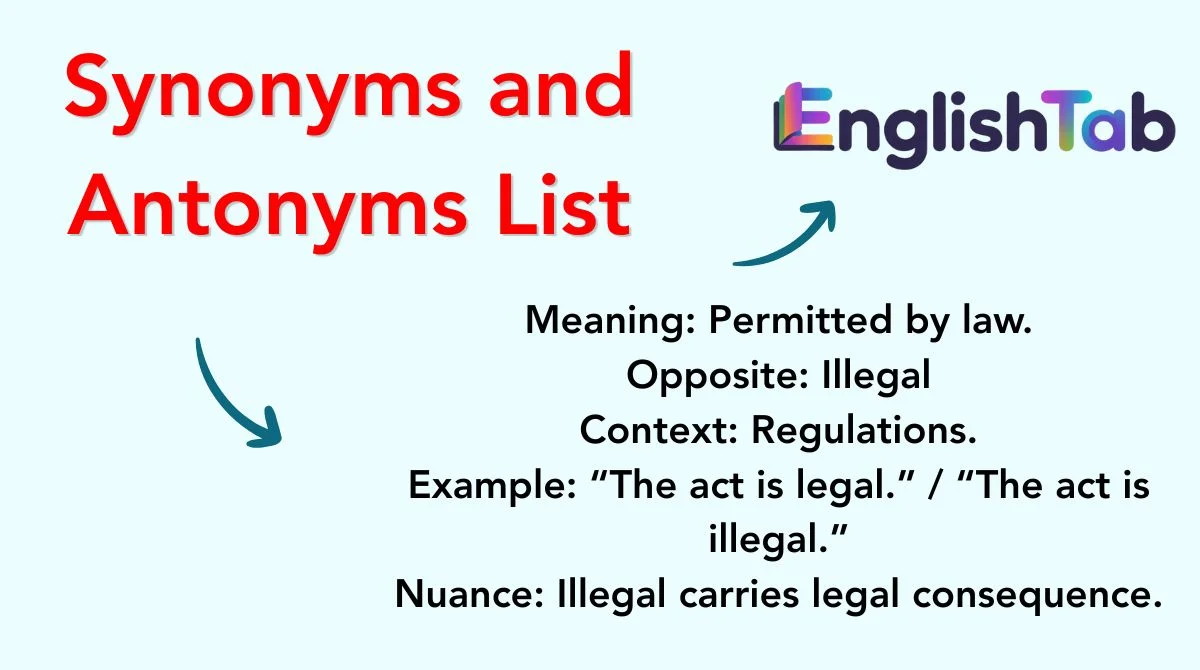
Legal
Meaning: Permitted by law.
Opposite: Illegal
Context: Regulations.
Example: “The act is legal.” / “The act is illegal.”
Nuance: Illegal carries legal consequence.
Possible
Meaning: Able to occur.
Opposite: Impossible
Context: Feasibility.
Example: “Success is possible.” / “Success is impossible.”
Nuance: Impossible signals complete limitation.
Honest
Meaning: Truthful.
Opposite: Dishonest
Context: Character judgment.
Example: “She is honest.” / “She is dishonest.”
Nuance: Dishonest implies moral failure.
Open
Meaning: Not closed or accessible.
Opposite: Closed
Context: Physical or figurative access.
Example: “The store is open.” / “The store is closed.”
Nuance: Closed may imply unavailability or refusal.
Antonym Comparison Table
| Word | Antonym | Degree Type | Emotional Weight | Academic Usage |
|---|---|---|---|---|
| Success | Failure | Gradable | Moderate | High |
| Strong | Weak | Gradable | Neutral | High |
| Legal | Illegal | Absolute | Serious | Very High |
| Honest | Dishonest | Absolute | Moral | High |
| Expand | Contract | Gradable | Neutral | Medium |
| Positive | Negative | Gradable | Emotional | High |
| Visible | Invisible | Binary | Neutral | Medium |
| Possible | Impossible | Absolute | Strong | High |
This table highlights how some antonyms are absolute (no middle ground), while others exist on a scale.
Academic Writing Examples
Contrast strengthens academic structure.
Example 1:
“The initial hypothesis was supported by the data; however, later trials opposed this conclusion.”
Example 2:
“While the short-term impact was positive, the long-term consequences were negative.”
Example 3:
“The argument appears strong at first glance, yet closer analysis reveals weak evidence.”
Such contrasts create analytical depth.
When Not to Replace the Word
Antonyms should not be forced.
Avoid replacing a word simply to create contrast. Sometimes contrast oversimplifies complex issues.
For example:
Incorrect: “The theory is either true or false.”
Better: “The theory may be partially supported.”
Binary opposites may ignore nuance. Academic writing often requires moderation rather than extremes.
Practice Exercises
- Replace the word with its strongest antonym:
The results were accurate. - Identify whether the antonym is gradable or absolute:
Legal ↔ Illegal - Write one sentence using “support” and another using its opposite.
- Choose the correct contextual opposite for “light” in this sentence:
“The box is light.” - Rewrite the sentence with contrast:
“The method was effective.”
These exercises build active vocabulary control.
FAQs
What is the difference between synonyms and antonyms?
Synonyms share similar meaning; antonyms express opposite meaning.
Are all antonyms complete opposites?
No. Some are absolute, while others exist on a scale.
Why are antonyms important in academic writing?
They improve clarity, strengthen comparison, and sharpen argument structure.
Can one word have multiple antonyms?
Yes. Context determines the correct opposite.
Should I always use direct opposites?
Not always. Choose based on precision and tone.
Conclusion
Mastering an 18+ synonyms and antonyms list is not about memorizing word pairs. It is about understanding contrast as a cognitive and rhetorical tool.
Antonyms sharpen arguments. They clarify differences. They strengthen persuasion. They create intellectual balance.
In advanced writing, precision matters more than variety. The best writers choose opposites carefully, analyze nuance, and apply contrast logically.
When used strategically, antonyms do more than oppose meaning—they illuminate it.

Dorian Hale is an English language enthusiast and content creator dedicated to making vocabulary and grammar learning simple, engaging, and accessible for everyone.