Language gains strength from contrast. When writers skillfully use synonym and antonyms, they create clarity, depth, and precision. Opposites sharpen ideas.
They allow readers to see differences clearly. They strengthen arguments. They add rhythm to sentences.
In academic writing, business communication, and creative expression, contrast is not decoration—it is structure. A strong claim becomes clearer when set against its opposite.
A concept becomes understandable when compared to what it is not.
This article provides a deep contrast analysis of the core word “strong.”
You will explore 17+ powerful antonyms, contextual contrasts, emotional tone differences, academic usage, and situations where replacement may weaken meaning.
Definition and Core Meaning of “Strong”
The word strong describes power, stability, intensity, or effectiveness. It can refer to physical force, emotional resilience, logical reasoning, or sensory impact.
Core meanings include:
- Having physical power
- Being mentally or emotionally resilient
- Being convincing or persuasive
- Having high intensity
- Being structurally stable
Examples:
- She has a strong grip.
- He presented a strong argument.
- The coffee tastes strong.
- The team showed strong leadership.
Because “strong” operates across physical, emotional, logical, and abstract domains, its antonyms also vary widely depending on context.
Direct Opposites (Clear Contrasts)
Below are 17 strong antonyms that directly contrast the meaning of “strong” in different contexts:
weak
fragile
feeble
frail
powerless
vulnerable
unstable
delicate
ineffective
unconvincing
soft
mild
timid
helpless
insecure
flimsy
breakable
Each of these presents a clear contrast in at least one sense of “strong.”
Contextual Opposites
Some words oppose “strong” only in specific situations.
For physical strength:
- frail
- fragile
- feeble
For arguments:
- weak
- unconvincing
- flawed
For personality:
- timid
- insecure
- hesitant
For flavor or intensity:
- mild
- bland
- faint
For structure:
- unstable
- flimsy
- delicate
This shows that antonyms are not fixed. They shift based on context.
Emotional & Tone-Based Opposites
Contrast also changes emotional tone.
Strong personality vs timid personality
Strong emotions vs suppressed emotions
Strong leadership vs passive leadership
Strong belief vs doubtful belief
Notice that emotional antonyms often carry judgment. Calling an argument “weak” is neutral criticism. Calling someone “powerless” carries emotional weight.
Tone influences impact.
17+ Antonyms Explained in Detail
Weak
Meaning: Lacking strength or force.
Context: Used for physical, emotional, logical, or structural weakness.
Example: The bridge is weak after the storm.
Nuance: The broadest antonym of “strong.” Neutral but critical.
Fragile
Meaning: Easily broken or damaged.
Context: Objects, relationships, emotional states.
Example: The fragile vase shattered.
Nuance: Suggests delicacy rather than total weakness.
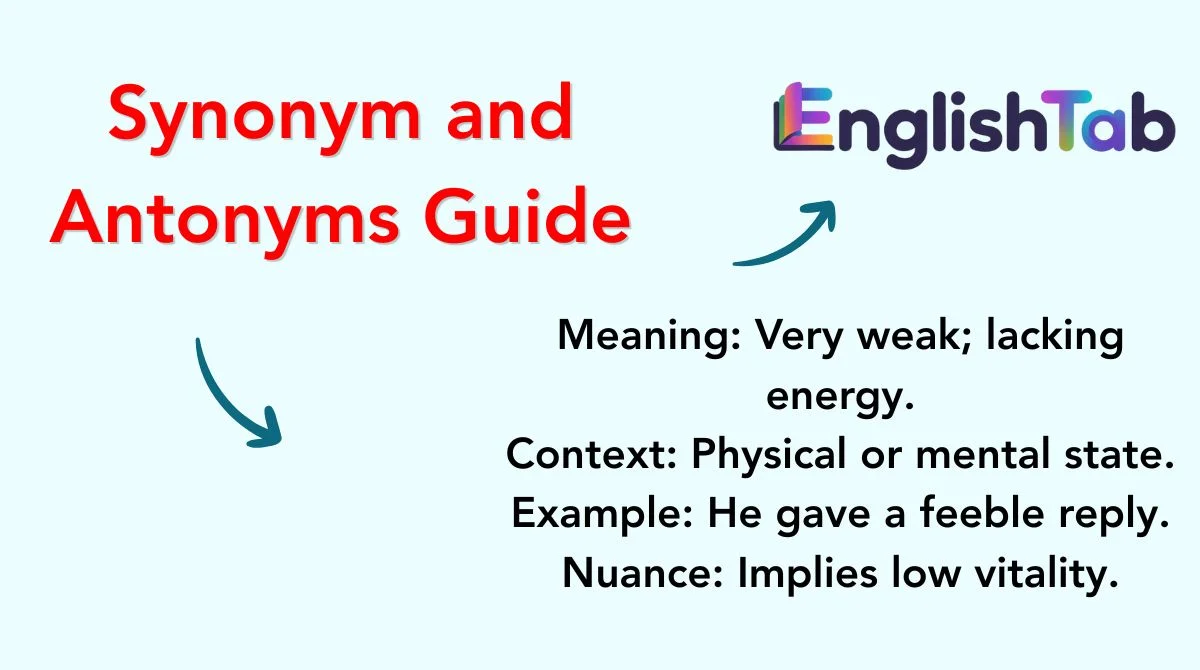
Feeble
Meaning: Very weak; lacking energy.
Context: Physical or mental state.
Example: He gave a feeble reply.
Nuance: Implies low vitality.
Frail
Meaning: Physically weak, often due to age.
Context: Consider or ill individuals.
Example: The frail patient needed assistance.
Nuance: Often associated with vulnerability.
Powerless
Meaning: Without ability to act or control.
Context: Social or political situations.
Example: Citizens felt powerless.
Nuance: Emphasizes lack of control.
Vulnerable
Meaning: Exposed to harm.
Context: Emotional or physical risk.
Example: Children are vulnerable in unsafe areas.
Nuance: Suggests susceptibility rather than weakness itself.
Unstable
Meaning: Not steady or secure.
Context: Structures, emotions, systems.
Example: The ladder is unstable.
Nuance: Focuses on reliability.
Delicate
Meaning: Easily damaged; refined.
Context: Physical objects or sensitive topics.
Example: This is a delicate matter.
Nuance: Can be positive or negative.
Ineffective
Meaning: Not producing desired results.
Context: Arguments, strategies.
Example: The policy was ineffective.
Nuance: Logical contrast to strong arguments.
Unconvincing
Meaning: Failing to persuade.
Context: Debates, writing.
Example: The explanation was unconvincing.
Nuance: Specifically relates to persuasion.
Soft
Meaning: Not firm or hard.
Context: Physical texture or discipline.
Example: The mattress is soft.
Nuance: Physical contrast.
Mild
Meaning: Not intense.
Context: Flavor, weather, personality.
Example: The sauce is mild.
Nuance: Refers to low intensity.
Timid
Meaning: Shy or lacking courage.
Context: Personality traits.
Example: She gave a timid response.
Nuance: Emotional weakness.
Helpless
Meaning: Unable to help oneself.
Context: Emergency situations.
Example: He felt helpless during the crisis.
Nuance: Emphasizes dependency.
Insecure
Meaning: Lacking confidence or safety.
Context: Emotional states.
Example: He felt insecure about his work.
Nuance: Psychological contrast.
Flimsy
Meaning: Weak and poorly made.
Context: Materials or excuses.
Example: The excuse was flimsy.
Nuance: Suggests poor quality.
Breakable
Meaning: Capable of being broken.
Context: Physical objects.
Example: The toy is easily breakable.
Nuance: Structural vulnerability.
Antonym Comparison Table
| Antonym | Context Type | Emotional Weight | Formal Usage | Intensity Level |
|---|---|---|---|---|
| Weak | General | Neutral | High | Medium |
| Fragile | Physical/Emotional | Light | High | Medium |
| Powerless | Social/Political | High | High | Strong |
| Timid | Personality | Medium | Medium | Medium |
| Ineffective | Academic | Neutral | Very High | Logical |
| Unconvincing | Academic | Neutral | Very High | Logical |
| Flimsy | Informal/Material | Mild | Medium | Moderate |
| Mild | Sensory | Low | High | Low |
| Helpless | Emotional | High | Medium | Strong |
This table demonstrates how contrast shifts based on emotional intensity and context.
Academic Writing Examples
Strong thesis:
The research presents a strong correlation between variables.
Weak thesis:
The research presents a weak correlation between variables.
Strong evidence:
The study provides strong evidence supporting the claim.
Unconvincing evidence:
The study provides unconvincing evidence due to limited data.
Strong leadership:
The administration showed strong leadership during reform.
Ineffective leadership:
The administration demonstrated ineffective leadership.
Notice how academic tone favors neutral logical antonyms like weak, ineffective, or unconvincing over emotional terms like helpless.
When Not to Replace the Word
Not all contexts require substitution.
Do not replace “strong” when:
- It expresses measurable intensity (strong wind).
- It is part of technical terminology (strong acid).
- It carries established academic meaning.
- Replacement reduces clarity.
Example:
Incorrect replacement:
The experiment showed a powerful correlation.
(Correlation is described as strong, not powerful.)
Precision matters more than variety.
Practice Exercises
Choose the best antonym for “strong”:
The argument was ______ and failed to persuade the audience.
a) fragile
b) unconvincing
c) soft
Correct answer: unconvincing
Rewrite using an appropriate antonym:
The structure is strong.
Possible answers:
The structure is unstable.
The structure is flimsy.
Identify context:
The soup is strong.
Best antonym: mild.
The leader is strong.
Best antonym: ineffective or timid depending on context.
Replace appropriately:
She gave a strong performance.
Contrast: She gave a weak performance.
FAQs
What is the most common antonym of strong?
The most common antonym is “weak” because it applies across physical, emotional, and logical contexts.
Are fragile and weak the same?
No. Fragile suggests delicacy and susceptibility to damage, while weak refers to lack of strength more broadly.
Can mild always replace weak?
No. Mild refers to low intensity, usually for flavor or weather, not structural or emotional strength.
Which antonym is best for academic writing?
Weak, ineffective, and unconvincing are most appropriate in formal academic contexts.
Is powerless stronger than weak?
Yes. Powerless carries more emotional and political weight than weak.
Conclusion
Mastering synonym and antonyms enhances writing clarity, argument precision, and stylistic flexibility.
The word “strong” carries multiple meanings across physical, emotional, structural, and academic contexts.
Its 17+ antonyms reveal that opposition is rarely simple.
True writing skill lies not in replacing words randomly but in selecting the exact contrast that fits context, tone, and purpose.
When used correctly, antonyms sharpen meaning. They highlight difference. They strengthen arguments through contrast.
In 2k26 and beyond, precision will remain the mark of authoritative writing.

Dorian Hale is an English language enthusiast and content creator dedicated to making vocabulary and grammar learning simple, engaging, and accessible for everyone.