Clear writing depends on contrast. Without contrast, ideas blur together. Readers struggle to understand emphasis, tone, and intention.
One of the strongest tools for clarity is the correct use of synonym and antonyms.
Synonyms strengthen expression by offering variety. Antonyms sharpen meaning by introducing opposition. Together, they create structure, rhythm, and precision in academic and professional writing.
Opposites are not just vocabulary tools. They define boundaries of meaning. When a writer understands how a word stands against its opposite, they understand its true depth.
This article explores 17+ powerful antonyms of a central root word, examines contextual and emotional contrasts, compares nuanced differences, and provides academic examples and exercises for mastery.
For clarity and strong contrast demonstration, the root word used in this guide is:
Success
Definition and Core Meaning of “Success”
Success refers to the achievement of a desired goal, outcome, or standard. It often implies accomplishment, favorable results, or positive recognition.
Core elements of the word include:
- Achievement
- Completion of objectives
- Recognition
- Progress toward goals
- Positive outcomes
Success can be measured differently depending on context:
- Academic success
- Financial success
- Personal success
- Social success
- Professional success
To understand this word deeply, we must analyze what it is not. Opposites define meaning boundaries. The contrast reveals precision.
Direct Opposites (Clear Contrasts)
These are the strongest antonyms that directly oppose the concept of success in most contexts.
Failure
Defeat
Loss
Collapse
Disaster
Flop
Bankruptcy
Downfall
Misfortune
Shortcoming
Setback
Inefficiency
Incompetence
Rejection
Frustration
Regression
Stagnation
Each of these words directly challenges the idea of achievement or positive outcome.
Contextual Opposites
Some words function as opposites depending on context rather than fixed meaning.
For example:
- Delay may oppose success in a deadline-driven environment.
- Abandonment may oppose success in project management.
- Withdrawal can be the opposite of competitive success.
- Silence may contrast with success in communication.
- Obscurity may oppose public success.
These contextual antonyms depend on the specific situation. They are not universal opposites but function as contrasts within defined frameworks.
Emotional & Tone-Based Opposites
Not all opposites are logical. Some are emotional.
Success carries emotional weight such as pride, satisfaction, and fulfillment. Emotional opposites include:
- Shame
- Disappointment
- Regret
- Humiliation
- Hopelessness
These words contrast the emotional experience of success rather than the structural outcome.
Tone also shifts:
- Success is upward.
- Failure feels downward.
- Success energizes.
- Defeat drains.
Emotional antonyms shape narrative tone in essays, speeches, and research analysis.
17+ Antonyms Explained in Detail
Below are detailed academic-level explanations of the strongest antonyms of success.
Failure
Meaning: The absence of achievement.
Context: Academic exams, business ventures, research attempts.
Example: The experiment ended in failure after repeated errors.
Nuance: Failure suggests complete non-achievement rather than partial weakness.
Defeat
Meaning: Being overcome in competition.
Context: Sports, politics, debates.
Example: The candidate faced defeat in the final election round.
Nuance: Defeat implies opposition from another force.
Loss
Meaning: The act of losing something valuable.
Context: Finance, sports, emotional experiences.
Example: The company reported a financial loss this quarter.
Nuance: Loss focuses on what is gone, not on the process of failing.
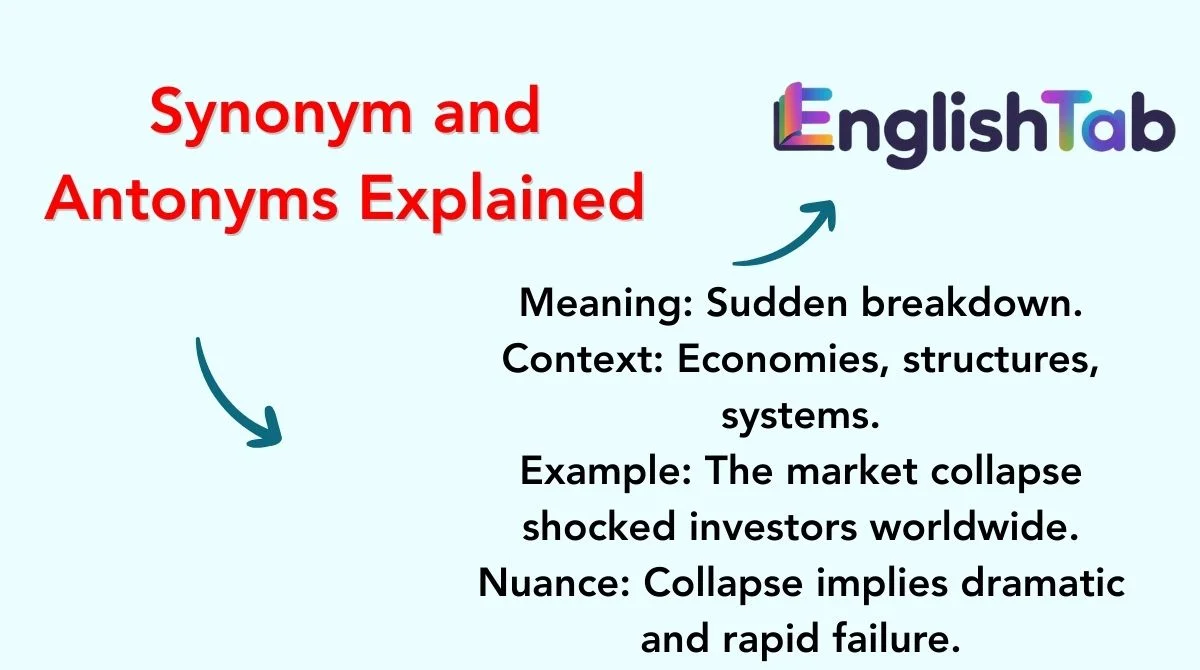
Collapse
Meaning: Sudden breakdown.
Context: Economies, structures, systems.
Example: The market collapse shocked investors worldwide.
Nuance: Collapse implies dramatic and rapid failure.
Disaster
Meaning: A catastrophic failure.
Context: Natural events, project management.
Example: The launch turned into a public relations disaster.
Nuance: Disaster includes severe negative consequences.
Flop
Meaning: A complete lack of expected success.
Context: Entertainment, product launches.
Example: The film became a box office flop.
Nuance: Informal tone compared to failure.
Bankruptcy
Meaning: Legal financial failure.
Context: Corporate finance.
Example: The firm declared bankruptcy after heavy debts.
Nuance: Specific to financial collapse.
Downfall
Meaning: Gradual decline leading to ruin.
Context: Leadership, reputation.
Example: Corruption led to his downfall.
Nuance: Emphasizes moral or strategic decline.
Misfortune
Meaning: Unlucky outcome.
Context: Personal situations.
Example: The delay was due to unforeseen misfortune.
Nuance: Suggests lack of control.
Shortcoming
Meaning: A weakness preventing success.
Context: Skills, systems.
Example: Communication was the team’s main shortcoming.
Nuance: Indicates partial limitation, not total failure.
Setback
Meaning: Temporary difficulty.
Context: Career progress.
Example: The delay was a minor setback.
Nuance: Implies recovery is possible.
Inefficiency
Meaning: Lack of effectiveness.
Context: Management systems.
Example: Administrative inefficiency slowed operations.
Nuance: Focuses on process, not outcome.
Incompetence
Meaning: Lack of ability.
Context: Leadership roles.
Example: Incompetence weakened the organization.
Nuance: Critiques capability rather than results alone.
Rejection
Meaning: Refusal of acceptance.
Context: Academic journals, job applications.
Example: The paper faced rejection from the journal.
Nuance: Involves external evaluation.
Frustration
Meaning: Emotional response to blocked success.
Context: Personal development.
Example: Continuous delays caused frustration.
Nuance: Emotional dimension rather than objective failure.
Regression
Meaning: Return to earlier stage.
Context: Learning, therapy.
Example: The patient showed regression in behavior.
Nuance: Opposes progress rather than achievement.
Stagnation
Meaning: Lack of growth.
Context: Economic development.
Example: Years of stagnation reduced innovation.
Nuance: Suggests stillness rather than collapse.
Antonym Comparison Table
Word | Strength Level | Emotional Weight | Reversible | Context Type
Failure | High | Moderate | Sometimes | General
Defeat | High | High | Yes | Competitive
Loss | Medium | High | Rare | Financial/Emotional
Collapse | Extreme | High | Rare | Structural
Setback | Low | Low | Yes | Temporary
Stagnation | Medium | Low | Yes | Economic
Rejection | Medium | High | Yes | Evaluative
Downfall | High | High | Rare | Moral/Strategic
Incompetence | Medium | Negative | Yes | Skill-based
This comparison shows that antonyms vary in permanence, intensity, and context.
Academic Writing Examples
In scholarly writing, precise contrast improves clarity.
Example 1:
While the initial trial demonstrated success, the replication study revealed failure due to methodological inconsistencies.
Example 2:
Economic success depends not only on growth but also on avoiding stagnation.
Example 3:
The policy prevented total collapse, though minor setbacks remained unavoidable.
Contrast words enhance argument depth and analytical sophistication.
When Not to Replace the Word
Not every antonym fits every context.
Avoid replacing success with:
- Disaster when discussing minor setbacks.
- Collapse when describing small mistakes.
- Failure when referring to incomplete but promising work.
Precision matters.
For example:
Incorrect: The team’s minor delay was a disaster.
Correct: The team experienced a temporary setback.
Overstating contrast weakens academic credibility.
Practice Exercises
Exercise 1
Replace success with an appropriate antonym:
- The company experienced great success → The company faced __________.
- The athlete celebrated success → The athlete suffered __________.
- The economy enjoyed success → The economy entered __________.
Exercise 2
Choose the strongest antonym:
- A temporary project delay
a) collapse
b) setback
c) disaster - A legal financial ruin
a) bankruptcy
b) frustration
c) stagnation
Exercise 3
Write two sentences contrasting success and one emotional opposite.
FAQs
What is the strongest antonym of success?
Failure is the most universal and direct opposite because it represents complete non-achievement.
Are all antonyms equal in intensity?
No. Collapse is stronger than setback. Disaster is more intense than shortcoming.
Can success have emotional opposites?
Yes. Words like shame and disappointment oppose the emotional experience of success.
Why are contextual opposites important?
Because meaning shifts depending on situation. In economics, stagnation may function as the opposite of success.
Is defeat the same as failure?
Not exactly. Defeat involves competition. Failure may occur without an opponent.
Conclusion
Understanding 17+ antonyms of success reveals how contrast sharpens clarity. Direct opposites define boundaries. Contextual opposites refine meaning. Emotional opposites deepen tone.
Writers who master synonym and antonyms gain control over emphasis, precision, and argument strength.
Contrast is not decorative. It is structural.
When used carefully, antonyms transform vague writing into disciplined, analytical communication.

Dorian Hale is an English language enthusiast and content creator dedicated to making vocabulary and grammar learning simple, engaging, and accessible for everyone.