Many people search for subset synonyms when they want to avoid repeating the word subset in essays, reports, or daily writing.
The word is useful, but using it too often can make your writing sound dull. Good writers know that word variety improves clarity and keeps readers engaged.
Whether you are writing an academic paper, a business report, a blog post, or even a casual message, choosing the right synonym matters.
In academic writing, precision is key. In professional settings, tone and clarity are important. In casual writing, simplicity works best.
This guide gives you more than 22 powerful alternatives to the word subset. You will learn when to use each one, what tone it carries, and how it fits into different types of writing.
By the end, you will know exactly which synonym works best for your context.
Let’s begin by understanding what subset really means.
What Does “Subset” Mean?
A subset is a smaller group that belongs to a larger group.
It is commonly used in:
- Mathematics
- Research and statistics
- Academic writing
- Business analysis
- Data science
For example, in data analysis, a subset may refer to a small selection taken from a larger dataset.
Tone explanation:
The word subset sounds formal and academic. It is neutral and precise. It is not emotional or casual.
When it is commonly used:
- When dividing data into smaller parts
- When describing a category within a larger category
- When analyzing specific segments of a population
- In technical or structured writing
Now, let’s explore better and more flexible alternatives.
22+ Best Synonyms for “Subset”
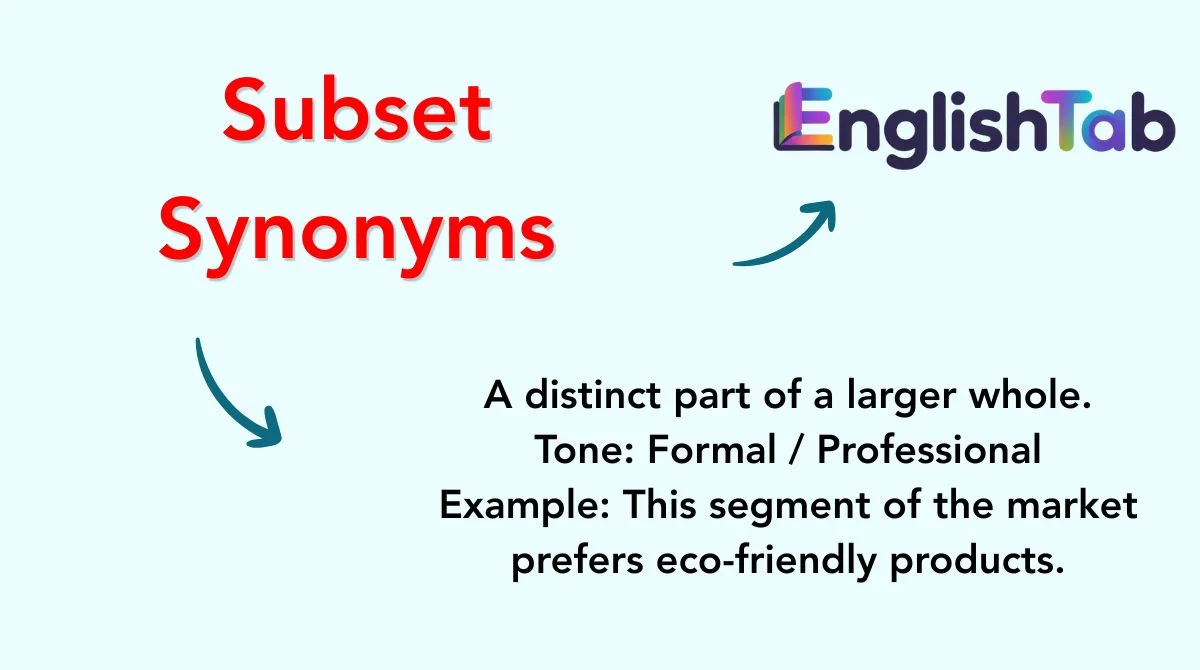
Segment
A distinct part of a larger whole.
Tone: Formal / Professional
Example: This segment of the market prefers eco-friendly products.
Portion
A part taken from a larger amount.
Tone: Neutral
Example: Only a small portion of the data was reviewed.
Section
A clearly divided part of something.
Tone: Neutral
Example: This section of the report focuses on customer feedback.
Category
A group sharing similar features.
Tone: Academic / Neutral
Example: This category includes young professionals.
Division
A part separated from a larger system.
Tone: Formal
Example: The sales division handles online orders.
Group
A collection of people or things.
Tone: Casual / Neutral
Example: This group of students scored highest.
Subgroup
A smaller group within a larger group.
Tone: Academic
Example: The study examined a subgroup of patients.
Cluster
A group positioned closely together.
Tone: Academic / Technical
Example: A cluster of users showed similar behavior.
Class
A set sharing common traits.
Tone: Academic
Example: This class of chemicals is highly reactive.
Tier
A level within a ranked system.
Tone: Professional
Example: Premium members belong to a higher tier.
Bracket
A range within specific limits.
Tone: Informal / Professional
Example: Most buyers fall into the middle-income bracket.
Band
A range within limits.
Tone: Informal
Example: Students in this band scored above average.
Fraction
A small part of a whole.
Tone: Academic
Example: Only a fraction of users responded.
Sample
A small part selected for study.
Tone: Academic
Example: The sample included 200 participants.
Selection
A chosen group.
Tone: Neutral
Example: This selection of products sold quickly.
Component
A part of a larger system.
Tone: Formal / Technical
Example: Safety is a key component of the plan.
Element
A single part of a whole.
Tone: Neutral
Example: Trust is an important element of teamwork.
Portion
A part divided from the whole.
Tone: Neutral
Example: A large portion of the audience agreed.
Unit
An individual part of a larger structure.
Tone: Technical
Example: Each unit belongs to a training group.
Division
A distinct branch of an organization.
Tone: Professional
Example: The marketing division targets new clients.
Minority
A smaller number within a group.
Tone: Formal
Example: A minority of users experienced issues.
Subdivision
A smaller part of a larger area.
Tone: Formal
Example: The region was split into subdivisions.
Stronger Alternatives (More Intense Options)
Sometimes you want a word that feels more specific or powerful than subset.
Here are stronger options and when to use them:
- Core group – Use when referring to the most important members.
- Elite segment – Use in marketing or status contexts.
- Key division – Use when importance must be emphasized.
- Primary cluster – Use in data or research writing.
- Principal category – Use in structured academic writing.
- Central faction – Use in political or strategic discussions.
- Dominant group – Use when one group has influence or power.
These words add weight and emphasis. Use them when importance matters.
Softer or Polite Alternatives
If you want a gentler tone, these options work well:
- Small group – Simple and clear.
- Part of – Very neutral and safe.
- Few members – Informal and friendly.
- Selected individuals – Polite and professional.
- Limited section – Neutral and controlled tone.
- Specific group – Clear without sounding technical.
- Certain members – Soft and indirect.
These are useful in emails, casual writing, and non-technical contexts.
Academic & IELTS-Friendly Alternatives
If you are preparing for IELTS, academic exams, or research writing, these words sound strong and formal:
- Cohort – A group studied over time.
- Demographic segment – Used in research and marketing.
- Population segment – Common in data analysis.
- Stratum – Used in statistics.
- Partition – A division in data sets.
- Classification – A structured grouping system.
- Subset population – Academic and precise.
- Categorical grouping – Formal and structured.
- Designated segment – Often used in reports.
- Specified cluster – Technical tone.
- Representative sample – Research term.
- Subclassification – Used in taxonomy and academic texts.
These alternatives improve your lexical range and make writing appear advanced.
Synonyms You Should Avoid (Context Warning)
Some words look similar to subset but can cause confusion.
Piece
Too vague. It does not show structured grouping.
Chunk
Too informal. Not suitable for academic writing.
Slice
Often used metaphorically. Not precise.
Share
Focuses on ownership, not grouping.
Batch
Refers to items processed together, not a structural subset.
Always check the context before choosing a synonym.
How to Choose the Right Synonym in Writing
Choosing the correct synonym depends on four main factors:
Context
Are you discussing data, people, products, or categories?
For data, use sample or cluster.
For business, use segment or division.
Tone
Academic writing needs formal words like cohort or stratum.
Casual writing works better with group or small part.
Audience
Experts expect precise terms.
General readers prefer simple words.
Clarity
Never choose a complex synonym if it confuses the reader.
Clarity is always more important than sounding advanced.
Example Paragraph Rewritten Using Synonyms
Original Sentence:
A subset of customers prefers online payment methods.
Rewrite 1:
A segment of customers prefers online payment methods.
Rewrite 2:
A specific group of customers prefers online payment methods.
Rewrite 3:
A portion of customers prefers online payment methods.
Rewrite 4:
A demographic segment prefers online payment methods.
Each version fits a different context and audience.
FAQs
What is the best synonym for subset in academic writing?
Cohort, stratum, and population segment work well in academic contexts because they sound precise and formal.
Can I use “group” instead of subset?
Yes, but only in casual or general writing. In technical writing, it may sound too simple.
Is “sample” the same as subset?
Not always. A sample is usually chosen for study, while a subset may simply be a smaller part.
What synonym should I use in business reports?
Use segment, division, or category. These sound professional.
Is “fraction” a good replacement?
Yes, when you want to highlight that the part is small.
What word is stronger than subset?
Core group or primary cluster adds more emphasis.
How can I improve vocabulary for IELTS?
Practice using words like cohort, stratum, classification, and partition in sentences.
Conclusion
The word subset is clear and useful, but repeating it weakens your writing. Strong writers use variation to improve flow, tone, and precision.
Depending on context, you can choose from simple words like group and portion, professional terms like segment and division, or advanced academic options like cohort and stratum.
Always consider your audience, tone, and purpose before selecting a synonym. The right word makes your writing stronger, clearer, and more professional.
Master these 22+ subset synonyms in 2026, and your writing will instantly sound sharper and more refined.

Dorian Hale is an English language enthusiast and content creator dedicated to making vocabulary and grammar learning simple, engaging, and accessible for everyone.