Opposites sharpen meaning. In academic writing, literature, persuasive essays, and even everyday communication, contrast clarifies emotion.
When a writer understands not only a word but its opposite, expression becomes more precise and intentional.
The word sorrow carries emotional weight. It suggests grief, sadness, pain, and loss. Yet clarity demands balance.
Knowing the right antonym for sorrow allows a writer to express emotional transitions, tonal shifts, and psychological states with depth and accuracy.
This article presents 18+ sorrow antonyms, carefully analyzed through academic comparison.
Rather than offering a surface-level list, we explore meaning, context, emotional intensity, nuance differences, and appropriate usage. The goal is not vocabulary inflation but contrast precision.
Definition and Core Meaning of “Sorrow”
Sorrow refers to deep emotional pain, distress, or sadness caused by loss, disappointment, regret, or suffering. It is stronger than mild sadness and often associated with grief or prolonged emotional hardship.
Core characteristics of sorrow include:
- Emotional heaviness
- Sense of loss or regret
- Reflective or inward mood
- Sustained rather than momentary feeling
Sorrow differs from simple sadness because it often involves personal attachment, memory, or consequence. In academic or literary writing, sorrow conveys gravity and seriousness.
Understanding its intensity helps determine which antonym best contrasts it.
Direct Opposites (Clear Contrasts)
These are the strongest and most immediate antonyms of sorrow. They represent emotional states that clearly oppose grief or emotional pain.
Joy
Happiness
Delight
Gladness
Cheerfulness
Bliss
Elation
Contentment
Pleasure
Euphoria
Jubilation
Merriment
Glee
Optimism
Satisfaction
Serenity
Exultation
Hope
These words stand in direct emotional opposition. While each carries its own nuance, they clearly contrast the emotional heaviness of sorrow.
Contextual Opposites
Some words oppose sorrow only in specific situations. They may not always function as perfect emotional opposites, but in certain contexts, they create meaningful contrast.
Relief
Comfort
Encouragement
Excitement
Peace
Gratitude
Calmness
Confidence
Assurance
For example, relief is not the opposite of sorrow in general, but after a painful situation, relief may replace sorrow. Context determines effectiveness.
Emotional and Tone-Based Opposites
Not all antonyms are equal in intensity. Emotional contrast exists on a spectrum.
High-intensity opposites:
- Euphoria
- Exultation
- Jubilation
Moderate-intensity opposites:
- Joy
- Happiness
- Delight
Low-intensity opposites:
- Contentment
- Serenity
- Calmness
Choosing the wrong intensity weakens writing. Replacing sorrow with euphoria may exaggerate meaning if the emotional shift is small. Tone awareness is essential.
18+ Antonyms Explained in Detail
Below are detailed explanations of key sorrow antonyms, including nuance differences and contextual guidance.
Joy
Meaning: A strong feeling of happiness and pleasure.
Context: Often spontaneous or emotionally expressive.
Example: The sorrow of loss was replaced by joy at reunion.
Nuance: Joy is active and expressive, while sorrow is heavy and inward.
Happiness
Meaning: A general state of well-being and satisfaction.
Context: Broader and more stable than joy.
Example: She moved from sorrow toward happiness over time.
Nuance: Happiness is sustained; sorrow is emotional distress.
Delight
Meaning: Great pleasure or satisfaction.
Context: Often tied to specific events.
Example: The child’s sorrow turned to delight when she saw her gift.
Nuance: Delight is lighter and often situational.
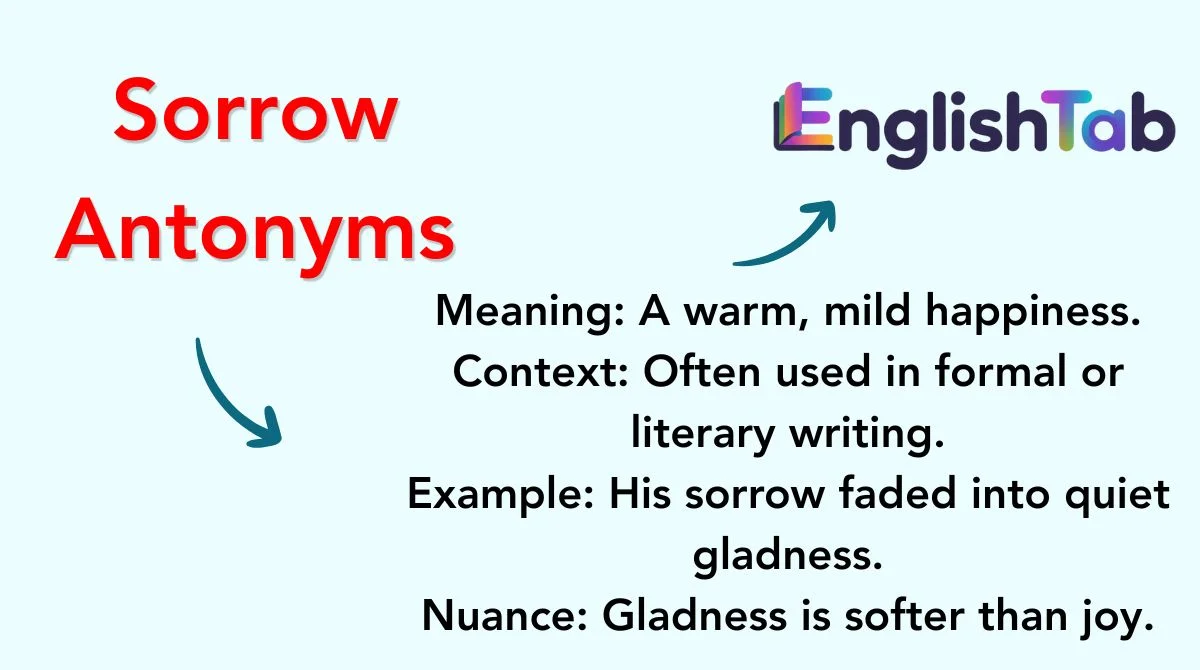
Gladness
Meaning: A warm, mild happiness.
Context: Often used in formal or literary writing.
Example: His sorrow faded into quiet gladness.
Nuance: Gladness is softer than joy.
Cheerfulness
Meaning: Bright, positive mood.
Context: Describes personality or atmosphere.
Example: Cheerfulness filled the room where sorrow once lingered.
Nuance: Cheerfulness reflects outward positivity.
Bliss
Meaning: Perfect happiness or spiritual joy.
Context: Often intense or idealized.
Example: After sorrow, she experienced pure bliss.
Nuance: Bliss suggests near-perfection, unlike ordinary happiness.
Elation
Meaning: Excited happiness.
Context: Success or achievement.
Example: His sorrow shifted to elation after winning.
Nuance: Elation includes excitement.
Contentment
Meaning: Peaceful satisfaction.
Context: Stable emotional balance.
Example: Contentment replaced years of sorrow.
Nuance: Contentment is calm and steady.
Pleasure
Meaning: Enjoyment or satisfaction.
Context: Sensory or emotional.
Example: She found pleasure after a season of sorrow.
Nuance: Pleasure can be physical or emotional.
Euphoria
Meaning: Intense excitement and happiness.
Context: High-energy emotion.
Example: The team moved from sorrow to euphoria.
Nuance: Much stronger and more dramatic.
Jubilation
Meaning: Triumphant joy.
Context: Celebration.
Example: Jubilation followed sorrow at the ceremony.
Nuance: Collective and loud.
Merriment
Meaning: Lively enjoyment.
Context: Social gatherings.
Example: Merriment filled the hall once marked by sorrow.
Nuance: Social and festive.
Glee
Meaning: Sharp, quick joy.
Context: Sudden positive reaction.
Example: Her sorrow turned to glee.
Nuance: Brief and expressive.
Optimism
Meaning: Hopeful confidence about the future.
Context: Mental outlook.
Example: Optimism overcame sorrow.
Nuance: Cognitive rather than purely emotional.
Satisfaction
Meaning: Fulfillment or achievement.
Context: Goal-oriented success.
Example: Satisfaction replaced sorrow after completion.
Nuance: Linked to accomplishment.
Serenity
Meaning: Calm peacefulness.
Context: Emotional balance.
Example: Serenity followed long sorrow.
Nuance: Quiet, reflective calm.
Exultation
Meaning: Intense triumphant joy.
Context: Victory.
Example: Exultation replaced sorrow in the crowd.
Nuance: Powerful and energetic.
Hope
Meaning: Expectation of positive outcome.
Context: Future-focused.
Example: Hope slowly replaced sorrow.
Nuance: Hope may coexist with sorrow but counters it.
Antonym Comparison Table
| Word | Intensity | Duration | Emotional Tone | Best Use Context |
|---|---|---|---|---|
| Joy | High | Medium | Expressive | Personal celebration |
| Happiness | Medium | Long | Stable | Life satisfaction |
| Contentment | Low | Long | Calm | Peaceful lifestyle |
| Euphoria | Very High | Short | Explosive | Sudden victory |
| Serenity | Low | Long | Quiet | Emotional recovery |
| Optimism | Medium | Long | Forward-looking | Future planning |
| Bliss | Very High | Variable | Idealized | Spiritual or romantic writing |
| Relief | Medium | Short | Transitional | After stress |
| Jubilation | High | Short | Collective | Public events |
Academic Writing Examples
- The novel traces the protagonist’s movement from profound sorrow to measured contentment.
- Economic recovery transformed public sorrow into cautious optimism.
- The speech replaced communal sorrow with collective jubilation.
- Rather than descending into sorrow, the philosopher embraced serenity.
These examples demonstrate how selecting the appropriate antonym shapes tone and academic precision.
When Not to Replace the Word
Replacing sorrow with an antonym is not always appropriate.
Do not replace when:
- The emotional state is mixed (bittersweet situations).
- The context requires seriousness or gravity.
- The narrative depends on emotional depth.
- The intensity shift would distort meaning.
For example, replacing sorrow with happiness in a grief narrative may oversimplify emotional truth. Writers must respect emotional realism.
Practice Exercises
- Replace sorrow with the most appropriate antonym:
After months of uncertainty, relief filled the family. - Choose the strongest contrast:
The crowd moved from sorrow to ______ after the announcement.
(Options: serenity, jubilation, calmness) - Identify nuance difference:
Explain why euphoria may not suit a quiet emotional recovery. - Write a paragraph showing emotional transition using three antonyms of sorrow.
- Compare contentment and joy in two sentences.
These exercises build contrast awareness and vocabulary precision.
FAQs
What is the strongest antonym of sorrow?
Euphoria or jubilation are among the strongest emotional opposites due to their intensity and energy.
Is happiness always the best opposite of sorrow?
No. Happiness is broad. Sometimes serenity, relief, or optimism fits better depending on context.
Can hope be an antonym of sorrow?
Yes, particularly when sorrow relates to despair about the future.
What is the difference between joy and bliss?
Joy is strong happiness. Bliss suggests ideal, almost perfect emotional fulfillment.
Are all positive emotions antonyms of sorrow?
Not necessarily. Some positive emotions, such as excitement, may not directly contrast emotional grief.
Conclusion
Mastering sorrow antonyms improves emotional clarity, academic precision, and stylistic depth. Direct opposites such as joy, happiness, and elation provide strong contrast.
Contextual opposites like relief and optimism add subtlety. Tone-based distinctions ensure that emotional intensity aligns with meaning.
Effective writing depends not only on vocabulary expansion but on nuanced selection.
By understanding emotional intensity, duration, context, and psychological dimension, writers can move beyond basic opposites toward intentional contrast.
Language becomes powerful when contrast is precise.

Dorian Hale is an English language enthusiast and content creator dedicated to making vocabulary and grammar learning simple, engaging, and accessible for everyone.