Opposites are not just vocabulary tools; they are clarity engines. In academic, creative, and professional writing, contrast sharpens meaning.
When a writer chooses the right antonym, ideas become more vivid, arguments gain precision, and tone becomes controlled rather than accidental.
The word “soft” appears simple, yet its range of meanings is surprisingly broad. It can describe texture, sound, personality, lighting, criticism, strength, colors, policies, and even economic conditions.
Because it operates across physical, emotional, and abstract domains, its antonyms are equally diverse.
This article provides a deep contrast-analysis of 17+ soft antonyms, examining their meanings, contextual usage, emotional tone, and academic relevance.
Rather than offering a shallow list, we will explore nuance, intensity, and situational precision—helping you select the most accurate opposite for your writing.
Definition and Core Meaning of “Soft”
Before identifying antonyms, we must understand what “soft” truly means.
At its core, soft refers to:
- Easily yielding to pressure (physical sense)
- Gentle in manner or behavior (personality sense)
- Low in intensity (sound or light)
- Mild in criticism or approach
- Weak in strength or firmness
- Subtle or muted in tone or color
Thus, “soft” represents yielding, mildness, gentleness, and reduced intensity.
Because of this semantic flexibility, the antonym of “soft” changes depending on whether we are discussing fabric, leadership, sound, policies, or economic data.
Direct Opposites (Clear Contrasts)
These are the strongest, most immediate antonyms of “soft” in physical and abstract senses:
- Hard
- Firm
- Rigid
- Solid
- Tough
- Stiff
- Harsh
- Loud
- Strong
- Severe
- Strict
- Intense
- Sharp
- Rough
- Coarse
- Brutal
- Aggressive
- Unyielding
- Stern
These words directly oppose softness in texture, tone, or temperament.
Contextual Opposites
Some words oppose “soft” only in certain situations:
- Bright (opposite of soft lighting)
- Bold (opposite of soft colors or speech)
- Cold (opposite of soft emotional warmth)
- Heavy (opposite of soft touch)
- Hardened (opposite of soft attitude)
- Vigorous (opposite of soft effort)
- Forceful (opposite of soft persuasion)
These antonyms depend entirely on context. A “soft policy” may be contrasted with a “strict” or “hardline” policy, while a “soft pillow” contrasts with a “firm” one.
Emotional & Tone-Based Opposites
When “soft” describes emotional tone, personality, or communication style, its opposites vary in intensity:
- Gentle vs. Harsh
- Compassionate vs. Stern
- Mild vs. Severe
- Calm vs. Aggressive
- Polite vs. Brutal
Emotional opposites often imply attitude rather than texture. For instance, “soft criticism” suggests diplomacy, while “harsh criticism” suggests severity.
Understanding emotional tone is essential in academic and persuasive writing.
17+ Antonyms Explained in Detail
Hard
Meaning: Not easily bent, cut, or compressed.
Context: Physical materials or strict approaches.
Example: The mattress was too hard to sleep on comfortably.
Nuance Difference: “Hard” is the most common and general opposite of soft. It implies resistance.
Firm
Meaning: Solid and stable but not necessarily rigid.
Context: Furniture, handshakes, policies.
Example: She prefers a firm pillow instead of a soft one.
Nuance Difference: Less extreme than hard; implies controlled strength.
Rigid
Meaning: Unable to bend or adapt.
Context: Rules, systems, structures.
Example: The school follows rigid guidelines.
Nuance Difference: Adds inflexibility beyond physical hardness.
Tough
Meaning: Strong and durable; difficult to break.
Context: Materials, personalities, challenges.
Example: The leather jacket is tough and long-lasting.
Nuance Difference: Suggests resilience, not just hardness.
Stiff
Meaning: Not flexible; difficult to bend.
Context: Muscles, fabrics, formal behavior.
Example: The new shoes felt stiff at first.
Nuance Difference: Often temporary or physical discomfort.
Harsh
Meaning: Severe, rough, or unpleasant.
Context: Weather, criticism, tone.
Example: The teacher’s harsh words discouraged students.
Nuance Difference: Emotional and sensory intensity.
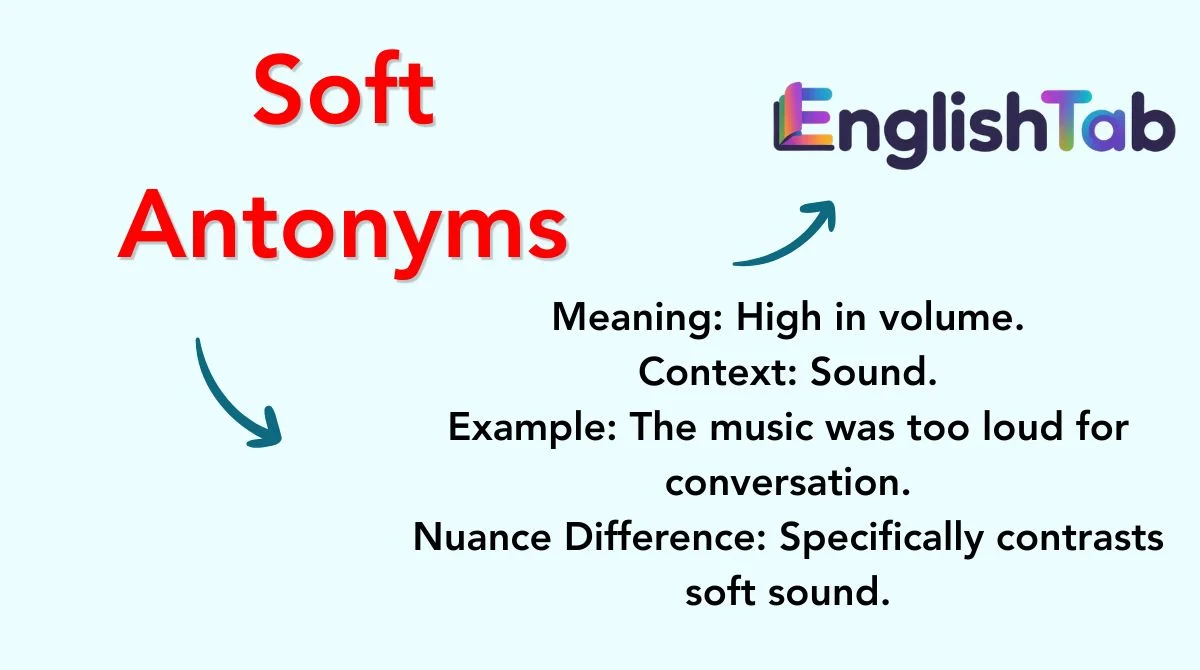
Loud
Meaning: High in volume.
Context: Sound.
Example: The music was too loud for conversation.
Nuance Difference: Specifically contrasts soft sound.
Strong
Meaning: Powerful or intense.
Context: Physical strength, flavor, argument.
Example: The coffee was too strong for her taste.
Nuance Difference: Opposes softness in power or concentration.
Severe
Meaning: Very serious or strict.
Context: Punishment, weather, criticism.
Example: The judge imposed a severe penalty.
Nuance Difference: Higher intensity than harsh in formal contexts.
Strict
Meaning: Demanding exact obedience.
Context: Rules, parenting, education.
Example: The coach maintains strict discipline.
Nuance Difference: Emphasizes rule enforcement.
Intense
Meaning: Extremely strong or concentrated.
Context: Emotion, light, effort.
Example: The intense sunlight replaced the soft glow.
Nuance Difference: Focuses on degree of strength.
Sharp
Meaning: Clearly defined or piercing.
Context: Sound, objects, contrast.
Example: A sharp tone replaced her soft voice.
Nuance Difference: Suggests precision or suddenness.
Rough
Meaning: Uneven or coarse in texture.
Context: Surfaces, behavior.
Example: The rock felt rough instead of soft.
Nuance Difference: Physical texture contrast.
Coarse
Meaning: Crude in texture or language.
Context: Fabric, speech.
Example: His coarse language shocked the audience.
Nuance Difference: Implies lack of refinement.
Brutal
Meaning: Extremely harsh or violent.
Context: Criticism, force, conditions.
Example: The review was brutally honest.
Nuance Difference: Strong emotional intensity.
Aggressive
Meaning: Forceful and assertive.
Context: Behavior, marketing, negotiation.
Example: The company adopted an aggressive strategy.
Nuance Difference: Active opposition to gentleness.
Unyielding
Meaning: Not bending or giving way.
Context: Physical objects or attitudes.
Example: The metal frame was unyielding.
Nuance Difference: Suggests persistent resistance.
Stern
Meaning: Serious and strict in expression.
Context: Leadership, parenting.
Example: Her stern voice replaced the soft reassurance.
Nuance Difference: Controlled severity.
Antonym Comparison Table
| Antonym | Physical Texture | Emotional Tone | Intensity Level | Flexibility |
|---|---|---|---|---|
| Hard | Yes | Rare | Medium | Low |
| Firm | Yes | Limited | Moderate | Medium |
| Rigid | Yes | Yes | High | Very Low |
| Harsh | No | Yes | High | Low |
| Severe | No | Yes | Very High | Low |
| Strict | No | Yes | Medium | Low |
| Loud | Sound | No | High | Not Applicable |
| Strong | Sometimes | Yes | Medium–High | Medium |
| Aggressive | No | Yes | High | Low |
| Stern | No | Yes | Medium | Low |
Academic Writing Examples
- The researcher avoided a harsh critique and instead offered balanced analysis.
- Economic conditions shifted from a soft market to a more aggressive expansion.
- The government replaced a soft policy with a strict regulatory framework.
- The material was tested for durability, proving tougher and less flexible than the original soft compound.
- A severe response may undermine diplomatic relationships.
In academic writing, word choice reflects analytical precision. Choosing between “harsh” and “severe,” for example, affects tone and perceived neutrality.
When Not to Replace the Word
Not every instance of “soft” should be replaced with an antonym.
Avoid replacement when:
- The softness is metaphorical and symbolic.
- Emotional warmth is intentional.
- The tone requires diplomatic understatement.
- Technical terminology requires exact phrasing (e.g., “soft skills”).
In many cases, “soft” carries subtle connotations of empathy, flexibility, and balance that harsher opposites may distort.
Practice Exercises
- Replace “soft” with the most accurate antonym:
- The manager took a soft approach to discipline.
- The pillow was too soft.
- The music played softly in the background.
- The country adopted a soft foreign policy.
- Identify whether the antonym should describe:
- Texture
- Sound
- Emotional tone
- Authority level
- Write two sentences contrasting “soft leadership” and “strict leadership.”
FAQs
What is the strongest antonym of soft?
“Hard” is the most direct and universal opposite, especially in physical contexts.
Is harsh always the opposite of soft?
Not always. “Harsh” works best when describing tone, criticism, or environmental conditions.
Can firm and hard be used interchangeably?
They overlap, but “firm” suggests balanced strength, while “hard” suggests greater resistance.
What is the opposite of soft in personality?
Depending on context: stern, aggressive, strict, or harsh.
What is the opposite of soft lighting?
Bright, intense, or harsh lighting.
Conclusion
The word “soft” operates across physical, emotional, and abstract dimensions. Because of this flexibility, its antonyms are equally diverse and context-dependent.
From hard and firm to harsh, severe, and aggressive, each opposite carries its own level of intensity, tone, and implication.
Effective writers do not simply replace words—they evaluate nuance, domain, and audience expectations.
Mastering these 17+ soft antonyms enables sharper academic writing, clearer communication, and stronger stylistic control.

Dorian Hale is an English language enthusiast and content creator dedicated to making vocabulary and grammar learning simple, engaging, and accessible for everyone.