People often search for “see you soon synonyms” because they want better ways to end a conversation. The phrase “see you soon” is common, simple, and friendly. But using it again and again can sound dull or repetitive.
In writing and speech, word variety matters. It keeps your message fresh. It also helps you match the right tone.
For example, the way you say goodbye to a friend is not the same as how you close a business email. Students preparing for academic exams also need more formal alternatives.
Whether you’re writing emails, texting friends, preparing for IELTS, or speaking in a professional setting, choosing the right closing phrase makes a strong impression.
In this guide, you’ll discover over 19 natural, powerful, and polite alternatives to “see you soon,” organized by tone and context.
Let’s explore the best options for 2026.
What Does “See You Soon” Mean?
“See you soon” is a friendly closing phrase. It means you expect to meet the person again in the near future.
It expresses:
- Hope
- Warmth
- Continuity
- A positive goodbye
Tone Explanation
The tone is casual and friendly. It feels warm but not too emotional. It is commonly used in everyday conversations.
When It Is Commonly Used
- Ending a phone call
- Leaving a workplace
- Saying goodbye to friends
- Casual emails
- Informal messages
It is rarely used in academic or very formal writing.
19+ Best Synonyms for “See You Soon”
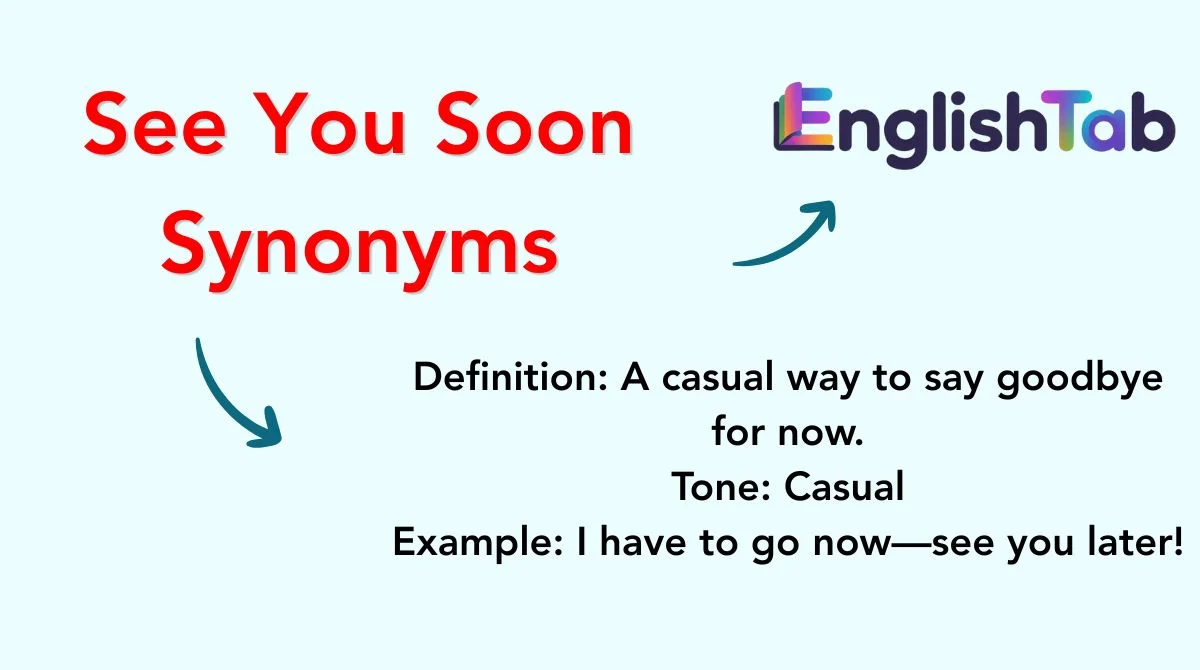
1. See You Later
Definition: A casual way to say goodbye for now.
Tone: Casual
Example: I have to go now—see you later!
2. Talk to You Soon
Definition: Indicates you will speak again shortly.
Tone: Casual / Professional
Example: I’ll review the document and talk to you soon.
3. Catch You Later
Definition: An informal way to say goodbye.
Tone: Informal
Example: I’m heading out—catch you later!
4. Until Next Time
Definition: A polite way to end a conversation when you expect another meeting.
Tone: Neutral
Example: It was great discussing this with you. Until next time.
5. See You Around
Definition: Suggests you will likely meet again, but not at a fixed time.
Tone: Casual
Example: I’ll see you around the office.
6. Be Seeing You
Definition: A slightly old-fashioned but friendly goodbye.
Tone: Informal
Example: Take care. I’ll be seeing you.
7. Until We Meet Again
Definition: A warm way to say goodbye with future hope.
Tone: Literary / Formal
Example: Farewell, until we meet again.
8. See You Then
Definition: Used when a specific meeting time is planned.
Tone: Neutral
Example: The meeting is at 10 a.m. See you then.
9. I’ll See You Shortly
Definition: Indicates a meeting very soon.
Tone: Professional
Example: I’m finishing up here. I’ll see you shortly.
10. Looking Forward to Seeing You
Definition: Expresses positive anticipation.
Tone: Professional
Example: I’m looking forward to seeing you next week.
11. Speak Soon
Definition: Suggests a future conversation.
Tone: Professional / Casual
Example: Let me know your thoughts. Speak soon.
12. Catch Up Soon
Definition: Implies reconnecting after some time.
Tone: Casual
Example: We haven’t talked in ages. Let’s catch up soon.
13. See You in a Bit
Definition: Means you’ll meet very soon.
Tone: Informal
Example: I’m grabbing coffee. See you in a bit.
14. I’ll Be in Touch
Definition: Promises future communication.
Tone: Professional
Example: I’ll be in touch with the final decision.
15. See You Next Time
Definition: Used when future meetings are expected.
Tone: Neutral
Example: Thanks for attending. See you next time.
16. Until Tomorrow
Definition: A goodbye for the next day.
Tone: Neutral
Example: Great work today. Until tomorrow.
17. See You Again
Definition: Simple phrase meaning future meeting.
Tone: Neutral
Example: It was a pleasure. I hope to see you again.
18. Until Later
Definition: Suggests reconnecting later in the day.
Tone: Casual
Example: I have errands to run. Until later.
19. Looking Forward to Our Next Meeting
Definition: A formal way to show anticipation.
Tone: Formal
Example: I’m looking forward to our next meeting.
Stronger Alternatives (More Intense Options)
These options express stronger emotion or anticipation.
- Can’t Wait to See You – Shows excitement.
- Eager to See You Again – Suitable for warm professional messages.
- Counting Down the Days – Very emotional and personal.
- Excited to Catch Up – Friendly and energetic.
- Anticipating Our Next Meeting – Strong but formal.
- Looking Ahead to Our Reunion – Emotional and expressive.
Use these when you want to show enthusiasm, not just routine goodbye.
Softer or Polite Alternatives
These are gentle and respectful.
- Take Care Until Then
- Wishing You Well Until We Meet Again
- Have a Great Week
- Stay Safe
- Best Until Next Time
- All the Best for Now
These work well in professional emails or polite conversations.
Academic & IELTS-Friendly Alternatives
For essays, presentations, and formal speaking:
- I Look Forward to Our Continued Discussion
- I Anticipate Our Future Collaboration
- Until Our Subsequent Meeting
- I Await Our Next Engagement
- I Appreciate Your Time and Look Forward to Reconnecting
- I Hope to Continue This Dialogue Soon
- I Trust We Shall Meet Again
- I Remain Available for Further Discussion
- I Look Forward to Further Interaction
- We Shall Reconvene Soon
These phrases sound polished and suitable for academic or business contexts.
Synonyms You Should Avoid (Context Warning)
Some phrases may confuse or mislead.
- Goodbye Forever – Sounds permanent.
- Farewell – Too dramatic for casual use.
- Later – Too short for formal settings.
- Peace Out – Very informal slang.
- Bye-Bye – Childish tone.
Always match the phrase with your setting.
How to Choose the Right Synonym in Writing
Choosing the best alternative depends on four key factors:
Context
Are you texting a friend or writing a formal email?
Tone
Do you want warm, neutral, or professional?
Audience
Is the reader a colleague, professor, or close friend?
Clarity
Avoid phrases that sound dramatic or unclear.
The best choice feels natural and fits the situation.
Example Paragraph Rewritten Using Synonyms
Original:
It was great meeting you today. See you soon.
Rewrite 1 (Professional):
It was great meeting you today. I look forward to our next meeting.
Rewrite 2 (Casual):
It was great meeting you today. Catch you later!
Rewrite 3 (Academic):
It was a pleasure discussing this topic with you. I anticipate our continued discussion.
Rewrite 4 (Friendly):
It was wonderful seeing you. Can’t wait to see you again!
FAQs
What is another way to say “see you soon”?
You can say “talk to you soon,” “until next time,” or “looking forward to seeing you.”
Is “see you soon” formal?
No. It is casual and friendly. It is not ideal for academic writing.
What is a professional alternative to “see you soon”?
Use “I look forward to our next meeting” or “I will be in touch.”
Can I use “see you soon” in emails?
Yes, in informal or semi-formal emails. Avoid it in very formal messages.
What is a more emotional way to say it?
Try “can’t wait to see you” or “counting down the days.”
What should I say instead of “see you soon” in IELTS speaking?
Use phrases like “I look forward to meeting again” or “I anticipate our next discussion.”
Is “until next time” better than “see you soon”?
It depends on context. “Until next time” sounds slightly more polished.
Conclusion
Using different ways to say “see you soon” makes your communication stronger and more natural. The right phrase depends on tone, setting, and audience.
Casual conversations allow relaxed expressions like “catch you later,” while professional and academic situations require polished options like “I look forward to our next meeting.”
Expanding your vocabulary helps you sound confident, clear, and thoughtful. Instead of repeating the same goodbye, choose an alternative that fits the moment.
Strong writing always comes down to smart word choice.

Dorian Hale is an English language enthusiast and content creator dedicated to making vocabulary and grammar learning simple, engaging, and accessible for everyone.