Precision in language is the foundation of persuasive and academic writing. One of the most effective tools for sharpening clarity is the strategic use of opposites.
Antonyms do more than simply reverse meaning—they frame contrast, deepen argumentation, and refine tone.
When writers understand how a word stands against its conceptual rivals, they gain control over nuance and rhetorical strength.
The word sabotage carries heavy implications: secrecy, intentional harm, and deliberate obstruction. Its opposites, therefore, are not merely “positive” words.
They represent support, protection, facilitation, advancement, and constructive intent.
This article presents 16+ sabotage antonyms, categorized and analyzed in depth. Each antonym is explored academically yet clearly, with contextual distinctions, usage examples, and nuanced comparisons.
Whether you are writing scholarly prose, business analysis, or creative content, mastering these opposites will elevate your expressive precision.
Definition and Core Meaning of “Sabotage”
Sabotage refers to the deliberate destruction, disruption, or obstruction of something, typically for personal, political, or strategic reasons. It involves:
- Intentional interference
- Hidden or indirect harm
- Undermining progress
- Damaging functionality or success
The term originated in industrial contexts but now applies broadly to relationships, projects, careers, policies, and even self-behavior (e.g., self-sabotage).
Key components of sabotage:
- Conscious intent
- Negative outcome
- Disruptive action
- Often covert execution
Understanding these core traits helps identify its strongest antonyms: words associated with advancement, support, protection, and constructive engagement.
Direct Opposites (Clear Contrasts)
Below are 16 of the strongest direct antonyms of sabotage:
- Support
- Assist
- Help
- Facilitate
- Promote
- Advance
- Strengthen
- Protect
- Defend
- Encourage
- Enable
- Improve
- Build
- Reinforce
- Preserve
- Cooperate
Each directly contrasts with sabotage by emphasizing positive contribution instead of destructive interference.
Contextual Opposites
Some words oppose sabotage only within certain contexts:
- Collaborate (in team dynamics)
- Empower (in leadership or education)
- Develop (in business or infrastructure)
- Maintain (in operations)
- Restore (after prior damage)
- Invest (in financial or strategic contexts)
For example, in business:
- Sabotage disrupts progress.
- Invest strengthens future potential.
In relationships:
- Sabotage undermines trust.
- Empower builds confidence.
Context determines which antonym is most accurate.
Emotional & Tone-Based Opposites
Sabotage carries a tone of hostility, betrayal, and destruction. Emotional opposites often include:
- Nurture
- Uplift
- Inspire
- Care
- Champion
These words not only reverse action but shift emotional intensity. Sabotage implies malice; nurture implies warmth. Sabotage suggests concealment; champion suggests visible advocacy.
Tone selection shapes reader perception. Academic writing may prefer “facilitate” or “strengthen,” while motivational writing may favor “empower” or “uplift.”
16+ Antonyms Explained in Detail
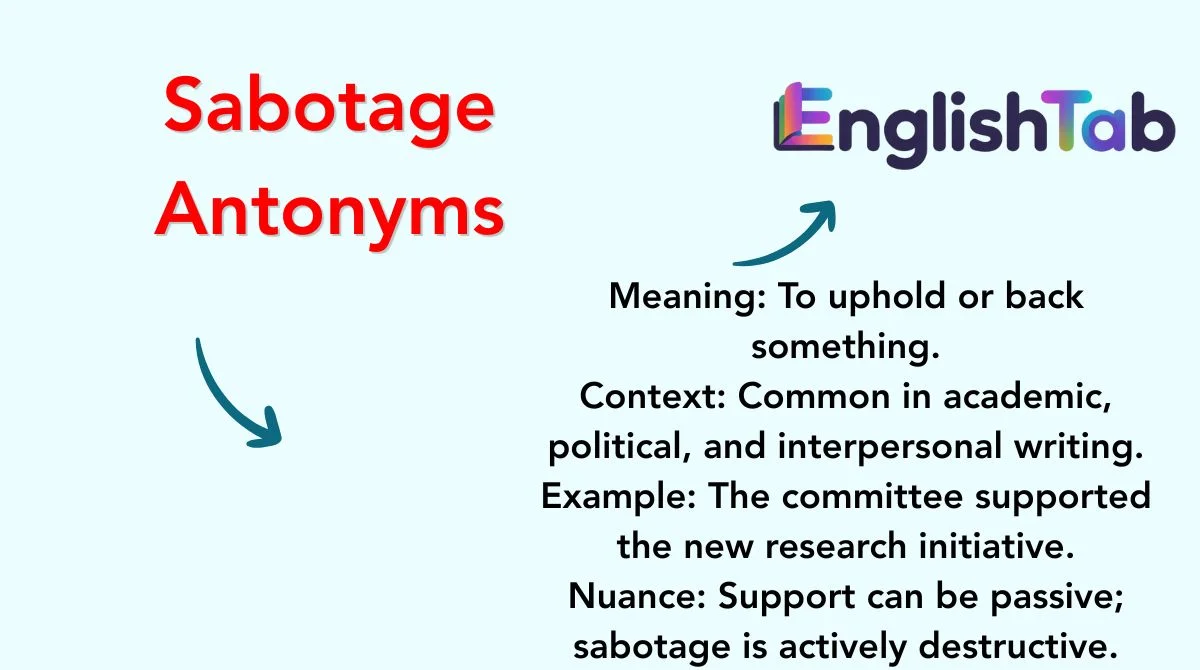
Support
Meaning: To uphold or back something.
Context: Common in academic, political, and interpersonal writing.
Example: The committee supported the new research initiative.
Nuance: Support can be passive; sabotage is actively destructive.
Assist
Meaning: To help or aid in completion.
Context: Professional and operational settings.
Example: The technician assisted in resolving the issue.
Nuance: Assist implies cooperative effort, not leadership.
Help
Meaning: To make something easier or possible.
Context: Everyday and academic language.
Example: Funding helped the project succeed.
Nuance: Broader and less formal than facilitate.
Facilitate
Meaning: To make a process easier or smoother.
Context: Academic, corporate, and administrative writing.
Example: The software facilitated communication between departments.
Nuance: Focuses on removing obstacles rather than direct action.
Promote
Meaning: To actively encourage growth or visibility.
Context: Marketing, leadership, policy.
Example: The organization promotes ethical practices.
Nuance: Implies advocacy and forward motion.
Advance
Meaning: To move something forward in progress or status.
Context: Research, technology, education.
Example: The findings advanced scientific understanding.
Nuance: Suggests measurable forward movement.
Strengthen
Meaning: To increase power, durability, or effectiveness.
Context: Policies, relationships, arguments.
Example: Clear communication strengthens trust.
Nuance: Focuses on resilience rather than expansion.
Protect
Meaning: To shield from harm.
Context: Security, law, environment.
Example: Regulations protect consumer rights.
Nuance: Defensive rather than growth-oriented.
Defend
Meaning: To resist attack or criticism.
Context: Legal and rhetorical contexts.
Example: She defended her thesis successfully.
Nuance: Reactive rather than proactive.
Encourage
Meaning: To inspire confidence or action.
Context: Education and leadership.
Example: Teachers encourage independent thinking.
Nuance: Emotional uplift rather than structural support.
Enable
Meaning: To provide the means or ability.
Context: Technology and accessibility.
Example: New policies enable innovation.
Nuance: Removes barriers to capacity.
Improve
Meaning: To enhance quality or performance.
Context: Universal usage.
Example: Feedback improves performance.
Nuance: Indicates refinement rather than foundational change.
Build
Meaning: To construct or create.
Context: Literal and metaphorical.
Example: The team built a strong reputation.
Nuance: Opposes destruction directly.
Reinforce
Meaning: To strengthen by addition or repetition.
Context: Education, construction, argumentation.
Example: Evidence reinforces the claim.
Nuance: Often supplementary.
Preserve
Meaning: To maintain in original condition.
Context: Cultural and environmental writing.
Example: Laws preserve historical landmarks.
Nuance: Focused on continuity.
Cooperate
Meaning: To work jointly toward a goal.
Context: Team environments.
Example: Departments cooperated on the merger.
Nuance: Emphasizes shared effort.
Empower
Meaning: To give authority or confidence.
Context: Leadership and social discourse.
Example: Training programs empower employees.
Nuance: Emotional and structural elevation.
Develop
Meaning: To grow or expand progressively.
Context: Business, urban planning.
Example: The city developed new infrastructure.
Nuance: Implies long-term evolution.
Antonym Comparison Table
| Antonym | Focus Type | Action Level | Emotional Tone | Common Context |
|---|---|---|---|---|
| Support | Stability | Moderate | Neutral | Academic, social |
| Facilitate | Process | Subtle | Neutral | Corporate, academic |
| Promote | Growth | Active | Positive | Marketing, policy |
| Advance | Progress | Strong | Neutral | Research |
| Protect | Defense | Reactive | Serious | Legal, safety |
| Encourage | Motivation | Light | Warm | Education |
| Enable | Capacity | Structural | Neutral | Tech, policy |
| Build | Creation | Strong | Positive | Business |
| Reinforce | Strength | Moderate | Neutral | Argument |
| Empower | Authority | Transformative | Inspirational | Leadership |
Academic Writing Examples
- Instead of sabotaging institutional reform, policymakers should facilitate structural change.
- The organization promoted ethical compliance rather than undermining accountability.
- Effective leadership strengthens collaboration rather than obstructing progress.
- Investment in research advances innovation instead of hindering development.
- Constructive feedback improves performance rather than damaging morale.
These contrasts clarify argumentative positioning.
When Not to Replace the Word
Not all opposites are interchangeable. Avoid replacing sabotage when:
- The original sentence requires emphasis on intentional harm.
- Legal implications are central.
- Covert destruction is specifically referenced.
- Emotional betrayal is a key theme.
For example:
“Internal sabotage led to the system’s collapse.”
Replacing sabotage with “weakness” removes the element of intent.
Precision matters more than positivity.
Practice Exercises
- Replace sabotage with an appropriate antonym:
- The manager chose to ______ team morale instead of undermining it.
- Choose the best antonym:
- The new software will (a) sabotage (b) enable (c) obstruct productivity.
- Write a sentence contrasting sabotage with two antonyms.
- Identify nuance differences between promote and advance.
- Rewrite:
- The policy sabotaged small businesses.
FAQs
What is the strongest opposite of sabotage?
The strongest structural opposite is build, as it directly contrasts destruction with construction.
Is support always an antonym of sabotage?
In many contexts, yes. However, support may lack the intensity required if sabotage implies aggressive interference.
Can protect replace sabotage in all cases?
No. Protect emphasizes defense, not proactive growth.
Which antonym is best for academic writing?
Facilitate, strengthen, and advance are preferred in formal contexts.
What is the emotional opposite of sabotage?
Empower or nurture best contrast its hostile undertone.
Conclusion
Understanding 16+ sabotage antonyms enhances linguistic precision and rhetorical control.
Sabotage embodies deliberate harm and obstruction; its opposites express construction, cooperation, empowerment, and protection.
Writers who master these contrasts gain flexibility in tone, clarity in argument, and authority in academic communication.
Rather than merely replacing a negative word with a positive one, the skilled writer selects the antonym that reflects intention, context, emotional weight, and structural impact.
Opposites illuminate meaning. When used strategically, they do more than contrast—they clarify thought itself.

Dorian Hale is an English language enthusiast and content creator dedicated to making vocabulary and grammar learning simple, engaging, and accessible for everyone.