Strong writing depends on precision. When a writer chooses the right word, meaning becomes clear and persuasive.
One of the most powerful tools for clarity is contrast. Opposites sharpen ideas. They show attitude. They reveal emotional tone. They highlight shifts in behavior.
The adverb reluctantly often signals hesitation, resistance, or unwilling participation. However, replacing it with a stronger opposite can completely change the emotional direction of a sentence.
In academic, narrative, and persuasive writing, using the correct antonym improves clarity and strengthens argument flow.
This comprehensive guide explores 21+ reluctantly antonyms, analyzing their meanings, emotional tones, and contextual differences.
The goal is not simply to list opposites, but to examine how each one functions in real writing situations.
Definition and Core Meaning of “Reluctantly”
The word reluctantly means:
- In an unwilling manner
- With hesitation
- With resistance or doubt
- Without enthusiasm
It describes action performed despite internal opposition.
Example:
- She reluctantly agreed to the proposal.
Here, the action (agreeing) happens, but emotional resistance remains. The tone is hesitant, not eager.
Understanding this emotional layer is essential before exploring antonyms.
Direct Opposites (Clear Contrasts)
These antonyms directly reverse the unwilling tone of reluctantly. They indicate willingness, eagerness, or enthusiasm.
Willingly
Eagerly
Gladly
Enthusiastically
Readily
Wholeheartedly
Cheerfully
Happily
Excitedly
Promptly
Freely
Voluntarily
Zealously
Passionately
Joyfully
Warmly
Delightedly
Energetically
Confidently
Openly
Unhesitatingly
Each of these words removes resistance and replaces it with positive engagement.
Contextual Opposites
Some words function as opposites only in specific situations.
For example:
Openly – Opposes reluctance in emotional or communicative contexts
Boldly – Opposes hesitation in decision-making
Actively – Opposes passive resistance
Promptly – Opposes delay caused by unwillingness
Decisively – Opposes uncertain compliance
These are not emotional opposites in every context. However, they contrast with reluctance when action speed or confidence is the focus.
Example:
- He reluctantly signed the contract.
- He decisively signed the contract.
The difference lies not only in willingness, but also in firmness of commitment.
Emotional & Tone-Based Opposites
Reluctance carries emotional weight. Therefore, choosing the right opposite depends on intensity.
Low-intensity contrast:
- Willingly
- Readily
Moderate intensity:
- Gladly
- Cheerfully
- Happily
High intensity:
- Enthusiastically
- Passionately
- Zealously
- Excitedly
The emotional temperature rises from simple agreement to active emotional investment.
For example:
She reluctantly joined the team.
She enthusiastically joined the team.
The second sentence implies excitement and emotional alignment.
21+ Antonyms Explained in Detail
Willingly
Meaning: In a ready and agreeable manner
Context: General opposite of reluctance
Example: She willingly accepted the responsibility.
Nuance: Neutral tone. It removes resistance but does not imply excitement.
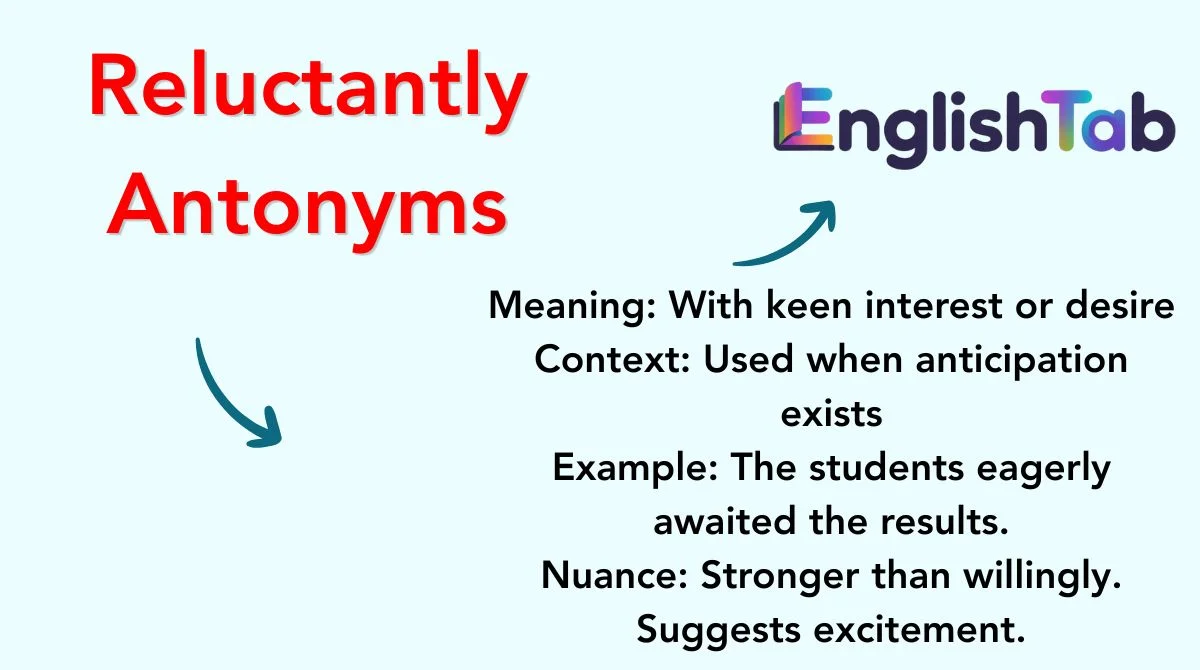
Eagerly
Meaning: With keen interest or desire
Context: Used when anticipation exists
Example: The students eagerly awaited the results.
Nuance: Stronger than willingly. Suggests excitement.
Gladly
Meaning: With pleasure
Context: Emotional acceptance
Example: He gladly offered his assistance.
Nuance: Warm emotional tone, less intense than enthusiastic.
Enthusiastically
Meaning: With energetic excitement
Context: High motivation situations
Example: The team enthusiastically supported the initiative.
Nuance: Strong emotional investment.
Readily
Meaning: Without hesitation
Context: Quick agreement
Example: She readily agreed to the proposal.
Nuance: Focuses on speed rather than emotion.
Wholeheartedly
Meaning: With full commitment
Context: Strong support
Example: The committee wholeheartedly approved the reform.
Nuance: Suggests sincerity and depth.
Cheerfully
Meaning: In a happy manner
Context: Social interactions
Example: He cheerfully completed the assignment.
Nuance: Light and positive.
Happily
Meaning: With joy
Context: Emotional willingness
Example: She happily volunteered.
Nuance: Similar to gladly but slightly more casual.
Excitedly
Meaning: With visible excitement
Context: Anticipation or joy
Example: The child excitedly opened the gift.
Nuance: Higher emotional intensity.
Promptly
Meaning: Without delay
Context: Timeliness matters
Example: He promptly responded to the email.
Nuance: Focus on action speed, not emotional warmth.
Freely
Meaning: Without restriction
Context: Consent situations
Example: She freely shared her opinion.
Nuance: Implies absence of pressure.
Voluntarily
Meaning: By choice
Context: Legal or formal settings
Example: The witness voluntarily provided testimony.
Nuance: Formal and objective.
Zealously
Meaning: With strong passion
Context: Advocacy
Example: The lawyer zealously defended her client.
Nuance: Intense commitment.
Passionately
Meaning: With deep emotion
Context: Emotional arguments
Example: She passionately argued for reform.
Nuance: Emotional intensity emphasized.
Joyfully
Meaning: With happiness
Context: Celebratory tone
Example: They joyfully welcomed the news.
Nuance: Positive emotional energy.
Warmly
Meaning: With friendliness
Context: Social acceptance
Example: The host warmly greeted the guests.
Nuance: Focuses on interpersonal tone.
Delightedly
Meaning: With delight
Context: Pleasant surprise
Example: She delightedly accepted the award.
Nuance: Suggests happiness from good news.
Energetically
Meaning: With vitality
Context: Physical or active tasks
Example: He energetically participated in the debate.
Nuance: Focus on physical energy.
Confidently
Meaning: With certainty
Context: Self-assured decisions
Example: She confidently presented her findings.
Nuance: Opposes doubt more than unwillingness.
Openly
Meaning: Without secrecy
Context: Communication
Example: He openly admitted his mistake.
Nuance: Opposes concealed reluctance.
Unhesitatingly
Meaning: Without pause
Context: Quick moral decisions
Example: She unhesitatingly defended her colleague.
Nuance: Strong emphasis on immediate action.
Boldly
Meaning: With courage
Context: Risk situations
Example: He boldly proposed a new strategy.
Nuance: Opposes fear-driven reluctance.
Antonym Comparison Table
| Word | Emotional Intensity | Focus | Best Context |
|---|---|---|---|
| Willingly | Low | Agreement | Neutral writing |
| Readily | Low | Speed | Formal decisions |
| Gladly | Moderate | Pleasure | Social tone |
| Enthusiastically | High | Excitement | Motivational writing |
| Wholeheartedly | High | Commitment | Academic support |
| Voluntarily | Neutral | Choice | Legal contexts |
| Promptly | Neutral | Timing | Professional writing |
| Passionately | High | Emotion | Persuasive essays |
| Confidently | Moderate | Certainty | Presentations |
Academic Writing Examples
Original:
The participants reluctantly completed the survey.
Revised:
The participants willingly completed the survey.
Stronger emphasis:
The participants enthusiastically completed the survey.
Legal context:
The participants voluntarily completed the survey.
Each alternative changes interpretation. Academic tone often favors willingly, voluntarily, or readily.
When Not to Replace the Word
Do not replace reluctantly when:
- Emotional hesitation is important to narrative tension.
- Character development depends on internal conflict.
- The argument relies on contrast between duty and desire.
Example:
He reluctantly testified against his friend.
Replacing with willingly destroys the emotional conflict.
Precision matters more than variety.
Practice Exercises
Rewrite the sentences using a suitable antonym:
- She reluctantly joined the discussion.
- The manager reluctantly approved the request.
- The child reluctantly apologized.
- The committee reluctantly adopted the policy.
- He reluctantly accepted the award.
Challenge: Choose different intensity levels for each revision.
FAQs
What is the strongest antonym of reluctantly?
Enthusiastically and zealously are among the strongest because they imply emotional excitement.
Is willingly always the best opposite?
No. It is neutral. If emotional tone matters, gladly or passionately may be more precise.
Can promptly replace reluctantly?
Only when delay due to hesitation is the focus.
Is voluntarily a true opposite?
In legal and formal contexts, yes. It removes coercion.
Why does tone matter in antonyms?
Because opposites do more than reverse meaning. They shift emotional temperature and interpretive framing.
Conclusion
Understanding 21+ reluctantly antonyms provides more than vocabulary expansion. It enhances clarity, strengthens contrast, and improves academic precision.
Reluctance signals hesitation and resistance. Its opposites range from mild agreement to passionate enthusiasm.
The correct choice depends on context, tone, and emotional intensity.
Mastering these distinctions transforms ordinary sentences into deliberate, controlled expressions of meaning.
In advanced writing, the difference between willingly and enthusiastically is not small. It shapes interpretation.
Effective writers do not simply replace words. They choose opposites strategically.

Dorian Hale is an English language enthusiast and content creator dedicated to making vocabulary and grammar learning simple, engaging, and accessible for everyone.