Many writers search for “not only this synonyms” because they feel stuck using the same phrase again and again. It sounds simple, but repetition can weaken your writing.
Whether you’re working on an essay, blog post, email, or report, word variety matters.
Using better alternatives makes your message clearer and more powerful. It also shows strong vocabulary skills. In academic writing, varied expressions improve grades.
In professional settings, they make communication sound polished. In casual writing, they keep your tone natural and smooth.
The phrase “not only this” is often used to add extra information. But there are many stronger, softer, and more formal ways to say it.
In this guide, you will learn over 17 high-quality alternatives, when to use them, and which ones to avoid. By the end, you will know exactly how to choose the right synonym for every situation.
What Does “Not Only This” Mean?
“Not only this” is used to add another point to what you just said. It signals that more information is coming.
It usually appears in sentences like:
- Not only this, but the results were surprising.
- The product is affordable. Not only this, it is durable.
Tone Explanation
The tone is neutral and conversational. It works in casual speech and simple writing. However, it can sound basic or repetitive in formal or academic texts.
When It Is Commonly Used
People use it when:
- Adding another benefit
- Emphasizing multiple points
- Strengthening an argument
- Speaking casually
But in formal writing, better transitions are often needed.
17+ Best Synonyms for “Not Only This”
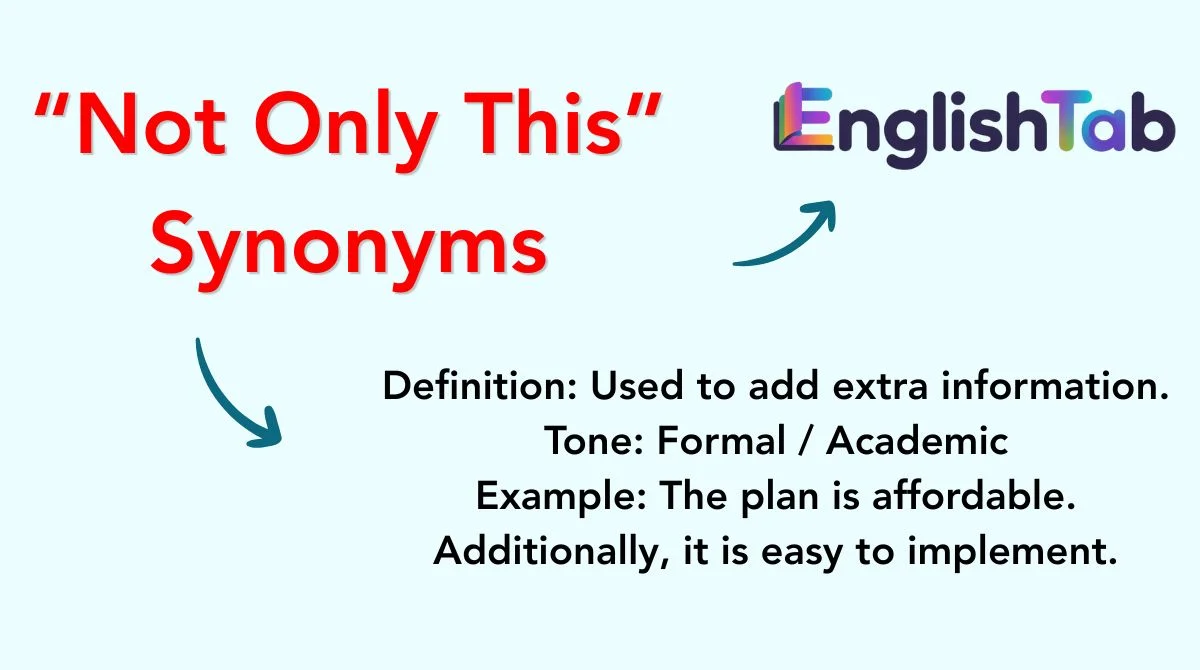
1. Additionally
Definition: Used to add extra information.
Tone: Formal / Academic
Example: The plan is affordable. Additionally, it is easy to implement.
2. Furthermore
Definition: Introduces another important point.
Tone: Formal / Academic
Example: The study was well-designed. Furthermore, the results were consistent.
3. Moreover
Definition: Adds information that strengthens a statement.
Tone: Formal / Academic
Example: The software is user-friendly. Moreover, it is secure.
4. In addition
Definition: Adds another fact or idea.
Tone: Neutral / Academic
Example: In addition, the company offers free support.
5. Also
Definition: Adds simple extra information.
Tone: Casual / Neutral
Example: She is talented. She is also hardworking.
6. Besides
Definition: Adds supporting or extra information.
Tone: Neutral / Informal
Example: It’s cheap. Besides, it lasts a long time.
7. As well
Definition: Means “too” or “in addition.”
Tone: Casual / Neutral
Example: He speaks Spanish and French as well.
8. Along with that
Definition: Adds connected information.
Tone: Conversational
Example: The phone is fast. Along with that, it has great battery life.
9. On top of that
Definition: Adds emphasis to an extra point.
Tone: Informal
Example: The service was slow. On top of that, it was expensive.
10. What’s more
Definition: Introduces surprising or stronger information.
Tone: Conversational
Example: The course is free. What’s more, you get a certificate.
11. Not to mention
Definition: Adds something obvious or important.
Tone: Informal / Conversational
Example: It’s a beautiful city, not to mention affordable.
12. Coupled with this
Definition: Shows two things working together.
Tone: Formal
Example: High demand, coupled with this shortage, raised prices.
13. Over and above that
Definition: Adds something extra beyond expectation.
Tone: Formal
Example: The package includes support. Over and above that, it offers training.
14. Together with that
Definition: Links two related ideas.
Tone: Neutral
Example: Together with that improvement, sales increased.
15. Beyond that
Definition: Moves the idea further.
Tone: Neutral
Example: The design is clean. Beyond that, it is easy to use.
16. As a bonus
Definition: Adds something positive and extra.
Tone: Casual / Marketing
Example: You get free shipping. As a bonus, returns are free.
17. To add to that
Definition: Introduces extra supporting information.
Tone: Conversational
Example: The team worked hard. To add to that, they met the deadline.
18. Equally important
Definition: Shows another point has the same value.
Tone: Formal / Academic
Example: Equally important, customer feedback improved.
Stronger Alternatives (More Intense Options)
Use these when you want strong emphasis:
- Indeed – Confirms and strengthens a point.
- Above all – Highlights the most important factor.
- More importantly – Signals higher importance.
- Chiefly – Focuses on the main reason.
- Primarily – Shows main importance.
- Significantly – Highlights impact.
- Notably – Points out something worth attention.
Use these in persuasive writing, research papers, or serious discussions.
Softer or Polite Alternatives
These sound gentle and natural:
- Plus – Casual and friendly.
- And also – Simple and clear.
- By the way – Adds a side note.
- As an added benefit – Positive tone.
- At the same time – Balanced addition.
- Likewise – Shows similarity.
- Similarly – Adds a related idea.
Use these in blogs, emails, and daily speech.
Academic & IELTS-Friendly Alternatives
If you’re writing essays or preparing for exams, try these:
- Moreover
- Furthermore
- Additionally
- In addition to this
- It is also worth noting that
- Another key point is
- Correspondingly
- Consequently (if cause-effect)
- Likewise
- Subsequently
- Notably
- Equally significant
These expressions improve coherence and raise band scores in academic writing.
Synonyms You Should Avoid (Context Warning)
Some alternatives seem correct but may confuse readers.
1. And
Too basic. It does not show emphasis.
2. Too
Sounds casual and may feel weak in formal writing.
3. As well as
Grammatically tricky in long sentences.
4. Including
Does not always show addition. It lists examples.
5. Even
Changes meaning and adds surprise, not simple addition.
Always check if the word truly adds information rather than changing meaning.
How to Choose the Right Synonym in Writing
Choosing the correct synonym depends on four key factors:
1. Context
Are you writing an essay, blog, report, or text message? Academic writing needs formal connectors like “furthermore.” A blog post can use “what’s more.”
2. Tone
If your tone is serious, avoid casual phrases like “on top of that.” For friendly writing, avoid stiff transitions.
3. Audience
Professors expect formal structure. Clients expect clarity. Friends expect simplicity.
4. Clarity
Never use a complex word if it makes your sentence confusing. Clear writing always wins.
Example Paragraph Rewritten Using Synonyms
Original:
The course is affordable. Not only this, it is easy to follow.
Rewrite 1 (Formal):
The course is affordable. Additionally, it is easy to follow.
Rewrite 2 (Conversational):
The course is affordable. What’s more, it is easy to follow.
Rewrite 3 (Academic):
The course is affordable. Furthermore, it provides a structured learning path.
Rewrite 4 (Marketing Tone):
The course is affordable. As a bonus, it is easy to follow.
Each version changes tone while keeping meaning.
FAQs
What is the best synonym for “not only this” in academic writing?
“Furthermore” and “Moreover” are the strongest academic choices.
Can I use “also” instead of “not only this”?
Yes, but it is less formal and less powerful.
Is “what’s more” formal?
No, it is conversational and better for blogs or speech.
What is a strong alternative for essays?
“Additionally,” “Moreover,” and “Equally important” work well.
Does “besides” sound professional?
It can, but it is slightly informal. Use carefully.
How can I avoid repeating transition words?
Create a list of alternatives and vary them naturally.
Is “not to mention” formal?
No, it is informal and better for casual contexts.
Conclusion
Using better synonyms for “not only this” improves clarity, flow, and professionalism in your writing. The right transition word can make your argument stronger, smoother, and more engaging.
Whether you are writing an academic essay, business report, blog post, or email, choosing the correct alternative matters.
Strong writers do not rely on one phrase repeatedly. They vary their language with purpose. Now you have over 17 powerful alternatives, plus stronger, softer, and academic-friendly options.
Use them wisely, match them to your tone, and your writing will instantly feel more polished in 2026 and beyond.

Dorian Hale is an English language enthusiast and content creator dedicated to making vocabulary and grammar learning simple, engaging, and accessible for everyone.