Clear writing depends on contrast. When we understand a word deeply, we also need to understand its opposite.
Opposites sharpen meaning, clarify tone, and prevent vague expression. In academic and professional writing, using the correct antonym can change the direction of an argument, shift emotional tone, and refine logical precision.
The word mutiny carries strong historical, political, and emotional weight. It implies rebellion against authority, organized defiance, and breakdown of command.
Because of this intensity, selecting the correct opposite is not simple. Some antonyms suggest loyalty. Others imply peace, cooperation, or discipline.
Still others focus on emotional obedience rather than structural hierarchy.
This article provides 19+ mutiny antonyms, organized by strength, context, tone, and academic relevance.
Each word is explained in detail with examples and nuance analysis to ensure precise usage in scholarly and professional writing.
Definition and Core Meaning of “Mutiny”
Mutiny refers to an organized rebellion against lawful authority, typically by soldiers or sailors against their commanding officers. Over time, its meaning expanded to include any coordinated refusal to obey leadership within a structured system.
Core elements of mutiny include:
- Collective resistance
- Rejection of authority
- Intent to overturn command
- Structured insubordination
Mutiny is stronger than disagreement. It is more organized than protest. It is more disruptive than dissent. It represents breakdown in hierarchy and deliberate revolt.
Understanding this depth helps us identify the strongest antonyms.
Direct Opposites (Clear Contrasts)
These antonyms directly oppose the central meaning of mutiny. They represent loyalty, obedience, and structured compliance.
- Loyalty
- Allegiance
- Obedience
- Submission
- Compliance
- Fidelity
- Devotion
- Discipline
- Respect
- Conformity
- Cooperation
- Support
- Unity
- Harmony
- Accord
- Consent
- Agreement
- Adherence
- Fealty
These words directly contrast organized rebellion by reinforcing authority, order, or unity.
Contextual Opposites
Some antonyms depend on context. They do not always oppose mutiny, but in certain situations they function as clear contrasts.
- Stability
- Order
- Peace
- Calm
- Solidarity
- Alignment
- Lawfulness
- Trust
- Confidence
- Reconciliation
For example, in a political essay, “order” may serve as the opposite of mutiny. In emotional writing, “trust” might function as the opposite because mutiny often grows from distrust.
Emotional & Tone-Based Opposites
Mutiny carries emotional intensity—anger, betrayal, frustration, defiance. Emotional antonyms soften this tone.
Low-intensity opposites:
- Calm
- Acceptance
- Patience
Moderate-intensity opposites:
- Cooperation
- Harmony
- Unity
High-intensity opposites:
- Devotion
- Loyalty
- Fidelity
These emotional layers matter in academic writing. Choosing “obedience” feels neutral and structural. Choosing “devotion” adds emotional depth.
19+ Antonyms Explained in Detail
Below are detailed explanations of 21 strong antonyms of mutiny.
Loyalty
Meaning: Faithful support toward authority or leadership.
Context: Political, military, corporate structures.
Example: The soldiers showed loyalty despite difficult conditions.
Nuance: Loyalty is emotional commitment, while mutiny is emotional rejection.
Allegiance
Meaning: Formal commitment or duty to a leader or state.
Context: Legal or national settings.
Example: Citizens swear allegiance to their country.
Nuance: Allegiance emphasizes official bonds; mutiny breaks them.
Obedience
Meaning: Following commands without resistance.
Context: Military, education, organizational hierarchy.
Example: Obedience ensured smooth operations.
Nuance: Obedience is behavioral compliance; mutiny is active defiance.
Submission
Meaning: Yielding to authority.
Context: Legal, military, interpersonal dynamics.
Example: The group chose submission instead of confrontation.
Nuance: Submission may be reluctant; mutiny is aggressive resistance.
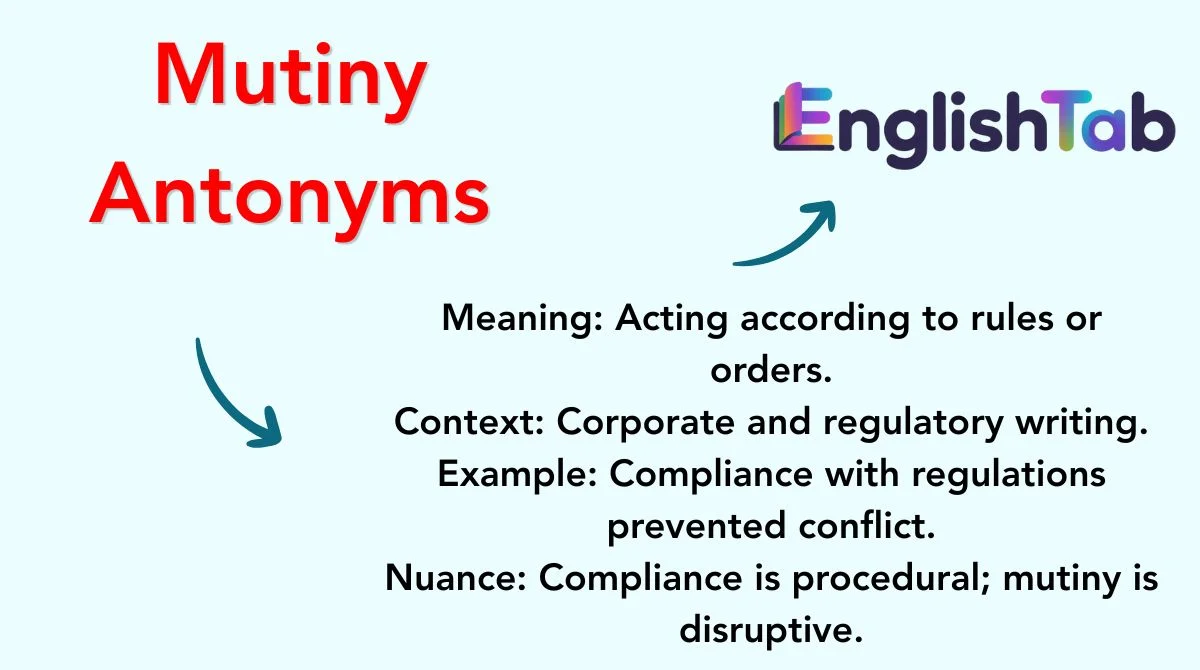
Compliance
Meaning: Acting according to rules or orders.
Context: Corporate and regulatory writing.
Example: Compliance with regulations prevented conflict.
Nuance: Compliance is procedural; mutiny is disruptive.
Fidelity
Meaning: Faithfulness to a person, cause, or belief.
Context: Ethical and political writing.
Example: His fidelity to the constitution was unwavering.
Nuance: Fidelity stresses integrity; mutiny suggests betrayal.
Devotion
Meaning: Deep dedication and commitment.
Context: Emotional or ideological settings.
Example: Her devotion to leadership inspired others.
Nuance: Devotion is passionate support; mutiny is passionate opposition.
Discipline
Meaning: Controlled and orderly behavior.
Context: Military and academic writing.
Example: Discipline prevented chaos.
Nuance: Discipline maintains hierarchy; mutiny dismantles it.
Respect
Meaning: Admiration and recognition of authority.
Context: Social and institutional structures.
Example: Respect for command maintained order.
Nuance: Respect undercuts rebellion before it forms.
Conformity
Meaning: Acting according to established standards.
Context: Sociological discussions.
Example: Conformity reduced internal conflict.
Nuance: Conformity suggests adaptation; mutiny suggests rebellion.
Cooperation
Meaning: Working together toward a shared goal.
Context: Organizational writing.
Example: Cooperation strengthened the team.
Nuance: Cooperation builds unity; mutiny fractures it.
Support
Meaning: Providing assistance or approval.
Context: Political and corporate environments.
Example: Public support prevented unrest.
Nuance: Support stabilizes leadership; mutiny challenges it.
Unity
Meaning: State of being joined together.
Context: Social and national writing.
Example: Unity prevented rebellion.
Nuance: Unity eliminates divisions that cause mutiny.
Harmony
Meaning: Peaceful agreement and cooperation.
Context: Community discussions.
Example: Harmony within the group reduced tension.
Nuance: Harmony suggests emotional balance; mutiny suggests emotional conflict.
Accord
Meaning: Agreement between parties.
Context: Legal and diplomatic writing.
Example: The treaty established accord.
Nuance: Accord is negotiated peace; mutiny is unilateral revolt.
Consent
Meaning: Permission or agreement.
Context: Legal frameworks.
Example: Decisions were made with consent.
Nuance: Consent shows approval; mutiny rejects authority.
Agreement
Meaning: Shared understanding or decision.
Context: Academic argumentation.
Example: Agreement prevented internal dispute.
Nuance: Agreement implies shared values; mutiny implies fractured values.
Adherence
Meaning: Steady support or attachment to rules.
Context: Policy discussions.
Example: Adherence to policy ensured stability.
Nuance: Adherence reinforces systems; mutiny rejects systems.
Fealty
Meaning: Formal loyalty to a leader.
Context: Historical analysis.
Example: Knights swore fealty to their king.
Nuance: Fealty emphasizes obligation; mutiny rejects obligation.
Solidarity
Meaning: Unity based on shared interests.
Context: Social movements.
Example: Solidarity strengthened leadership.
Nuance: Solidarity strengthens structure; mutiny fractures it.
Antonym Comparison Table
| Antonym | Emotional Level | Formal Use | Strongest Context | Key Difference from Mutiny |
|---|---|---|---|---|
| Loyalty | High | Yes | Military/Political | Emotional faithfulness |
| Obedience | Neutral | Yes | Military/Education | Behavioral compliance |
| Compliance | Low | Yes | Corporate/Legal | Rule-based following |
| Devotion | High | Moderate | Ideological | Passionate support |
| Discipline | Neutral | Yes | Military | Order maintenance |
| Unity | Moderate | Yes | Social/Political | Collective cohesion |
| Submission | Moderate | Yes | Legal | Yielding to authority |
| Allegiance | High | Yes | National | Formal commitment |
| Harmony | Low | Moderate | Community | Emotional peace |
Academic Writing Examples
- Instead of mutiny, the committee demonstrated loyalty to institutional leadership.
- The absence of mutiny reflected discipline within the ranks.
- Organizational stability depends more on cooperation than confrontation.
- Political systems survive through allegiance, not rebellion.
In analytical essays, replacing mutiny with softer words like dissent changes tone. Replacing it with stronger antonyms like devotion changes ideological interpretation.
When Not to Replace the Word
Do not replace mutiny when:
- Writing about historical naval revolts
- Discussing legal definitions
- Analyzing criminal charges
- Referring to organized armed rebellion
Antonyms cannot capture the severity of mutiny in military law. Over-softening the term reduces accuracy.
Practice Exercises
- Replace mutiny with the strongest antonym:
The troops planned a mutiny against their commander. - Choose the best antonym for academic tone:
The board feared mutiny during restructuring. - Rewrite using a high-emotional opposite.
- Identify which antonym fits legal writing best.
- Compare loyalty and obedience in one sentence.
FAQs
What is the strongest antonym of mutiny?
Loyalty and allegiance are the strongest because they directly oppose rebellion.
Is obedience always the opposite of mutiny?
In hierarchical systems, yes. In emotional contexts, devotion may work better.
Can harmony replace mutiny in formal writing?
Only in social contexts, not legal or military ones.
What is the academic alternative to mutiny?
Organized resistance is a synonym. Compliance or adherence can serve as antonyms.
Is dissent the opposite of mutiny?
No. Dissent is mild disagreement. Mutiny is organized revolt.
Conclusion
Understanding mutiny antonyms requires more than listing opposites. It requires analyzing structure, emotion, authority, and context.
Words like loyalty, obedience, and allegiance directly counter rebellion. Words like harmony and unity address emotional conditions that prevent rebellion.
In academic writing, selecting the correct antonym strengthens clarity, sharpens argumentation, and ensures tonal accuracy. The right opposite is not just a vocabulary choice—it is a conceptual decision.

Dorian Hale is an English language enthusiast and content creator dedicated to making vocabulary and grammar learning simple, engaging, and accessible for everyone.