Strong writing depends on contrast. When we understand opposites clearly, our ideas become sharper, arguments stronger, and explanations easier to follow.
Antonyms do more than simply reverse meaning—they create clarity, balance, and intellectual precision.
The word multifarious carries depth and nuance. It suggests complexity, diversity, and variety all at once. But what happens when we need to express the opposite?
Choosing the right antonym is not always simple. Different contexts require different forms of contrast.
This guide presents 22+ multifarious antonyms, explained in depth, with academic comparisons and detailed nuance analysis.
By the end, you will not only know the direct opposites of multifarious, but also understand when and how to use each one effectively.
Definition and Core Meaning of “Multifarious”
The adjective multifarious describes something that has many different parts, forms, types, or elements. It suggests diversity, variety, multiplicity, and complexity.
Core features of multifarious:
- Many kinds or types
- Great diversity
- Numerous elements
- Wide-ranging scope
- Complex structure
Example:
The university offers multifarious research programs across disciplines.
Here, the word implies academic diversity and broad specialization.
To understand its antonyms properly, we must recognize that multifarious combines two ideas:
- Quantity (many)
- Variety (different types)
Its opposites, therefore, typically suggest:
- Few
- Single
- Uniform
- Limited
- Identical
- Simple
- Undiversified
Direct Opposites (Clear Contrasts)
These antonyms most clearly oppose the meaning of multifarious. They directly suggest singularity, uniformity, or lack of variety.
Single
Uniform
Identical
Homogeneous
Monotonous
Limited
Restricted
Simple
Unvaried
Consistent
Singular
Sole
Exclusive
Isolated
One-dimensional
Uncomplicated
Narrow
Specific
Definite
Finite
Scarce
Sparse
These words create strong structural contrast with multifarious and are suitable for academic replacement in clearly defined contexts.
Contextual Opposites
Some antonyms function depending on situation. They may not always oppose multifarious, but in certain contexts they clearly contrast it.
Centralized
Focused
Specialized
Standardized
Streamlined
Concentrated
Rigid
Fixed
Static
Predictable
Repetitive
Minimal
For example:
A multifarious curriculum
vs.
A focused curriculum
In this case, “focused” suggests limited scope rather than wide diversity.
Emotional & Tone-Based Opposites
Beyond structure and quantity, multifarious often carries a positive tone of richness or vibrancy. Some antonyms contrast it emotionally rather than structurally.
Dull
Bland
Colorless
Lifeless
Tedious
Flat
Boring
Dry
Mechanical
These words emphasize lack of richness rather than lack of quantity.
For instance:
The city’s multifarious culture attracts tourists.
The town’s bland atmosphere discourages visitors.
Here, the contrast involves vibrancy versus dullness.
22+ Antonyms Explained in Detail
Below are detailed explanations of major multifarious antonyms with nuance analysis.
Single
Meaning: One only; not multiple.
Context: Used when something consists of just one part.
Example: The proposal focused on a single solution.
Nuance: Emphasizes numerical limitation more than uniformity.
Uniform
Meaning: The same throughout; consistent.
Context: Common in scientific or policy writing.
Example: The policy enforces uniform standards.
Nuance: Suggests sameness across elements.
Identical
Meaning: Exactly the same.
Context: Used in technical comparisons.
Example: The two samples were identical in composition.
Nuance: Stronger than uniform; implies perfect sameness.
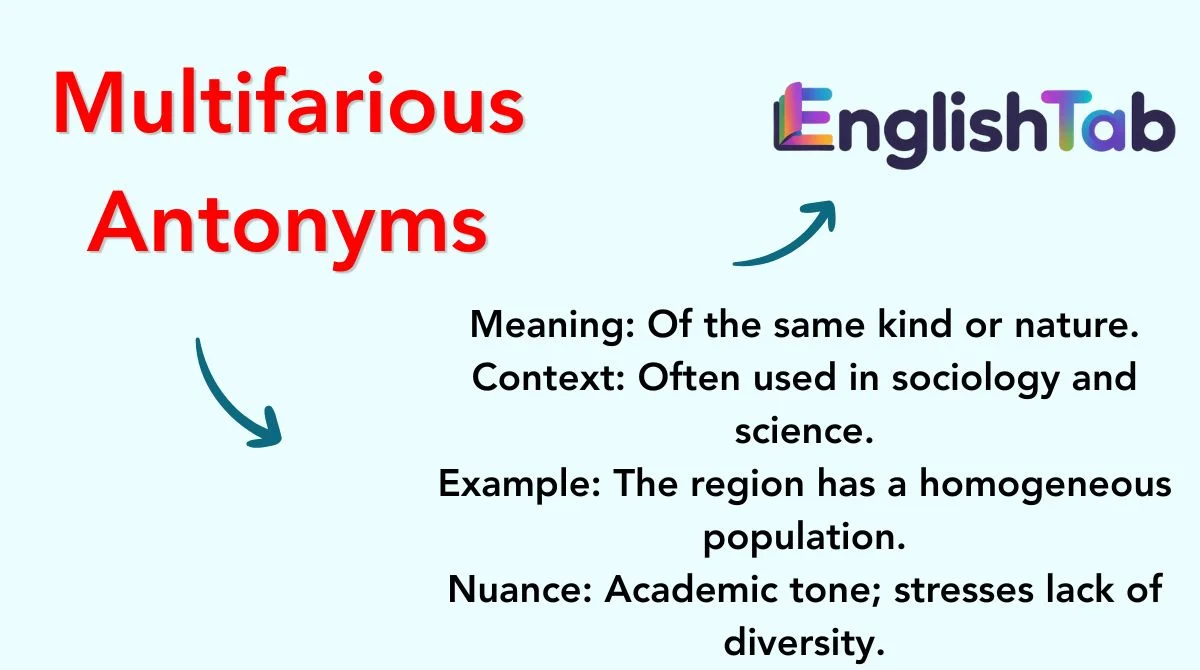
Homogeneous
Meaning: Of the same kind or nature.
Context: Often used in sociology and science.
Example: The region has a homogeneous population.
Nuance: Academic tone; stresses lack of diversity.
Monotonous
Meaning: Lacking variation; repetitive.
Context: Describes speech, design, or routine.
Example: The lecture became monotonous after an hour.
Nuance: Adds negative emotional tone.
Limited
Meaning: Restricted in scope or number.
Context: Policy, resources, options.
Example: The study had limited variables.
Nuance: Emphasizes constraint rather than sameness.
Restricted
Meaning: Constrained or controlled.
Example: Access to data was restricted.
Nuance: Suggests external limitation.
Simple
Meaning: Not complex.
Example: The explanation was simple and direct.
Nuance: Opposes complexity more than diversity.
Unvaried
Meaning: Without change or diversity.
Example: The diet remained unvaried.
Nuance: Direct semantic contrast.
Consistent
Meaning: Stable and unchanging.
Example: The results were consistent across trials.
Nuance: Focuses on stability rather than narrowness.
Singular
Meaning: Unique or one.
Example: She pursued a singular objective.
Nuance: Can imply distinctiveness, not just one.
Sole
Meaning: Only one.
Example: He was the sole participant.
Nuance: Strong emphasis on exclusivity.
Exclusive
Meaning: Limited to one group or purpose.
Example: The club is exclusive.
Nuance: Suggests restriction by choice.
Isolated
Meaning: Separated or alone.
Example: The theory stands isolated.
Nuance: Adds idea of separation.
One-dimensional
Meaning: Lacking depth or variety.
Example: The character felt one-dimensional.
Nuance: Often critical in tone.
Uncomplicated
Meaning: Simple and not complex.
Example: The process is uncomplicated.
Nuance: Neutral; contrasts structural complexity.
Narrow
Meaning: Limited in range.
Example: The research had a narrow focus.
Nuance: Opposes broad diversity.
Specific
Meaning: Clearly defined.
Example: The assignment required a specific answer.
Nuance: Not always opposite, but contrasts broad scope.
Definite
Meaning: Clearly stated or precise.
Example: The instructions were definite.
Nuance: Suggests clarity rather than variety.
Finite
Meaning: Limited in number.
Example: Resources are finite.
Nuance: Logical contrast to multiplicity.
Scarce
Meaning: Rare or limited.
Example: Water was scarce.
Nuance: Quantity-focused contrast.
Sparse
Meaning: Thinly distributed.
Example: The forest became sparse.
Nuance: Visual sense of limited elements.
Standardized
Meaning: Made uniform.
Example: The test is standardized.
Nuance: Institutional sameness.
Streamlined
Meaning: Simplified and efficient.
Example: The company streamlined operations.
Nuance: Suggests reduction of complexity.
Antonym Comparison Table
| Antonym | Focus Area | Emotional Tone | Best Used In |
|---|---|---|---|
| Single | Quantity | Neutral | Logical arguments |
| Uniform | Sameness | Neutral | Policy, science |
| Homogeneous | Cultural sameness | Academic | Sociology |
| Monotonous | Repetition | Negative | Descriptive writing |
| Limited | Restriction | Neutral | Research discussions |
| Simple | Complexity | Neutral | Explanations |
| Narrow | Scope | Slightly critical | Academic critique |
| Sparse | Distribution | Neutral | Environmental descriptions |
| Exclusive | Access | Slightly critical | Social analysis |
Academic Writing Examples
Example 1:
The committee proposed a multifarious strategy involving economic, environmental, and social reforms.
The revised proposal adopted a uniform strategy focused solely on fiscal reform.
Example 2:
The region is known for its multifarious linguistic heritage.
In contrast, the neighboring district remains culturally homogeneous.
Example 3:
Her multifarious research interests include philosophy, biology, and political science.
His work remains narrowly specialized in constitutional law.
These examples demonstrate contextual precision in academic contrast.
When Not to Replace the Word
Avoid replacing multifarious when:
- You need to emphasize richness and diversity positively.
- You are describing layered complexity.
- The diversity itself is central to the argument.
Replacing it with “complex” removes diversity nuance. Replacing it with “many” removes sophistication.
Use antonyms only when genuine contrast is required.
Practice Exercises
- Replace “multifarious” with an appropriate antonym:
- The organization had multifarious branches worldwide.
- The curriculum became multifarious over time.
- Choose the strongest antonym:
- A multifarious society vs. a ______ society.
- A multifarious debate vs. a ______ debate.
- Rewrite with contrast:
- The company shifted from a multifarious product line to a ______ model.
Suggested answers:
Homogeneous, narrow, single, streamlined.
FAQs
What is the strongest antonym of multifarious?
The strongest structural antonyms are “single,” “uniform,” and “homogeneous,” depending on context.
Is simple always an antonym?
Not always. Multifarious refers to diversity, while simple refers to complexity. They overlap but are not identical opposites.
Can limited replace multifarious?
Yes, when the focus is on scope rather than diversity.
Is monotonous a direct antonym?
It is more of a tone-based antonym. It contrasts variation emotionally rather than numerically.
What is the academic alternative to homogeneous?
“Uniform” is often used in policy and scientific contexts.
Conclusion
Understanding multifarious antonyms requires more than listing opposites. Because the word combines diversity, quantity, and complexity, its contrasts vary by context.
Some antonyms focus on number (single, sole).
Some focus on sameness (uniform, homogeneous).
Some focus on restriction (limited, narrow).
Others emphasize emotional flatness (monotonous, bland).
Precision in academic writing depends on choosing the correct type of contrast. By mastering these 22+ multifarious antonyms, writers gain control over nuance, tone, and intellectual clarity.
Effective contrast is not about replacing words—it is about refining meaning.

Dorian Hale is an English language enthusiast and content creator dedicated to making vocabulary and grammar learning simple, engaging, and accessible for everyone.