Clear writing depends on contrast. When we understand what a word is not, we understand more clearly what it is. Opposites sharpen meaning.
They prevent confusion. They help writers avoid vague language. In academic, professional, and strategic contexts, identifying precise antonyms strengthens argument structure and improves rhetorical balance.
The word mission carries strong directional meaning. It suggests purpose, action, and intent. Because of its forceful tone, replacing it carelessly with a weak opposite can distort meaning.
That is why studying mission antonyms requires more than listing random opposites. We must analyze structure, tone, and context.
This 2K26 guide offers 21+ carefully examined mission antonyms, with contrast analysis and academic examples for advanced clarity.
Definition and Core Meaning of “Mission”
The word mission generally refers to:
- A specific purpose or goal
- An assigned task
- A long-term objective
- A meaningful undertaking
- A strategic directive
In organizational settings, a mission defines identity and direction. In military contexts, it means a planned operation. In personal development, it implies life purpose.
Key semantic components of mission:
- Intention
- Direction
- Planning
- Commitment
- Action
Therefore, strong antonyms must negate one or more of these elements—especially intention, purpose, or direction.
Direct Opposites (Clear Contrasts)
These are the strongest and most structurally opposite terms to mission, directly negating purpose or direction:
Failure
Aimlessness
Purposelessness
Neglect
Abandonment
Inaction
Withdrawal
Retreat
Disengagement
Rejection
Opposition
Sabotage
Destruction
Cancellation
Resignation
Drift
Confusion
Stagnation
Misguidance
Deviation
Chaos
Each of these words removes or contradicts intention, goal-orientation, or structured action.
Contextual Opposites
Some words function as mission antonyms only in specific contexts:
Diversion – Opposes mission when focus shifts away from primary objective
Delay – Counters mission when urgency is central
Distraction – Opposes structured purpose
Resistance – Opposes mission when mission implies advancement
Contradiction – Opposes stated purpose
Obstruction – Prevents execution
Hesitation – Weakens decisive mission
Isolation – Opposes collaborative missions
Improvisation – Opposes strategic planning in formal missions
These are not universal antonyms but operate situationally.
Emotional & Tone-Based Opposites
Mission carries emotional intensity. It implies determination and resolve. Emotional antonyms shift tone dramatically:
Apathy – Emotional absence of purpose
Indifference – Lack of commitment
Cynicism – Distrust of goals
Despair – Loss of directional hope
Complacency – Comfort without forward action
Defeatism – Expectation of failure
These words oppose the psychological energy embedded in mission.
21+ Antonyms Explained in Detail
Below are expanded explanations with nuance comparisons.
Failure
Meaning: Lack of success in achieving a goal.
Context: Opposes mission when objectives are not accomplished.
Example: The mission succeeded, but the previous attempt ended in failure.
Nuance: Failure reflects outcome, not absence of purpose.
Aimlessness
Meaning: Lack of direction or goal.
Context: Directly contradicts mission’s purpose-driven nature.
Example: Without leadership, the project drifted into aimlessness.
Nuance: Strong structural opposite.
Purposelessness
Meaning: Absence of intention.
Context: The pure conceptual opposite of mission.
Example: The initiative collapsed into purposelessness.
Nuance: Philosophical contrast rather than operational.
Neglect
Meaning: Failure to give attention or care.
Context: Opposes mission commitment.
Example: Organizational neglect undermined the mission.
Nuance: Passive rather than active opposition.
Abandonment
Meaning: Leaving something unfinished.
Context: Contradicts sustained mission pursuit.
Example: Abandonment of the mission damaged credibility.
Nuance: Suggests intentional withdrawal.
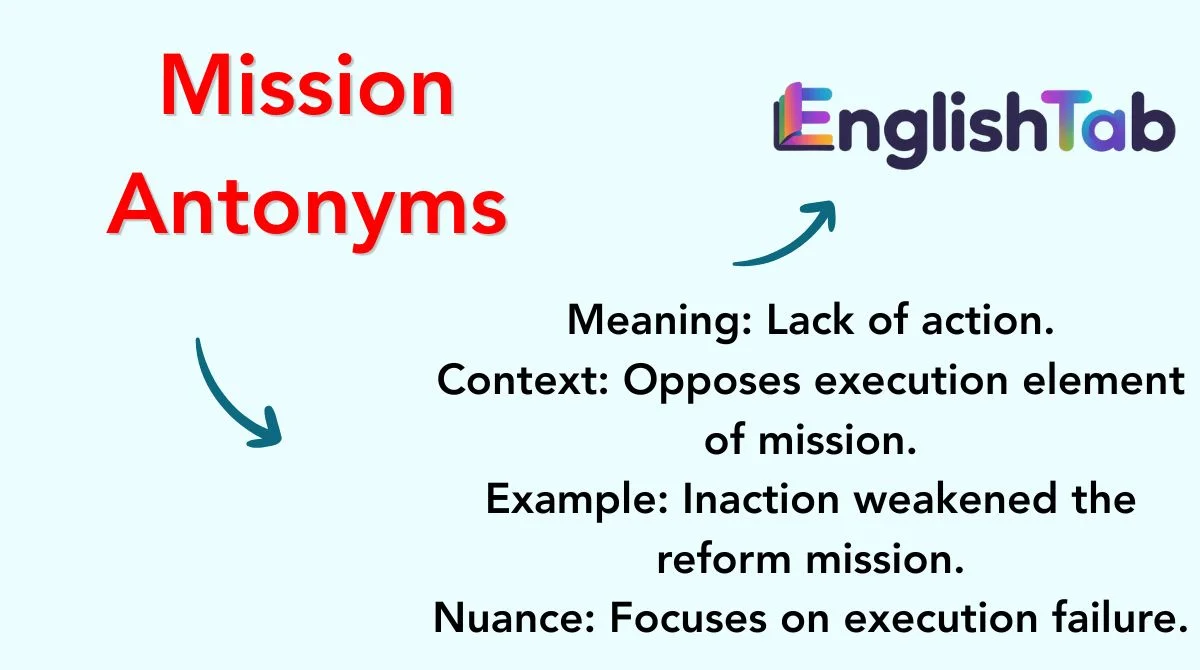
Inaction
Meaning: Lack of action.
Context: Opposes execution element of mission.
Example: Inaction weakened the reform mission.
Nuance: Focuses on execution failure.
Withdrawal
Meaning: Pulling back from engagement.
Context: Opposes advancement-driven mission.
Example: Strategic withdrawal ended the mission early.
Nuance: Tactical rather than philosophical opposite.
Retreat
Meaning: Movement away from conflict or goal.
Context: Common military antonym.
Example: The retreat signaled mission termination.
Nuance: Often defensive.
Disengagement
Meaning: Removal from involvement.
Context: Opposes active participation.
Example: Stakeholder disengagement weakened the mission.
Nuance: Emotional and strategic dimension.
Rejection
Meaning: Refusal to accept.
Context: Opposes mission endorsement.
Example: Public rejection halted the mission.
Nuance: External opposition.
Opposition
Meaning: Active resistance.
Context: Opposes mission advancement.
Example: Political opposition blocked the mission.
Nuance: Competitive contrast.
Sabotage
Meaning: Deliberate destruction.
Context: Strongest destructive antonym.
Example: Internal sabotage destroyed the mission.
Nuance: Intentional harm.
Destruction
Meaning: Complete ruin.
Context: Opposes constructive mission.
Example: Environmental destruction contradicted the mission statement.
Nuance: Total negation.
Cancellation
Meaning: Official termination.
Context: Ends mission formally.
Example: Budget cuts led to mission cancellation.
Nuance: Administrative opposition.
Resignation
Meaning: Voluntary stepping down.
Context: Opposes leadership-driven mission.
Example: Her resignation paused the mission.
Nuance: Personal dimension.
Drift
Meaning: Gradual loss of direction.
Context: Soft opposite of mission clarity.
Example: The company drifted from its mission.
Nuance: Subtle and progressive.
Confusion
Meaning: Lack of clarity.
Context: Opposes mission clarity.
Example: Confusion replaced the original mission focus.
Nuance: Cognitive contrast.
Stagnation
Meaning: Lack of growth or progress.
Context: Opposes forward movement.
Example: Stagnation replaced mission-driven innovation.
Nuance: Temporal slowdown.
Misguidance
Meaning: Incorrect direction.
Context: Opposes accurate mission alignment.
Example: Misguidance derailed the mission.
Nuance: Directional distortion.
Deviation
Meaning: Departure from path.
Context: Opposes consistency.
Example: Policy deviation weakened mission integrity.
Nuance: Partial, not total opposition.
Chaos
Meaning: Complete disorder.
Context: Opposes structured mission planning.
Example: Chaos replaced the strategic mission plan.
Nuance: Environmental contrast.
Antonym Comparison Table
| Antonym | Type | Strength of Opposition | Emotional Tone | Outcome-Based? |
|---|---|---|---|---|
| Failure | Outcome | Strong | Neutral | Yes |
| Aimlessness | Conceptual | Very Strong | Low | No |
| Purposelessness | Conceptual | Very Strong | Neutral | No |
| Inaction | Behavioral | Strong | Neutral | No |
| Retreat | Tactical | Moderate | Defensive | Yes |
| Sabotage | Active | Extreme | Hostile | Yes |
| Stagnation | Temporal | Moderate | Passive | No |
| Chaos | Structural | Strong | Negative | No |
Academic Writing Examples
Effective academic contrast:
The organization’s mission emphasized sustainability, whereas internal misguidance produced policy deviation.
The research mission focused on innovation; however, stagnation within leadership structures slowed progress.
While the national mission promoted expansion, political opposition reduced its effectiveness.
In comparative essays, use antonyms to show tension:
Mission versus drift
Mission versus chaos
Mission versus complacency
Such pairings strengthen thesis clarity.
When Not to Replace the Word
Do not replace mission with an antonym when:
- Describing neutral activities
- Discussing exploratory research
- Writing metaphorically
- The original term implies sacred or institutional meaning
Replacing “mission” with “failure” in early-stage planning is inaccurate if no outcome exists yet.
Precision matters more than variety.
Practice Exercises
- Rewrite the sentence replacing “mission” with an appropriate antonym:
The company’s mission collapsed after leadership conflict. - Choose the strongest antonym:
The team’s lack of direction showed complete ______. - Compare:
Mission vs stagnation — explain in two sentences. - Academic contrast:
Write one sentence contrasting mission and deviation in policy reform. - Identify tone difference:
Mission vs sabotage.
FAQs
What is the strongest direct antonym of mission?
Aimlessness and purposelessness are conceptually strongest because they remove intention entirely.
Is failure always an antonym of mission?
No. Failure refers to result, while mission refers to intention.
Can chaos be an antonym of mission?
Yes, when mission implies structure and order.
Is inaction stronger than retreat?
Inaction suggests no attempt. Retreat implies attempt followed by withdrawal.
Why study mission antonyms?
Understanding opposites improves clarity, argumentative precision, and rhetorical contrast.
Conclusion
The word mission carries structural, emotional, and strategic power. Its antonyms vary depending on whether we negate intention, execution, direction, or outcome.
Some opposites attack the concept itself—aimlessness and purposelessness. Others oppose execution—inaction and withdrawal. Some express emotional contradiction—apathy and cynicism.
Still others show destructive resistance—sabotage and chaos.
Effective writers do not randomly replace strong words. They analyze nuance. They consider tone. They select precise contrast.
In 2K26 academic and professional writing, clarity is authority. Mastering mission antonyms ensures sharper analysis, deeper comparison, and more persuasive argumentation.

Dorian Hale is an English language enthusiast and content creator dedicated to making vocabulary and grammar learning simple, engaging, and accessible for everyone.