In academic and professional writing, clarity depends on contrast. When readers understand what a word is not, they better grasp what it is. Opposites sharpen meaning. They define boundaries. They prevent ambiguity.
The word lucrative carries strong financial implications. It suggests profit, reward, and measurable gain. But when we remove profitability, what remains? Loss? Insignificance? Waste? Risk?
Understanding the antonyms of lucrative does more than expand vocabulary. It improves economic analysis, strengthens argumentative writing, refines tone, and prevents exaggeration.
In business, finance, academic essays, and policy analysis, precision matters.
This guide presents 24+ lucrative antonyms with deep contrast analysis, contextual nuance, and academic usage guidance.
Definition and Core Meaning of “Lucrative”
Lucrative is an adjective describing something that produces substantial financial profit or material gain.
Core elements of meaning:
- Generates income
- Produces measurable financial reward
- Offers economic advantage
- Yields high returns relative to cost
Example:
The investment proved lucrative within three years.
It is not simply “good” or “beneficial.” It specifically refers to financial profitability. Therefore, true antonyms must challenge that economic gain component.
Direct Opposites (Clear Contrasts)
These words most directly oppose financial profitability:
Unprofitable
Unproductive
Unrewarding
Loss-making
Deficit-producing
Money-losing
Nonviable
Unsustainable
Inefficient
Unremunerative
Costly
Wasteful
Impoverishing
Damaging
Depleting
Failing
Bankrupting
Unsuccessful
Unfruitful
Unviable
Ineffective
Risky
Liability-inducing
Burdening
These antonyms clearly signal absence of financial benefit or presence of financial harm.
Contextual Opposites
Some words oppose lucrative only in certain contexts. Their meaning shifts depending on economic framing.
Modest
Minimal
Average
Marginal
Stagnant
Declining
Underperforming
Experimental
Charitable
Voluntary
For example, “charitable” is not inherently unprofitable, but it often prioritizes social value over financial gain. “Experimental” projects may lack immediate profit but aim for future returns.
Context determines whether they truly function as antonyms.
Emotional & Tone-Based Opposites
The emotional tone of lucrative suggests excitement, opportunity, and advantage. Some antonyms shift emotional intensity:
Disastrous
Catastrophic
Hopeless
Bleak
Discouraging
Regrettable
Dismal
These do not merely suggest low profit—they imply failure with emotional weight. Tone analysis is critical in academic writing to avoid exaggeration.
24+ Antonyms Explained in Detail
Below are 28 carefully analyzed antonyms of lucrative, each with meaning, context, example, and nuance difference.
Unprofitable
Meaning: Not generating profit.
Context: Business performance analysis.
Example: The branch remained unprofitable for five years.
Nuance: Neutral, factual absence of profit without emotional judgment.
Unremunerative
Meaning: Not providing adequate financial reward.
Context: Employment or contract evaluation.
Example: The consulting work proved unremunerative.
Nuance: More formal and academic than unprofitable.
Loss-making
Meaning: Producing financial loss.
Context: Corporate reporting.
Example: The airline discontinued its loss-making routes.
Nuance: Stronger than unprofitable because it implies actual loss.
Deficit-producing
Meaning: Causing financial shortfall.
Context: Public sector or government budgets.
Example: The program became deficit-producing.
Nuance: Often used in policy discussions.
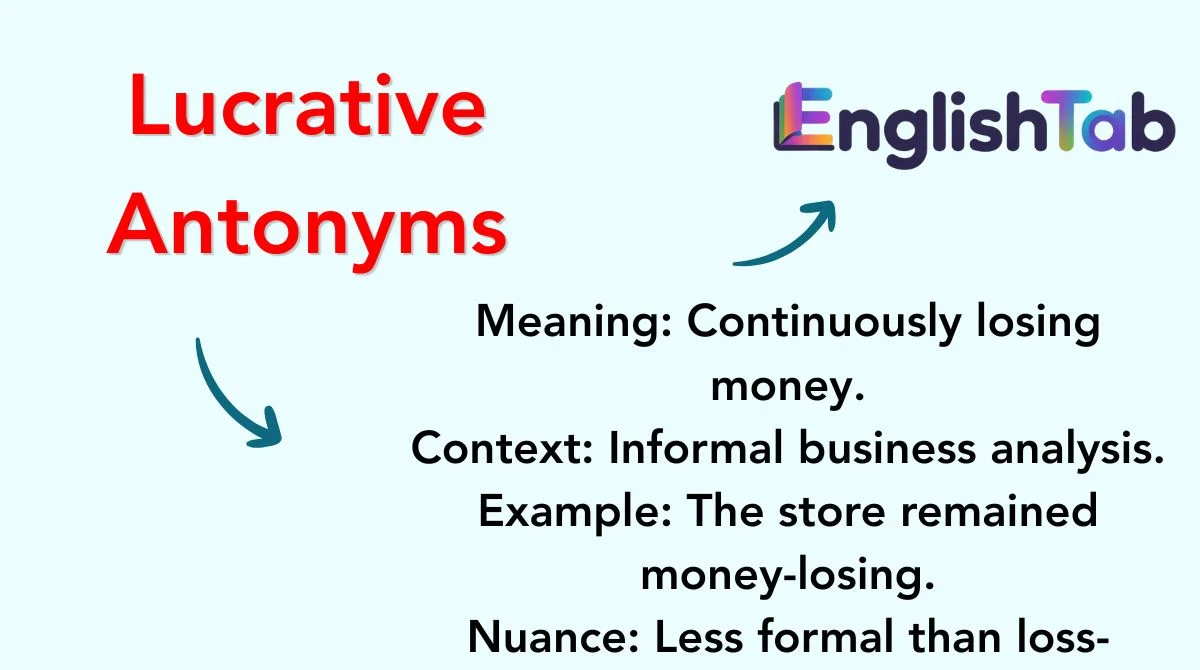
Money-losing
Meaning: Continuously losing money.
Context: Informal business analysis.
Example: The store remained money-losing.
Nuance: Less formal than loss-making.
Nonviable
Meaning: Not capable of sustained success.
Context: Business proposals.
Example: The startup was deemed nonviable.
Nuance: Broader than financial loss; includes operational failure.
Unsustainable
Meaning: Cannot continue long term.
Context: Economics and environmental studies.
Example: The pricing model was unsustainable.
Nuance: Focuses on long-term stability, not immediate loss.
Inefficient
Meaning: Wasting resources.
Context: Production analysis.
Example: The process was inefficient.
Nuance: Suggests poor resource use rather than direct loss.
Wasteful
Meaning: Carelessly using resources.
Context: Budget evaluations.
Example: The campaign was wasteful.
Nuance: Implies mismanagement.
Costly
Meaning: Expensive to maintain.
Context: Investment risk discussion.
Example: The mistake proved costly.
Nuance: May not imply total loss.
Impoverishing
Meaning: Causing financial decline.
Context: Socioeconomic studies.
Example: The policy was impoverishing for rural communities.
Nuance: Stronger social impact tone.
Damaging
Meaning: Causing harm.
Context: Financial or reputational analysis.
Example: The scandal was financially damaging.
Nuance: Broader than profit-related harm.
Depleting
Meaning: Reducing resources.
Context: Resource management.
Example: The project was depleting company reserves.
Nuance: Focus on gradual financial drain.
Failing
Meaning: Not achieving success.
Context: Business reports.
Example: The failing enterprise shut down.
Nuance: Broader than financial failure.
Bankrupting
Meaning: Leading to bankruptcy.
Context: Legal and financial cases.
Example: Legal fees were bankrupting the firm.
Nuance: Extreme financial collapse.
Unsuccessful
Meaning: Not achieving intended results.
Context: Academic and business writing.
Example: The venture was unsuccessful.
Nuance: Does not always imply financial loss.
Unfruitful
Meaning: Producing no useful result.
Context: Research and negotiations.
Example: Talks were unfruitful.
Nuance: Often metaphorical.
Unviable
Meaning: Unable to succeed financially.
Context: Economic evaluation.
Example: The plan was unviable.
Nuance: Similar to nonviable but more finance-focused.
Ineffective
Meaning: Not producing desired effect.
Context: Policy review.
Example: The strategy was ineffective.
Nuance: May relate to impact, not profit.
Risky
Meaning: Involving potential loss.
Context: Investment writing.
Example: The deal appeared risky.
Nuance: Suggests possible loss, not guaranteed.
Liability-inducing
Meaning: Creating financial obligations.
Context: Legal-financial contexts.
Example: The contract was liability-inducing.
Nuance: Technical and formal.
Burdening
Meaning: Creating financial strain.
Context: Budget analysis.
Example: The tax increase was burdening small firms.
Nuance: Focus on pressure rather than loss.
Marginal
Meaning: Producing very small profit.
Context: Market performance.
Example: Returns were marginal.
Nuance: Not fully opposite but weak profitability.
Stagnant
Meaning: Not growing financially.
Context: Economic reports.
Example: Sales remained stagnant.
Nuance: No growth rather than loss.
Declining
Meaning: Decreasing over time.
Context: Revenue analysis.
Example: Profits were declining.
Nuance: Directional reduction.
Disastrous
Meaning: Causing severe damage.
Context: Market collapse analysis.
Example: The investment was disastrous.
Nuance: Emotionally intense.
Catastrophic
Meaning: Extremely harmful.
Context: Economic crises.
Example: Losses were catastrophic.
Nuance: Stronger than disastrous.
Dismal
Meaning: Very poor in quality or outcome.
Context: Performance reports.
Example: Earnings were dismal.
Nuance: Less extreme but clearly negative.
Antonym Comparison Table
| Word | Financial Loss? | Emotional Intensity | Formality | Scope |
|---|---|---|---|---|
| Unprofitable | Yes | Low | Neutral | Business |
| Loss-making | Yes | Medium | Formal | Corporate |
| Nonviable | Possible | Low | Formal | Strategic |
| Risky | Possible | Medium | Neutral | Investment |
| Disastrous | Yes | High | Dramatic | Broad |
| Unsustainable | Eventual | Medium | Academic | Long-term |
| Marginal | Minimal profit | Low | Neutral | Economic |
| Bankrupting | Extreme loss | High | Formal | Legal |
Academic Writing Examples
- The previously lucrative export sector became unprofitable after tariff increases.
- The initiative was deemed nonviable due to insufficient funding.
- Analysts described the merger as financially unsustainable.
- The experimental venture proved loss-making in its early phase.
Each example shows careful word selection based on context and intensity.
When Not to Replace the Word
Do not replace lucrative when:
- Financial profit is clearly central.
- You need positive economic emphasis.
- The focus is measurable return.
- Tone must remain neutral and precise.
Overusing dramatic antonyms like catastrophic weakens academic credibility. Select proportional contrast.
Practice Exercises
- Replace lucrative with an appropriate antonym:
“The mining contract was no longer lucrative after regulations changed.” - Choose the strongest antonym for a total financial collapse.
- Rewrite using a moderate-intensity antonym:
“The investment appeared lucrative but failed to deliver returns.” - Compare nonviable and unprofitable in a sentence.
- Identify which antonym best fits long-term decline without immediate loss.
FAQs
What is the most direct antonym of lucrative?
Unprofitable is the most direct and neutral opposite.
Is risky an antonym of lucrative?
Only contextually. Risk does not guarantee loss.
Which antonym is strongest?
Bankrupting and catastrophic represent extreme financial damage.
Are all antonyms financial?
No. Some emphasize operational failure rather than profit.
Can marginal be an antonym?
Yes, when profit is minimal and fails to meet expectations.
Conclusion
Understanding 24+ lucrative antonyms strengthens analytical writing.
Direct opposites clarify financial absence. Contextual opposites refine economic nuance. Emotional antonyms control tone.
Effective writers choose contrast carefully. Not every low-profit situation is disastrous. Not every failing venture is bankrupting. Precision matters.
Mastering these distinctions ensures clarity, academic integrity, and persuasive authority in 2026 and beyond.

Dorian Hale is an English language enthusiast and content creator dedicated to making vocabulary and grammar learning simple, engaging, and accessible for everyone.