In persuasive communication, clarity depends not only on what a writer includes but also on what they exclude. Understanding opposites sharpens argumentation, strengthens contrast, and enhances analytical depth.
When discussing logos—the appeal to logic in rhetoric—knowing its antonyms helps scholars, students, and professional writers distinguish between reasoned argument and its counterforces.
Opposites create intellectual precision. They illuminate boundaries. They prevent conceptual confusion.
In academic writing, especially in rhetoric, philosophy, communication studies, and literary analysis, the ability to contrast logos with its antonyms allows deeper critical insight.
This comprehensive 2026 guide explores more than 18 logos antonyms, explains their nuances, compares their rhetorical effects, and demonstrates when and how to use them properly in scholarly contexts.
Definition and Core Meaning of “Logos”
The concept of logos originates from classical rhetoric, particularly the works of Aristotle. In rhetorical theory, logos refers to persuasion through logic, reason, evidence, and structured argument.
Core characteristics of logos include:
- Use of facts and data
- Logical sequencing
- Cause-and-effect reasoning
- Evidence-based claims
- Analytical tone
- Rational appeal to the intellect
Logos seeks to convince the audience through clear reasoning rather than emotional stimulation or character-based persuasion.
Understanding its antonyms requires identifying forces that undermine, oppose, or replace logical reasoning.
Direct Opposites (Clear Contrasts)
The strongest antonyms of logos are words that clearly reject or contradict reason-based persuasion.
Here are 18 powerful direct opposites:
- Emotion
- Irrationality
- Illogic
- Absurdity
- Fallacy
- Nonsense
- Chaos
- Confusion
- Delusion
- Impulsiveness
- Bias
- Prejudice
- Subjectivity
- Fantasy
- Sensationalism
- Manipulation
- Superstition
- Dogmatism
These terms represent intellectual opposition to structured reasoning.
Contextual Opposites
Some words act as antonyms to logos depending on context rather than strict definition.
Examples include:
- Pathos (when emotional appeal replaces logic)
- Myth (when narrative replaces evidence)
- Intuition (when instinct overrides reasoning)
- Faith (when belief supersedes proof)
- Tradition (when custom overrides analysis)
- Authority (when position replaces reasoning)
- Popularity (when majority opinion replaces evidence)
- Anecdote (when isolated example replaces data)
These are not inherently anti-logical but become oppositional when used in place of reasoning.
Emotional & Tone-Based Opposites
Logos operates in a calm, structured tone. Emotional opposites intensify feeling at the expense of logic.
Tone-based contrasts include:
- Hysteria
- Outrage
- Fury
- Panic
- Sentimentality
- Dramatic exaggeration
- Emotional manipulation
These forms prioritize emotional intensity over analytical structure.
18+ Antonyms Explained in Detail
Below is a detailed exploration of 20 major antonyms of logos.
Emotion
Meaning: Strong feeling rather than reason.
Context: When persuasion relies on sympathy or anger instead of facts.
Example: The speech focused on tragic stories rather than statistics.
Nuance: Emotion can support logos, but when it replaces reasoning entirely, it becomes its opposite.
Irrationality
Meaning: Absence of logical thinking.
Context: Decisions made without coherent reasoning.
Example: The market panic reflected irrationality, not evidence.
Nuance: Irrationality is broader than emotion; it includes distorted thinking.
Illogic
Meaning: Faulty reasoning structure.
Context: Arguments that contradict themselves.
Example: The claim collapsed under its own illogic.
Nuance: Illogic directly contradicts logos in structural terms.
Absurdity
Meaning: Utter lack of reason.
Context: Claims that defy basic rational principles.
Example: The conspiracy theory reached absurdity.
Nuance: Absurdity often implies extreme illogic.
Fallacy
Meaning: A deceptive or mistaken argument.
Context: Logical errors in reasoning.
Example: The appeal to popularity was a clear fallacy.
Nuance: Fallacies undermine logos from within.
Nonsense
Meaning: Meaningless or incoherent speech.
Context: Statements lacking logical or semantic sense.
Example: The explanation sounded like nonsense.
Nuance: Less technical than fallacy; more dismissive in tone.
Chaos
Meaning: Disorder without structure.
Context: Arguments lacking organization.
Example: The debate devolved into chaos.
Nuance: Logos depends on structure; chaos destroys it.
Confusion
Meaning: Lack of clarity or coherence.
Context: Ideas presented without logical order.
Example: The report created confusion instead of clarity.
Nuance: Confusion may result from poor logos.
Delusion
Meaning: False belief resistant to evidence.
Context: Beliefs maintained despite proof.
Example: The policy rested on economic delusion.
Nuance: Delusion rejects logos actively.
Impulsiveness
Meaning: Acting without forethought.
Context: Decisions based on immediate feeling.
Example: The vote was driven by impulsiveness.
Nuance: Impulsiveness bypasses analytical reasoning.
Bias
Meaning: Prejudice influencing judgment.
Context: Partial reasoning favoring one side unfairly.
Example: Confirmation bias shaped the conclusion.
Nuance: Bias distorts logos subtly.
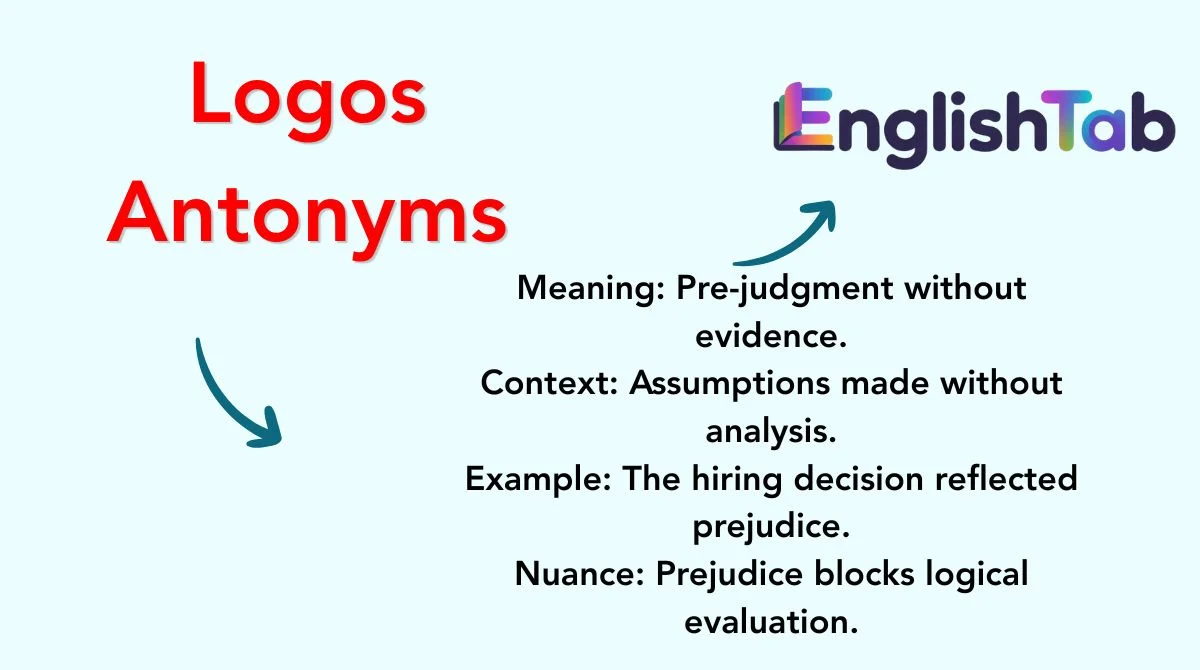
Prejudice
Meaning: Pre-judgment without evidence.
Context: Assumptions made without analysis.
Example: The hiring decision reflected prejudice.
Nuance: Prejudice blocks logical evaluation.
Subjectivity
Meaning: Personal perspective over objective reasoning.
Context: Arguments based on individual feelings.
Example: The review relied on subjectivity.
Nuance: Subjectivity can coexist with logos but becomes oppositional when it replaces evidence.
Fantasy
Meaning: Imagined scenario detached from reality.
Context: Claims unsupported by facts.
Example: The economic prediction was pure fantasy.
Nuance: Fantasy lacks evidentiary grounding.
Sensationalism
Meaning: Exaggerated presentation for shock value.
Context: Media prioritizing attention over accuracy.
Example: The headline used sensationalism instead of analysis.
Nuance: Sensationalism competes with logical persuasion.
Manipulation
Meaning: Controlling others through deceptive tactics.
Context: Twisting information to influence.
Example: The advertisement relied on emotional manipulation.
Nuance: Manipulation may imitate logos superficially.
Superstition
Meaning: Belief not based on reason or evidence.
Context: Decisions rooted in irrational belief.
Example: The policy was guided by superstition.
Nuance: Superstition contradicts empirical reasoning.
Dogmatism
Meaning: Rigid belief resistant to questioning.
Context: Refusal to examine evidence.
Example: Dogmatism prevented rational debate.
Nuance: Dogmatism closes off logos entirely.
Hysteria
Meaning: Overwhelming emotional reaction.
Context: Collective panic replacing calm reasoning.
Example: Public hysteria distorted policy decisions.
Nuance: Hysteria amplifies emotional extremes.
Myth
Meaning: Traditional story lacking empirical support.
Context: Cultural narratives replacing evidence.
Example: The claim was based on economic myth.
Nuance: Myth becomes opposite to logos when treated as proof.
Antonym Comparison Table
| Antonym | Level of Opposition | Emotional Intensity | Logical Structure Present? | Typical Context |
|---|---|---|---|---|
| Emotion | Moderate | High | Sometimes | Speeches |
| Irrationality | Strong | Variable | No | Decision-making |
| Fallacy | Strong | Low | Flawed | Debate |
| Bias | Moderate | Low | Distorted | Research |
| Sensationalism | Moderate | High | Weak | Media |
| Dogmatism | Strong | Low | Closed | Ideology |
| Superstition | Strong | Medium | None | Belief systems |
| Chaos | Strong | Variable | None | Argument structure |
Academic Writing Examples
- The editorial relied on emotional appeals rather than logos, weakening its credibility.
- The researcher avoided bias to maintain logical integrity.
- Sensationalism undermines structured argumentation.
- Dogmatism restricts rational discourse.
- Superstition cannot substitute empirical evidence.
These examples illustrate how antonyms function in analytical contexts.
When Not to Replace the Word
Do not substitute logos when:
- Discussing classical rhetorical theory formally
- Referring specifically to Aristotelian rhetorical categories
- Comparing logos with ethos and pathos in structured analysis
- Teaching foundational rhetoric
Precision matters. Replacing logos with “logic” may reduce theoretical clarity.
Practice Exercises
- Identify the logos antonym in the sentence:
“The campaign relied on outrage instead of statistics.” - Rewrite a sentence replacing emotional manipulation with logical reasoning.
- Classify each as direct or contextual antonym:
Bias, Fantasy, Intuition, Fallacy. - Write a paragraph contrasting logos and dogmatism.
- Analyze a news headline and identify whether it uses sensationalism or logical structure.
FAQs
What is the strongest antonym of logos?
Irrationality and illogic are the most direct opposites because they negate structured reasoning entirely.
Is emotion always the opposite of logos?
No. Emotion complements logos when balanced. It becomes an antonym only when it replaces reasoning.
Can bias coexist with logos?
Yes, but it weakens logical credibility.
Is pathos automatically an antonym?
Not inherently. It is a parallel rhetorical appeal but becomes oppositional when logic is absent.
Why study logos antonyms?
To strengthen analytical clarity and rhetorical precision.
Conclusion
Understanding logos antonyms deepens rhetorical awareness. By examining direct, contextual, and emotional opposites, writers sharpen critical thinking and improve persuasive clarity.
Logical reasoning remains foundational in academic and professional discourse.
Yet its opposites—irrationality, bias, sensationalism, and dogmatism—regularly influence communication.
Recognizing these contrasts empowers scholars to defend intellectual integrity.
Mastery of these 18+ logos antonyms enables more nuanced analysis, clearer writing, and stronger argumentation in 2026 and beyond.

Dorian Hale is an English language enthusiast and content creator dedicated to making vocabulary and grammar learning simple, engaging, and accessible for everyone.