Opposites are not just vocabulary tools; they are precision instruments in writing. When writers choose the right antonym, they clarify direction, tone, and intent.
The word journey suggests movement, progress, transition, and development. Its opposite, however, is not always a single word.
Depending on context, the contrast may involve stillness, regression, completion, confinement, or stagnation.
Understanding journey antonyms strengthens academic writing, creative expression, and analytical comparison.
When you know what truly contrasts with “journey,” you avoid vague substitutions and produce sharper, more accurate sentences.
This article presents more than 20 strong antonyms, explores their nuances, and explains when each works best.
Definition and Core Meaning of “Journey”
A journey refers to:
- Movement from one place to another
- A process of development or transformation
- A progression over time
- A purposeful path toward a goal
The concept implies:
- Motion
- Change
- Direction
- Experience
- Duration
Because “journey” carries both physical and metaphorical meanings, its antonyms also vary by context.
Direct Opposites (Clear Contrasts)
The following words present the strongest structural contrast to “journey,” especially when the word refers to movement or progress:
- Stagnation
- Immobility
- Stillness
- Standstill
- Halt
- Stop
- End
- Arrival
- Completion
- Settlement
- Stay
- Residence
- Confinement
- Captivity
- Fixity
- Inaction
- Regression
- Retreat
- Withdrawal
- Return
These terms represent absence of movement, reversal of direction, or termination of progress.
Contextual Opposites
Some words oppose “journey” only in certain contexts:
- Destination
- Stability
- Routine
- Permanence
- Home
- Origin
- Pause
- Delay
- Interruption
- Static state
For example, “destination” is not always an antonym. However, when “journey” emphasizes process, “destination” emphasizes endpoint, creating contrast.
Emotional & Tone-Based Opposites
The emotional tone of “journey” is often hopeful, adventurous, or transformative. Emotional opposites may include:
- Despair
- Entrapment
- Hopelessness
- Emptiness
- Isolation
- Stagnation
These words oppose not just physical movement but psychological progression.
20+ Antonyms Explained in Detail
Stagnation
Meaning: Lack of movement or growth.
Context: Used when “journey” refers to development or progress.
Example: The company experienced stagnation instead of growth.
Nuance: Stronger than stillness because it suggests decay or decline.
Immobility
Meaning: Inability to move.
Context: Physical contrast to travel or motion.
Example: The injury resulted in immobility.
Nuance: More clinical and physical than “stillness.”
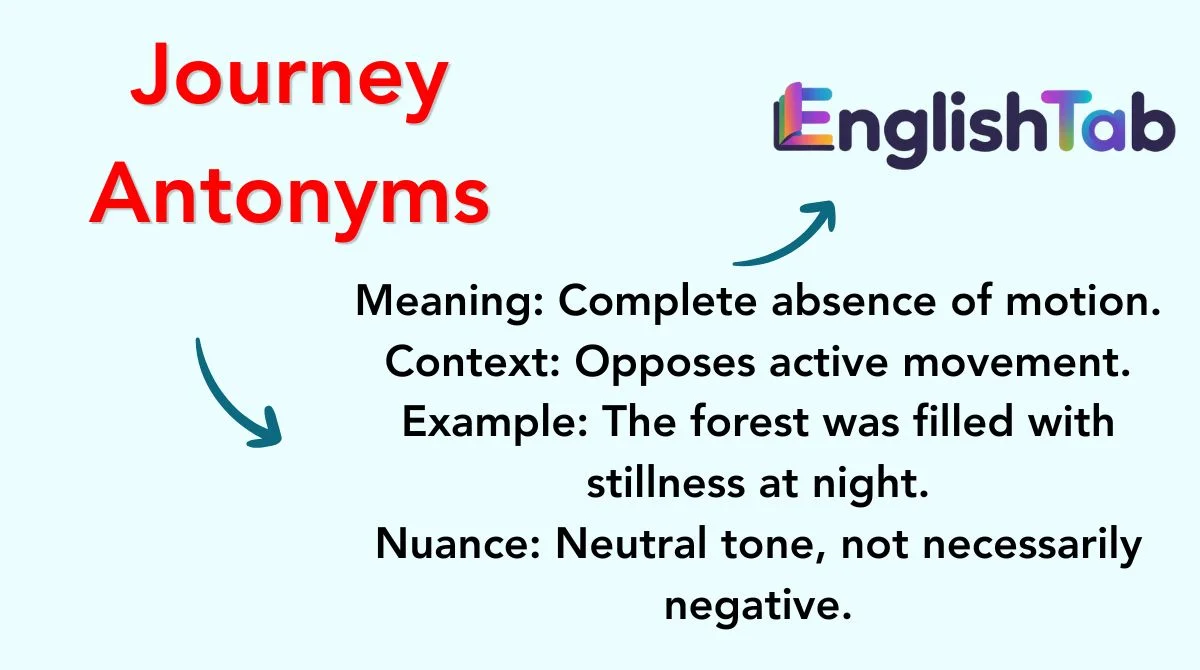
Stillness
Meaning: Complete absence of motion.
Context: Opposes active movement.
Example: The forest was filled with stillness at night.
Nuance: Neutral tone, not necessarily negative.
Standstill
Meaning: Total halt in activity.
Context: Often economic or mechanical.
Example: Traffic came to a standstill.
Nuance: Implies sudden interruption.
Halt
Meaning: A forced stop.
Context: Sudden end to movement.
Example: The project came to a halt.
Nuance: Suggests abruptness.
Stop
Meaning: Cease movement or action.
Context: Everyday contrast to travel.
Example: The car came to a stop.
Nuance: Less dramatic than halt.
End
Meaning: Final point of something.
Context: Opposes ongoing process.
Example: The journey reached its end.
Nuance: Can coexist with journey but marks its conclusion.
Arrival
Meaning: Reaching the destination.
Context: Contrasts process with completion.
Example: Arrival marked the completion of months of travel.
Nuance: Positive but final.
Completion
Meaning: Fulfillment of a task or process.
Context: Opposes the ongoing nature of a journey.
Example: Completion required patience.
Nuance: Formal and academic.
Settlement
Meaning: Establishing permanent residence.
Context: Opposes wandering or travel.
Example: After years of travel, they chose settlement.
Nuance: Implies long-term stability.
Stay
Meaning: Remaining in one place.
Context: Opposes departure.
Example: She chose to stay rather than explore.
Nuance: Mild contrast.
Residence
Meaning: Fixed place of living.
Context: Opposes roaming.
Example: Residence replaced exploration.
Nuance: Formal.
Confinement
Meaning: Restriction within limits.
Context: Opposes freedom of movement.
Example: Confinement limited personal growth.
Nuance: Strongly negative.
Captivity
Meaning: Being held against one’s will.
Context: Opposes voluntary travel.
Example: Captivity replaced freedom.
Nuance: Emotional and intense.
Fixity
Meaning: Permanence without change.
Context: Opposes transformation.
Example: Cultural fixity resisted innovation.
Nuance: Abstract and philosophical.
Inaction
Meaning: Lack of action.
Context: Opposes forward motion.
Example: Inaction delayed progress.
Nuance: Suggests responsibility.
Regression
Meaning: Return to earlier state.
Context: Opposes forward development.
Example: The policy caused regression.
Nuance: Implies backward movement.
Retreat
Meaning: Withdrawal from advancement.
Context: Military or strategic reversal.
Example: The army signaled retreat.
Nuance: Controlled backward movement.
Withdrawal
Meaning: Pulling back from engagement.
Context: Emotional or physical contrast.
Example: Emotional withdrawal halted growth.
Nuance: Often psychological.
Return
Meaning: Going back to origin.
Context: Opposes forward journey.
Example: Return marked a reversal of plans.
Nuance: Neutral; may follow a journey.
Permanence
Meaning: Lasting stability.
Context: Opposes temporary movement.
Example: Permanence replaced transition.
Nuance: Long-term fixity.
Pause
Meaning: Temporary stop.
Context: Interrupts movement.
Example: A pause delayed the expedition.
Nuance: Not permanent.
Antonym Comparison Table
| Word | Physical Contrast | Emotional Tone | Degree of Finality | Academic Use |
|---|---|---|---|---|
| Stagnation | Yes | Negative | Ongoing | High |
| Halt | Yes | Neutral | Sudden | Medium |
| Completion | No | Positive | Final | High |
| Confinement | Yes | Negative | Ongoing | High |
| Regression | Metaphorical | Negative | Reversal | High |
| Stay | Yes | Neutral | Temporary | Low |
| Permanence | No | Neutral | Long-term | High |
| Retreat | Yes | Strategic | Reversal | Medium |
Academic Writing Examples
- The nation’s economic journey was interrupted by stagnation.
- Personal development requires movement rather than inaction.
- Innovation replaces fixity in dynamic societies.
- The reform process avoided regression.
- Social transformation contrasts sharply with cultural permanence.
These examples demonstrate contextual precision rather than random substitution.
When Not to Replace the Word
Avoid replacing “journey” when:
- The metaphor is central to theme
- Emotional tone depends on movement imagery
- The word emphasizes experience rather than distance
- The context is narrative rather than analytical
For instance, in reflective writing, “journey” may be irreplaceable because it implies growth, not mere motion.
Practice Exercises
- Replace “journey” with a stronger antonym in this sentence:
“The project’s journey toward reform slowed.” - Identify whether the opposite should be physical or metaphorical:
“Her emotional journey ended in despair.” - Choose the most accurate antonym:
- stagnation
- arrival
- confinement
- Rewrite:
“The company avoided regression during its growth journey.” - Compare “halt” and “completion” as antonyms in two different sentences.
FAQs
What is the strongest antonym of journey?
“Stagnation” is often the strongest metaphorical antonym because it directly opposes progress.
Is destination an antonym of journey?
Only in specific contexts where process contrasts with endpoint.
Can return be an opposite?
Yes, when “journey” implies forward movement rather than circular travel.
Which antonym works best in academic writing?
“Regression,” “stagnation,” and “fixity” are commonly used in scholarly contexts.
Are emotional opposites valid?
Yes. Words like “confinement” and “despair” oppose the transformative tone of a journey.
Conclusion
The word “journey” is rich in meaning. Its antonyms are not limited to simple stops or endings.
Depending on context, the opposite may involve stagnation, regression, confinement, permanence, or completion.
Writers who understand these nuanced contrasts produce clearer, more persuasive work. Instead of choosing random substitutes, select antonyms based on:
- Direction
- Duration
- Emotional tone
- Finality
- Context
Precision in contrast strengthens argument, enhances readability, and deepens analysis.

Dorian Hale is an English language enthusiast and content creator dedicated to making vocabulary and grammar learning simple, engaging, and accessible for everyone.