In academic and professional writing, clarity depends not only on choosing the right word—but also on understanding its opposite.
Antonyms create contrast. Contrast creates precision. And precision strengthens arguments.
The word intercession carries a powerful meaning: stepping in on behalf of someone else.
But what happens when no one intervenes? What words describe refusal, obstruction, neutrality, or even hostility instead of advocacy?
This comprehensive 2026 guide explores 21+ intercession antonyms, categorized and analyzed in depth. You will learn:
- Direct opposites that clearly reject intervention
- Contextual opposites that depend on tone or situation
- Emotional contrasts that shift intensity
- Academic-level distinctions between close alternatives
- Practical usage examples and nuance differences
By the end, you’ll not only understand what intercession means—but when and how to use its strongest opposites with confidence.
Definition and Core Meaning of “Intercession”
Intercession refers to the act of intervening on behalf of another person, typically to help, mediate, defend, or plead for them.
Core elements include:
- Acting as a mediator
- Advocating for someone else
- Attempting to influence a decision
- Stepping between parties in conflict
- Offering support or protection
In legal, religious, diplomatic, and interpersonal contexts, intercession implies supportive intervention. It carries a generally positive or protective tone.
Example:
The lawyer’s intercession reduced the defendant’s sentence.
To find its antonyms, we look for words that indicate:
- Refusal to intervene
- Withdrawal of support
- Opposition instead of advocacy
- Harm instead of help
- Neutrality instead of mediation
Direct Opposites (Clear Contrasts)
These words represent the strongest conceptual opposites of intercession—situations where no advocacy or mediation occurs.
Abandonment
Neglect
Opposition
Obstruction
Interference
Betrayal
Desertion
Refusal
Nonintervention
Withdrawal
Rejection
Hostility
Condemnation
Denial
Suppression
Sabotage
Persecution
Accusation
Resistance
Deterrence
Indifference
Each of these directly contradicts the supportive or mediating nature of intercession.
Contextual Opposites
Some words function as antonyms depending on context. They may not always oppose intercession, but in certain scenarios they contrast sharply.
Isolation
Detachment
Neutrality
Passivity
Self-interest
Silence
Compliance
Submission
Disengagement
Retaliation
For example:
- Neutrality may contrast with intercession in diplomatic conflicts.
- Silence may oppose advocacy in moral debates.
- Retaliation contrasts with mediation because it escalates rather than resolves conflict.
Context determines strength of opposition.
Emotional & Tone-Based Opposites
Intercession often carries warmth, protection, and concern. Emotional opposites shift tone dramatically.
Compassion vs Indifference
Advocacy vs Hostility
Mediation vs Aggression
Protection vs Persecution
Support vs Betrayal
These contrasts highlight intensity differences. For instance:
- Indifference is emotionally passive.
- Betrayal is emotionally charged and severe.
- Hostility introduces aggression rather than help.
Understanding tone is critical in academic writing.
21+ Antonyms Explained in Detail
Below are 21 carefully analyzed antonyms with meaning, context, example, and nuance comparison.
Abandonment
Meaning: Leaving someone without support.
Context: Emotional, legal, social settings.
Example: His abandonment during the crisis shocked everyone.
Nuance: Unlike intercession, abandonment removes protection rather than providing it.
Neglect
Meaning: Failure to care or act.
Context: Parental, institutional, governmental.
Example: Government neglect worsened the humanitarian crisis.
Nuance: Neglect implies inaction, whereas intercession implies active involvement.
Opposition
Meaning: Active resistance against someone or something.
Context: Political, academic, legal.
Example: The committee’s opposition blocked the proposal.
Nuance: Intercession supports; opposition challenges.
Obstruction
Meaning: Deliberate hindrance.
Context: Legal and bureaucratic environments.
Example: Obstruction of justice carries severe penalties.
Nuance: Obstruction prevents progress; intercession facilitates it.
Interference
Meaning: Unwanted involvement.
Context: Personal, political disputes.
Example: Foreign interference influenced the election.
Nuance: Intercession is requested or helpful; interference is intrusive.
Betrayal
Meaning: Violation of trust.
Context: Personal relationships, political alliances.
Example: His betrayal ended the partnership.
Nuance: Intercession builds trust; betrayal destroys it.
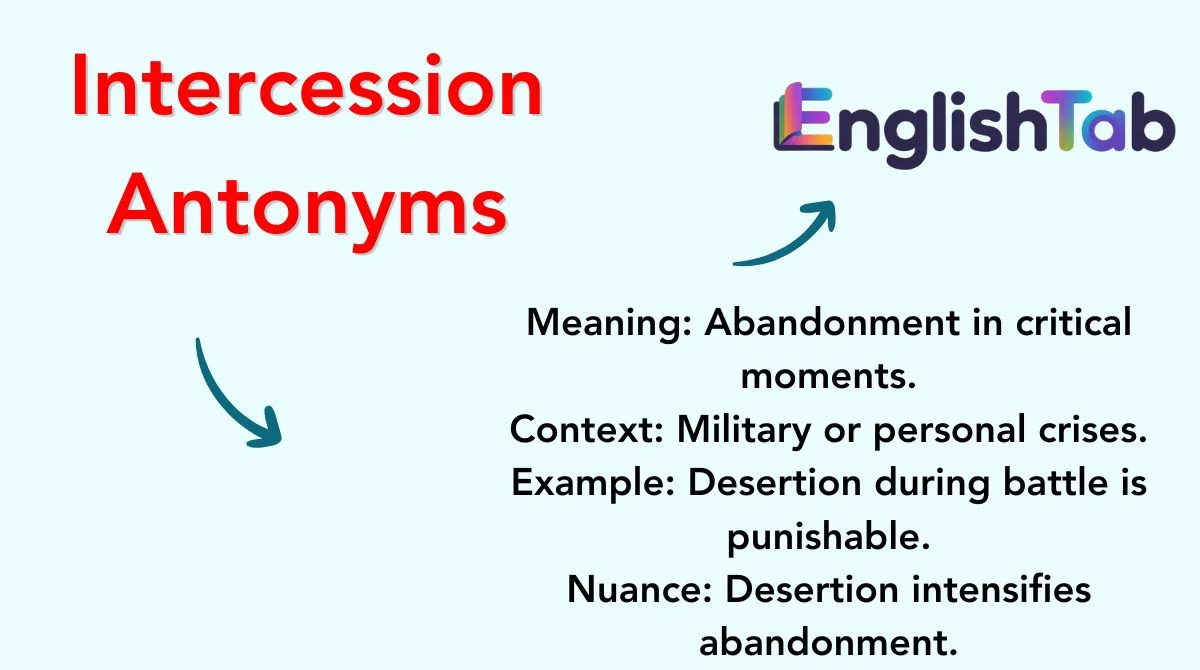
Desertion
Meaning: Abandonment in critical moments.
Context: Military or personal crises.
Example: Desertion during battle is punishable.
Nuance: Desertion intensifies abandonment.
Refusal
Meaning: Declining to act.
Context: Negotiations, appeals.
Example: The judge’s refusal ended the appeal.
Nuance: Refusal signals rejection of intercession opportunity.
Nonintervention
Meaning: Deliberate choice not to get involved.
Context: International relations.
Example: The country adopted a policy of nonintervention.
Nuance: Direct conceptual opposite in diplomatic settings.
Withdrawal
Meaning: Pulling back support.
Context: Financial, emotional, political.
Example: Withdrawal of aid caused instability.
Nuance: Intercession gives; withdrawal removes.
Rejection
Meaning: Dismissal or denial.
Context: Appeals, petitions.
Example: Rejection of the plea left no options.
Nuance: Rejection ends intercessory attempts.
Hostility
Meaning: Open aggression.
Context: Conflict situations.
Example: Hostility between nations escalated tensions.
Nuance: Emotional opposite of mediation.
Condemnation
Meaning: Public disapproval.
Context: Legal or moral judgment.
Example: The leader faced condemnation.
Nuance: Intercession defends; condemnation criticizes.
Denial
Meaning: Refusal to accept or grant.
Context: Legal appeals.
Example: Denial of parole disappointed supporters.
Nuance: Administrative opposite of intercession.
Suppression
Meaning: Forceful control or silencing.
Context: Political and social contexts.
Example: Suppression of protest drew criticism.
Nuance: Intercession amplifies voice; suppression silences it.
Sabotage
Meaning: Intentional damage.
Context: Strategic conflicts.
Example: Sabotage disrupted negotiations.
Nuance: Sabotage actively harms instead of helping.
Persecution
Meaning: Systematic mistreatment.
Context: Religious or political oppression.
Example: Persecution forced many to flee.
Nuance: Intercession protects; persecution harms.
Accusation
Meaning: Blaming someone.
Context: Legal disputes.
Example: False accusation ruined his career.
Nuance: Accusation replaces defense.
Resistance
Meaning: Active opposition.
Context: Political or social movements.
Example: Resistance to reform slowed progress.
Nuance: Resistance blocks; intercession bridges.
Deterrence
Meaning: Discouraging action.
Context: Policy or legal strategy.
Example: Strict laws serve as deterrence.
Nuance: Intercession encourages consideration; deterrence discourages.
Indifference
Meaning: Lack of concern.
Context: Emotional or ethical debates.
Example: Public indifference prolonged injustice.
Nuance: Soft emotional opposite of advocacy.
Antonym Comparison Table
| Antonym | Level of Action | Emotional Tone | Intensity | Typical Context |
|---|---|---|---|---|
| Abandonment | Passive | Cold | Moderate | Personal |
| Neglect | Passive | Detached | Mild | Social |
| Opposition | Active | Firm | Moderate | Political |
| Obstruction | Active | Strategic | High | Legal |
| Betrayal | Active | Emotional | High | Personal |
| Nonintervention | Passive | Neutral | Low | Diplomatic |
| Hostility | Active | Aggressive | High | Conflict |
| Suppression | Active | Authoritarian | Severe | Political |
| Indifference | Passive | Apathetic | Low | Social |
Academic Writing Examples
- Instead of offering intercession, the committee demonstrated open opposition.
- Government nonintervention intensified the crisis.
- Judicial refusal eliminated the possibility of relief.
- Institutional neglect replaced meaningful advocacy.
- Hostility undermined diplomatic resolution.
These contrasts strengthen argumentative clarity.
When Not to Replace the Word
Avoid replacing intercession when:
- The context is religious prayer (specific theological meaning).
- The situation involves formal legal mediation.
- The act is voluntary advocacy, not neutral involvement.
- The tone requires positive moral connotation.
Using words like “interference” or “opposition” could distort meaning.
Practice Exercises
- Replace intercession with an appropriate antonym in this sentence:
“The leader’s ______ worsened the conflict.” - Choose between neglect and opposition for a passive failure to act.
- Identify which antonym fits diplomatic neutrality.
- Write two sentences contrasting intercession and betrayal.
- Explain why suppression is stronger than indifference.
FAQs
What is the strongest antonym of intercession?
Betrayal or persecution, depending on context, represent the strongest emotional opposites.
Is nonintervention always an antonym?
Only in diplomatic or policy contexts.
Can interference be an antonym?
Yes, when involvement is harmful rather than helpful.
Is indifference a weak opposite?
Yes. It contrasts emotionally but lacks active hostility.
Why does context matter?
Because intercession implies positive intervention, and opposites vary in intensity and intention.
Conclusion
Understanding 21+ intercession antonyms expands more than vocabulary—it sharpens analytical precision.
Intercession represents advocacy, mediation, and protective involvement. Its opposites range from passive neglect to active hostility. Selecting the correct antonym depends on:
- Level of action
- Emotional intensity
- Contextual environment
- Moral implication
Writers who master oppositional vocabulary create sharper contrasts, clearer arguments, and more persuasive academic work.
Language becomes powerful not only when we know what a word means—but when we understand what it is not.

Dorian Hale is an English language enthusiast and content creator dedicated to making vocabulary and grammar learning simple, engaging, and accessible for everyone.