Precision in language is the backbone of effective communication. One of the most powerful tools for achieving clarity is contrast.
Opposites sharpen meaning. They define boundaries. They expose nuance. When a writer understands both a word and its antonyms, expression becomes sharper, arguments stronger, and tone more controlled.
The word incognito carries a very specific meaning tied to concealment and identity masking. Replacing it carelessly weakens clarity. Replacing it strategically strengthens writing.
This comprehensive 2K26 guide explores 24+ incognito antonyms, analyzing them through direct contrast, contextual opposition, emotional intensity, and academic usage.
Each term is explained in depth, allowing you to choose the strongest alternative depending on context.
Definition and Core Meaning of “Incognito”
Incognito refers to being in disguise, concealed, or deliberately unrecognized. It describes a state in which identity is hidden from public awareness.
Core elements of meaning:
- Concealed identity
- Intentional anonymity
- Lack of public recognition
- Hidden presence
- Disguised appearance
The word originates from Latin, meaning “unknown.” In modern usage, it appears in contexts such as travel, celebrity privacy, undercover investigations, and digital browsing.
Example:
The diplomat traveled incognito to avoid media attention.
The opposite, therefore, must signal exposure, visibility, recognition, or open identification.
Direct Opposites (Clear Contrasts)
These antonyms directly oppose concealment and anonymity. They emphasize visibility, recognition, and open identity.
Open
Public
Identified
Recognized
Famous
Notorious
Revealed
Exposed
Visible
Known
Declared
Announced
Prominent
Conspicuous
Transparent
Official
Confirmed
Acknowledged
Celebrated
Unhidden
Manifest
Obvious
Evident
Overt
These words strongly contradict the core meaning of incognito by replacing secrecy with clarity or concealment with exposure.
Contextual Opposites
Some words function as antonyms depending on situation rather than strict definition. These include:
- Social visibility (popular, admired)
- Legal exposure (registered, documented)
- Emotional openness (candid, expressive)
- Political identity (outspoken, declared)
For example, a person may not be “incognito” but also not “famous.” Instead, they may be “official” or “registered,” which contrasts concealment without implying celebrity.
Context shapes the strength of opposition.
Emotional & Tone-Based Opposites
Language carries emotional weight. Some antonyms oppose incognito with intensity:
- Famous suggests admiration.
- Notorious suggests negative publicity.
- Prominent implies importance.
- Conspicuous implies standing out, sometimes unintentionally.
- Overt emphasizes deliberate visibility.
Tone matters. Calling someone “exposed” suggests vulnerability. Calling them “celebrated” implies honor. Both oppose incognito but in emotionally different ways.
24+ Antonyms Explained in Detail
Below are detailed explanations of 24+ strong antonyms, each examined for meaning, usage, and nuance.
Open
Meaning: Not hidden; accessible.
Context: Used for visible actions or identities.
Example: The leader made an open appearance.
Nuance: Suggests lack of secrecy but not necessarily fame.
Public
Meaning: Known or seen by many.
Context: Media, announcements, events.
Example: The meeting was public, not incognito.
Nuance: Emphasizes audience exposure.
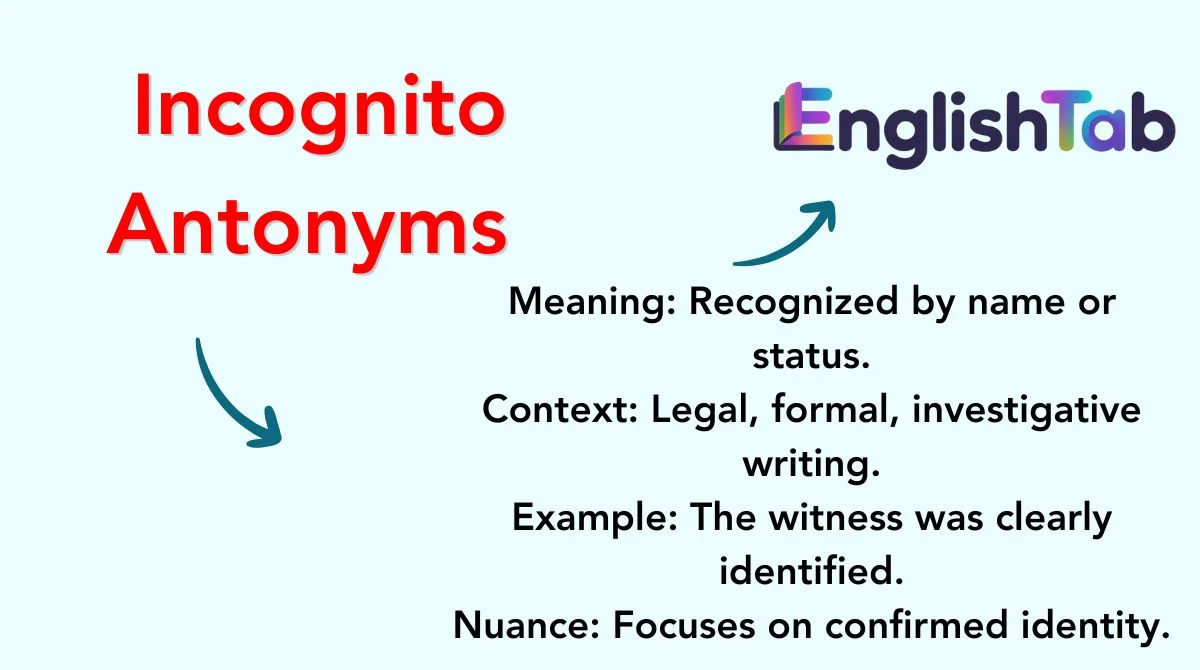
Identified
Meaning: Recognized by name or status.
Context: Legal, formal, investigative writing.
Example: The witness was clearly identified.
Nuance: Focuses on confirmed identity.
Recognized
Meaning: Officially acknowledged or known.
Context: Academic, social, political settings.
Example: She is a recognized authority.
Nuance: Suggests respect or legitimacy.
Famous
Meaning: Widely known.
Context: Cultural, entertainment, leadership.
Example: The famous actor arrived openly.
Nuance: Implies admiration and publicity.
Notorious
Meaning: Famous for negative reasons.
Context: Crime, controversy.
Example: The notorious figure avoided no attention.
Nuance: Negative publicity.
Revealed
Meaning: Made known.
Context: Journalism, investigation.
Example: His identity was revealed.
Nuance: Suggests prior concealment.
Exposed
Meaning: Left without protection or concealment.
Context: Scandals, vulnerability.
Example: The undercover agent was exposed.
Nuance: Implies risk or danger.
Visible
Meaning: Able to be seen.
Context: Physical presence.
Example: She remained visible throughout the event.
Nuance: Focuses on physical perception.
Known
Meaning: Familiar or recognized.
Context: General writing.
Example: He is known across the region.
Nuance: Neutral recognition.
Declared
Meaning: Officially stated.
Context: Legal or political.
Example: The candidate declared his identity publicly.
Nuance: Suggests formality.
Announced
Meaning: Publicly made known.
Context: Media, speeches.
Example: The visit was announced in advance.
Nuance: Planned publicity.
Prominent
Meaning: Important and well-known.
Context: Academic, political.
Example: A prominent scholar attended.
Nuance: Status-based recognition.
Conspicuous
Meaning: Easily noticed.
Context: Social or physical visibility.
Example: His presence was conspicuous.
Nuance: Sometimes unintended attention.
Transparent
Meaning: Open and honest.
Context: Ethics, governance.
Example: The process was transparent.
Nuance: Moral clarity.
Official
Meaning: Authorized or formal.
Context: Government or institutions.
Example: The official visit drew attention.
Nuance: Legitimacy.
Confirmed
Meaning: Verified as true.
Context: Reports, investigations.
Example: Her identity was confirmed.
Nuance: Removes uncertainty.
Acknowledged
Meaning: Recognized openly.
Context: Academic citations.
Example: The author was acknowledged.
Nuance: Acceptance.
Celebrated
Meaning: Publicly praised.
Context: Cultural or academic recognition.
Example: A celebrated historian attended.
Nuance: Positive recognition.
Unhidden
Meaning: Not concealed.
Context: Direct contrast usage.
Example: His motives were unhidden.
Nuance: Rare but literal opposite.
Manifest
Meaning: Clearly shown.
Context: Formal academic writing.
Example: The evidence was manifest.
Nuance: Strong visibility.
Obvious
Meaning: Easily understood or seen.
Context: Argumentation.
Example: The identity was obvious.
Nuance: Leaves no doubt.
Evident
Meaning: Plainly visible or understood.
Context: Research papers.
Example: The truth became evident.
Nuance: Slightly more formal than obvious.
Overt
Meaning: Open and observable.
Context: Politics or social analysis.
Example: The campaign was overt.
Nuance: Emphasizes intentional visibility.
Antonym Comparison Table
| Word | Visibility Level | Emotional Tone | Formality | Best Used In |
|---|---|---|---|---|
| Open | Moderate | Neutral | Medium | General writing |
| Public | High | Neutral | Medium | Media contexts |
| Famous | Very High | Positive | Low | Cultural topics |
| Notorious | Very High | Negative | Medium | Crime analysis |
| Exposed | High | Vulnerable | Medium | Investigative writing |
| Prominent | High | Positive | High | Academic texts |
| Transparent | Moderate | Ethical | High | Policy writing |
| Overt | High | Intentional | High | Political analysis |
Academic Writing Examples
- Instead of writing:
“The official attended incognito.” You may write:
“The official attended openly, making his presence public and acknowledged.” - Research-based usage:
“The author did not publish anonymously; her identity was fully declared.” - Political analysis:
“Rather than acting covertly, the movement operated in overt and transparent ways.”
Choosing the correct antonym enhances clarity and academic authority.
When Not to Replace the Word
Do not replace incognito when:
- The disguise element is central.
- The secrecy is intentional and temporary.
- The narrative relies on undercover activity.
- Literary tone demands precision.
For example:
The detective worked incognito to gather evidence.
Replacing it with “secretly” or “privately” weakens the meaning because disguise is key.
Practice Exercises
- Replace incognito with a stronger antonym:
- The singer did not arrive incognito; she arrived ______.
- The investigation was not incognito but completely ______.
- The scholar was far from incognito; she was widely ______.
- Choose the strongest antonym:
- For political transparency: overt / famous / obvious
- For celebrity recognition: manifest / famous / confirmed
- For academic authority: prominent / public / open
- Rewrite:
- “The leader avoided attention.”
Convert to a sentence using a clear antonym of incognito.
- “The leader avoided attention.”
FAQs
What is the strongest antonym of incognito?
The strongest general antonym is public, because it directly opposes concealment with visibility.
Is famous always the opposite of incognito?
Not always. Famous implies widespread recognition, while incognito refers specifically to hidden identity. Someone can be famous yet temporarily incognito.
Can exposed be used as a direct opposite?
Yes, especially when hidden identity becomes revealed unexpectedly.
Is anonymous the same as incognito?
Anonymous focuses on name concealment, while incognito emphasizes disguise or hidden presence.
Which antonym works best in academic writing?
Prominent, evident, overt, and transparent are strong academic alternatives.
Conclusion
Mastering antonyms deepens linguistic precision. The word incognito carries layers of concealment, disguise, and intentional anonymity.
Its opposites span from simple visibility to intense public recognition.
Choosing the correct antonym depends on context, tone, emotional weight, and academic purpose.
Words like public, overt, prominent, and exposed provide strong contrast, but each carries nuance.
Language is not just about replacing words. It is about selecting the exact contrast that strengthens clarity, credibility, and impact.
Understanding these 24+ incognito antonyms gives writers sharper tools for 2K26-level communication excellence.

Dorian Hale is an English language enthusiast and content creator dedicated to making vocabulary and grammar learning simple, engaging, and accessible for everyone.