Opposites sharpen meaning. In academic writing, journalism, storytelling, and policy analysis, contrast is one of the most powerful clarity tools.
When writers understand antonyms deeply—not just as dictionary opposites but as contextual contrasts—they can control tone, precision, and argument strength.
The verb immigrate carries legal, social, emotional, and geopolitical weight. Therefore, its antonyms are not simple mirror words. Some express movement in the opposite direction.
Others reflect social resistance, exclusion, or emotional withdrawal. Still others operate only in certain contexts.
This comprehensive 2026 guide explores 24+ immigrate antonyms, explains their nuances, and compares their academic usage so you can apply them accurately and professionally.
Definition and Core Meaning of “Immigrate”
Immigrate means to enter and settle permanently in a foreign country.
Key elements embedded in the term:
- Movement across national borders
- Intent to live permanently
- Legal or official relocation
- Social integration into a new state
For example:
Thousands of families immigrate each year in search of economic opportunity.
Unlike temporary travel, immigration implies long-term settlement and a shift in national belonging. Therefore, antonyms must challenge at least one of these core components: direction, permanence, legality, or inclusion.
Direct Opposites (Clear Contrasts)
These are the strongest and most structurally direct antonyms of immigrate. They typically reverse direction or cancel permanent settlement.
- Emigrate
- Depart
- Exit
- Leave
- Return
- Repatriate
- Withdraw
- Evacuate
- Relocate (away)
- Disperse
- Abandon
- Vacate
- Retreat
- Move out
- Resettle (back)
- Go back
- Remigrate
- Out-migrate
- Reverse migrate
- Exit permanently
- Pull out
- Disengage
- Return home
- Evict (in passive contrast contexts)
Some of these are directional opposites. Others are structural or legal reversals.
Contextual Opposites
Certain words oppose immigrate only depending on usage:
- Stay (remain in original country)
- Remain
- Resist migration
- Block entry
- Close borders
- Deport
- Expel
- Extradite
- Exclude
- Reject
These words do not describe movement in the opposite direction but instead cancel, prevent, or reverse immigration.
For example:
The government chose to close borders instead of encouraging immigration.
Here, the contrast lies in policy rather than movement.
Emotional & Tone-Based Opposites
Immigration often carries hope, ambition, and forward movement. Emotional antonyms therefore reflect rejection, displacement, or forced removal:
- Deport (harsh, legal removal)
- Expel (strong rejection)
- Ban (restrictive tone)
- Reject (social or political denial)
- Abandon (emotionally heavy departure)
- Flee (opposite motivation — escape rather than settle)
Tone shifts dramatically depending on which antonym is selected.
Compare:
She immigrated to Canada for opportunity.
She was deported from Canada.
The emotional force is radically different.
24+ Antonyms Explained in Detail
Below are detailed explanations of 26 strong antonyms.
Emigrate
Meaning: To leave one’s country to settle elsewhere.
Context: Directional opposite from the perspective of the original country.
Example: Many citizens emigrated during the economic crisis.
Nuance: Technically not a pure opposite—it is perspective-based. Immigration is arrival; emigration is departure.
Depart
Meaning: To leave a place.
Context: General movement away.
Example: The family departed before completing paperwork.
Nuance: Lacks permanence element of immigration.
Exit
Meaning: To go out from.
Context: Formal or institutional usage.
Example: The program tracks when individuals exit the country.
Nuance: More mechanical than emotional.
Leave
Meaning: To go away from.
Context: Informal, broad.
Example: They chose to leave instead of immigrate.
Nuance: Does not imply cross-border movement.
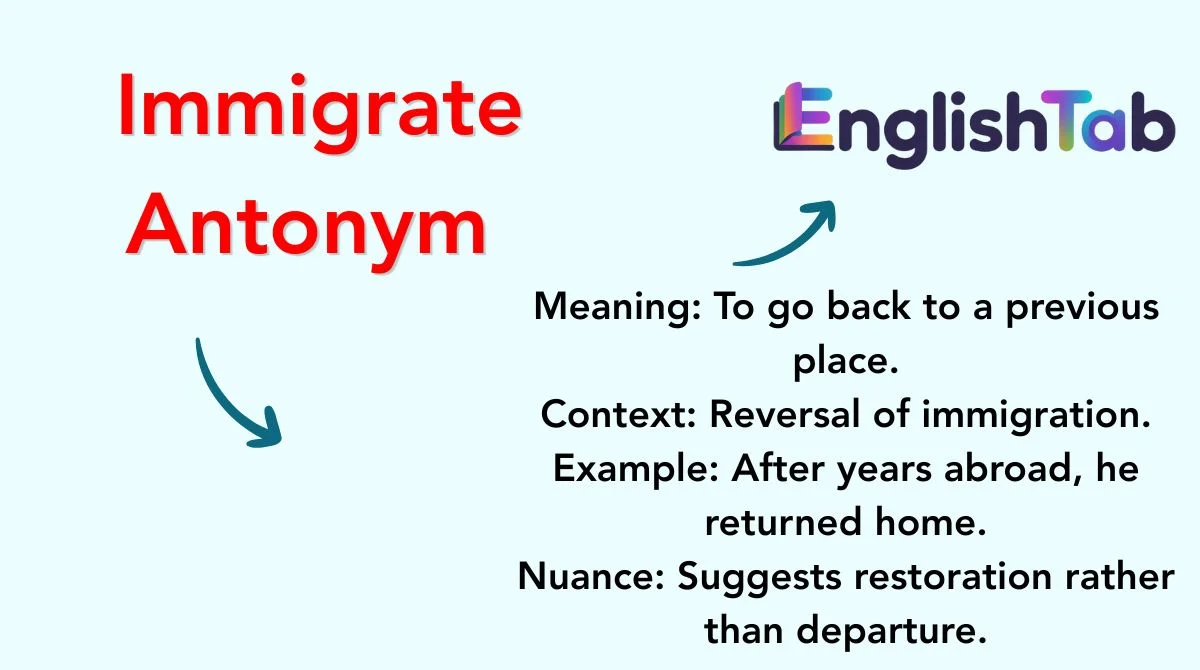
Return
Meaning: To go back to a previous place.
Context: Reversal of immigration.
Example: After years abroad, he returned home.
Nuance: Suggests restoration rather than departure.
Repatriate
Meaning: To return to one’s homeland.
Context: Legal or official return.
Example: Citizens were repatriated after conflict.
Nuance: Often state-assisted.
Withdraw
Meaning: To pull back.
Context: Institutional or organizational movement.
Example: Workers withdrew from foreign employment programs.
Nuance: Less geographic emphasis.
Evacuate
Meaning: To leave urgently for safety.
Context: Emergency situations.
Example: Residents evacuated before the storm.
Nuance: Opposite motivation—safety rather than settlement.
Relocate (back)
Meaning: To move residence elsewhere.
Context: Corporate or structured movement.
Example: The company relocated staff back to headquarters.
Nuance: Not always permanent.
Disperse
Meaning: To scatter.
Context: Population breakdown.
Example: The community dispersed after policy changes.
Nuance: Opposes concentration aspect of immigration.
Abandon
Meaning: To leave behind permanently.
Context: Emotional tone.
Example: Some abandoned their migration plans.
Nuance: Strong emotional implication.
Vacate
Meaning: To leave a property.
Context: Legal property use.
Example: Tenants vacated the premises.
Nuance: Property-focused, not national.
Retreat
Meaning: To move backward.
Context: Political or military.
Example: The group retreated from international expansion.
Nuance: Suggests reversal under pressure.
Move out
Meaning: To leave a residence.
Context: Residential shift.
Example: They moved out instead of settling permanently.
Nuance: Informal.
Resettle (back)
Meaning: To settle again in former place.
Context: Migration reversal.
Example: Refugees resettled in their home country.
Nuance: Structured relocation.
Remigrate
Meaning: To migrate again, often back.
Context: Cyclical migration patterns.
Example: Workers remigrated after contracts ended.
Nuance: Technical demographic term.
Out-migrate
Meaning: To leave a region.
Context: Population studies.
Example: Youth out-migrated in large numbers.
Nuance: Statistical usage.
Reverse migrate
Meaning: To migrate back.
Context: Economic reversal trends.
Example: Professionals reverse migrated during recession.
Nuance: Modern sociological term.
Evict
Meaning: To remove legally from property.
Context: Housing law.
Example: They were evicted before applying to immigrate.
Nuance: Coercive removal.
Deport
Meaning: To forcibly remove from a country.
Context: Immigration enforcement.
Example: The individual was deported for visa violations.
Nuance: Strong legal and emotional force.
Expel
Meaning: To officially force out.
Context: Institutional or national.
Example: Authorities expelled undocumented residents.
Nuance: Authoritative rejection.
Exclude
Meaning: To deny entry or participation.
Context: Policy restriction.
Example: The policy excludes foreign applicants.
Nuance: Preventative rather than removal.
Reject
Meaning: To refuse acceptance.
Context: Visa processing.
Example: The application was rejected.
Nuance: Administrative tone.
Ban
Meaning: To officially prohibit.
Context: Government policy.
Example: The country banned new arrivals.
Nuance: Broad prohibition.
Close borders
Meaning: To restrict entry nationally.
Context: Political response.
Example: Leaders closed borders during crisis.
Nuance: Collective action rather than individual movement.
Antonym Comparison Table
| Word | Directional Opposite | Legal Force | Emotional Intensity | Academic Usage |
|---|---|---|---|---|
| Emigrate | Yes | Neutral | Low | Demographics |
| Return | Yes | Neutral | Moderate | Sociology |
| Repatriate | Yes | Strong | Moderate | International law |
| Deport | Yes | Strong | High | Policy analysis |
| Expel | Yes | Strong | High | Political science |
| Exclude | No | Moderate | Low | Policy theory |
| Abandon | No | None | High | Narrative writing |
| Evacuate | Yes | Emergency | High | Disaster studies |
| Withdraw | Partial | Low | Low | Institutional writing |
Academic Writing Examples
Policy analysis:
While immigration increased labor supply, repatriation policies reduced demographic growth.
Comparative sociology:
Nations that encourage immigration often discourage emigration through retention incentives.
Legal context:
The distinction between voluntary return and deportation reflects differing legal consequences.
Historical writing:
Industrial expansion attracted immigrants, whereas economic collapse prompted reverse migration.
When Not to Replace the Word
Avoid replacing immigrate when:
- Legal specificity is required
- Data distinguishes immigration from emigration
- International law terminology must remain precise
- Statistical clarity is essential
For example, using leave instead of emigrate may weaken analytical precision.
Practice Exercises
- Replace immigrate with a suitable antonym in this sentence:
“The policy encourages citizens to ______ instead of settle permanently.” - Identify whether the following is directional or policy-based: exclude.
- Rewrite this contrast academically:
“Some families immigrated; others went back.” - Choose the strongest emotional antonym for a forced removal scenario.
- Explain the difference between deport and repatriate in two sentences.
FAQs
What is the strongest direct antonym of immigrate?
Emigrate is the clearest directional counterpart, though technically perspective-based.
Is deport the opposite of immigrate?
In enforcement contexts, yes. It represents forced removal after entry.
Can return be an antonym?
Yes, when referring to reversal of permanent settlement.
Are all antonyms movement-based?
No. Some are policy-based, such as exclude or ban.
Which antonym is most formal?
Repatriate is highly formal and used in international law.
Conclusion
Understanding 24+ immigrate antonyms requires more than memorizing opposites. True mastery involves recognizing directionality, legal authority, emotional intensity, and contextual nuance.
Some antonyms reverse movement. Others prevent it. Some imply coercion.
Others suggest voluntary choice. Selecting the correct opposite sharpens clarity, strengthens academic argumentation, and enhances analytical precision.
In professional writing—especially in sociology, political science, law, and migration studies—precision is not optional. It defines credibility.
Master the contrasts, and you master the meaning.

Dorian Hale is an English language enthusiast and content creator dedicated to making vocabulary and grammar learning simple, engaging, and accessible for everyone.