Opposites sharpen meaning. In academic and professional writing, clarity often emerges through contrast. When we understand what a word is not, we better grasp what it truly is.
The study of antonyms is not just about vocabulary expansion; it is about precision, nuance, and intellectual depth.
The word honesty carries ethical weight. It implies truthfulness, moral integrity, and transparency. Yet in real-world communication, dishonesty appears in many forms—subtle, strategic, emotional, or intentional.
Exploring 24+ honesty antonyms allows writers to move beyond simplistic opposites and instead choose language that accurately reflects context, tone, and degree.
This article presents a structured and analytical examination of honesty’s opposites. It avoids surface-level definitions and instead focuses on comparison, nuance, and practical application.
Definition and Core Meaning of “Honesty”
Honesty refers to the quality of being truthful, sincere, and morally upright. It includes:
- Speaking the truth
- Acting with integrity
- Avoiding deception
- Maintaining transparency
Honesty is both a moral principle and a communicative practice. It operates in personal relationships, legal systems, academic work, journalism, politics, and everyday conversation.
To understand its antonyms, we must identify its core components:
- Truthfulness
- Transparency
- Integrity
- Sincerity
- Moral uprightness
Any word that directly undermines one or more of these elements functions as an antonym of honesty.
Direct Opposites (Clear Contrasts)
These are the strongest and most unmistakable antonyms of honesty:
- Dishonesty
- Deceit
- Deception
- Fraud
- Lying
- Falsehood
- Untruthfulness
- Duplicity
- Treachery
- Corruption
- Cheating
- Perjury
- Hypocrisy
- Betrayal
- Fabrication
- Falsification
- Misrepresentation
- Trickery
- Sham
- Counterfeit
- Insincerity
- Evasion
- Concealment
- Manipulation
Each of these directly conflicts with truth or integrity. However, their intensity and scope differ significantly.
Contextual Opposites
Some words function as antonyms only in certain situations:
- Secrecy
- Privacy
- Discretion
- Diplomacy
- Spin
- Withholding
- Omission
- Strategic ambiguity
For example, privacy is not inherently dishonest. Yet in contexts requiring transparency—such as public office—it can function as the opposite of honesty.
Thus, context determines whether a word truly opposes honesty or simply limits openness.
Emotional & Tone-Based Opposites
Some antonyms differ primarily in emotional force:
- Deception (neutral tone)
- Treachery (emotionally charged)
- Betrayal (personal and painful)
- Fraud (legal and formal)
- Trickery (mild or playful)
- Corruption (systemic and moral collapse)
Understanding emotional intensity allows writers to select words that match the seriousness of the situation.
24+ Antonyms Explained in Detail
Below is a deep comparative breakdown.
Dishonesty
Meaning: Lack of truthfulness or integrity.
Context: General opposite of honesty.
Example: The report was rejected due to dishonesty in data collection.
Nuance: Broad term covering many forms of unethical behavior.
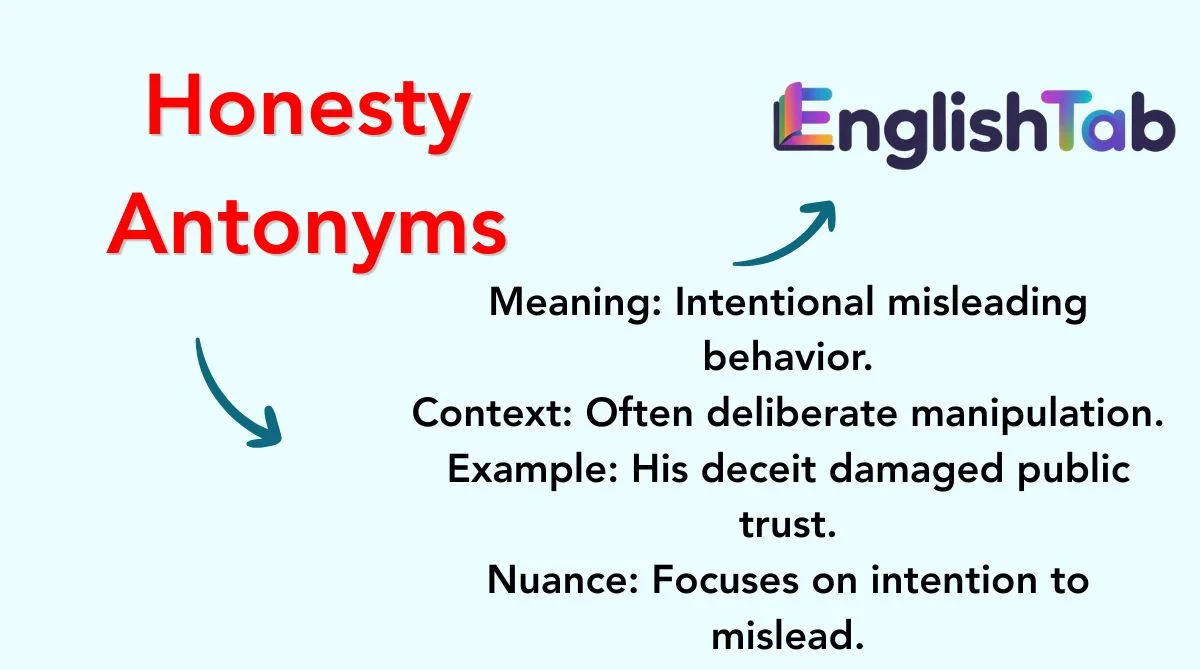
Deceit
Meaning: Intentional misleading behavior.
Context: Often deliberate manipulation.
Example: His deceit damaged public trust.
Nuance: Focuses on intention to mislead.
Deception
Meaning: Act of causing someone to believe something false.
Context: Personal or institutional.
Example: The advertisement relied on deception.
Nuance: Slightly more neutral than “treachery.”
Fraud
Meaning: Criminal deception for financial gain.
Context: Legal or financial settings.
Example: The company was charged with fraud.
Nuance: Formal and legalistic.
Lying
Meaning: Making false statements knowingly.
Context: Everyday communication.
Example: She admitted to lying about her grades.
Nuance: Direct and simple.
Falsehood
Meaning: Statement that is untrue.
Context: Academic or formal writing.
Example: The theory was based on falsehood.
Nuance: Focuses on the untrue statement, not the intent.
Duplicity
Meaning: Deceptive double-dealing.
Context: Political or strategic environments.
Example: The leader’s duplicity became evident.
Nuance: Suggests two-faced behavior.
Treachery
Meaning: Betrayal of trust.
Context: Emotional or political conflict.
Example: His treachery shocked his allies.
Nuance: Strong emotional weight.
Corruption
Meaning: Moral decay, especially in power systems.
Context: Government or institutions.
Example: Corruption undermines democracy.
Nuance: Systemic dishonesty.
Cheating
Meaning: Breaking rules unfairly.
Context: Academic, sports, relationships.
Example: Cheating violates trust.
Nuance: Rule-focused dishonesty.
Perjury
Meaning: Lying under oath.
Context: Legal settings.
Example: Perjury is punishable by law.
Nuance: Highly specific legal offense.
Hypocrisy
Meaning: Claiming moral standards one does not follow.
Context: Moral criticism.
Example: Public hypocrisy damages credibility.
Nuance: Conflict between words and actions.
Betrayal
Meaning: Breaking trust.
Context: Personal relationships.
Example: The betrayal ended their friendship.
Nuance: Emotional damage emphasized.
Fabrication
Meaning: Inventing information.
Context: Journalism or research.
Example: The article was pure fabrication.
Nuance: Creative invention of falsehood.
Falsification
Meaning: Altering facts dishonestly.
Context: Academic or scientific misconduct.
Example: Data falsification led to dismissal.
Nuance: Manipulating real information.
Misrepresentation
Meaning: Presenting false or misleading account.
Context: Business or media.
Example: The contract involved misrepresentation.
Nuance: Distortion rather than full invention.
Trickery
Meaning: Clever deception.
Context: Informal situations.
Example: The prank relied on trickery.
Nuance: May be mild or playful.
Sham
Meaning: Something falsely presented as genuine.
Context: Critical tone.
Example: The ceremony was a sham.
Nuance: Implies total lack of authenticity.
Counterfeit
Meaning: Fake imitation.
Context: Goods or currency.
Example: Counterfeit bills were discovered.
Nuance: Physical falseness.
Insincerity
Meaning: Lack of genuine feeling.
Context: Emotional communication.
Example: Her apology felt like insincerity.
Nuance: Focuses on emotional authenticity.
Evasion
Meaning: Avoiding truth deliberately.
Context: Political interviews.
Example: His answer was pure evasion.
Nuance: Avoidance rather than direct lying.
Concealment
Meaning: Hiding information.
Context: Legal or personal secrets.
Example: Concealment raised suspicion.
Nuance: Passive dishonesty.
Manipulation
Meaning: Influencing unfairly or deceptively.
Context: Psychological or strategic.
Example: Emotional manipulation destroys trust.
Nuance: Control-focused dishonesty.
Untruthfulness
Meaning: Habit of not telling truth.
Context: Formal tone.
Example: Untruthfulness damages credibility.
Nuance: More descriptive than accusatory.
Antonym Comparison Table
| Word | Intentional? | Emotional Intensity | Legal Implication | Focus |
|---|---|---|---|---|
| Dishonesty | Yes | Medium | No | General integrity |
| Fraud | Yes | High | Yes | Financial gain |
| Hypocrisy | Yes | Medium | No | Moral inconsistency |
| Treachery | Yes | Very High | No | Betrayal |
| Perjury | Yes | High | Yes | Courtroom |
| Manipulation | Yes | Medium | Sometimes | Control |
| Concealment | Sometimes | Low | Sometimes | Hiding |
| Deception | Yes | Medium | No | Misleading |
Academic Writing Examples
- The study was retracted due to falsification of data.
- Political corruption erodes institutional trust.
- Witness perjury compromises judicial integrity.
- Media misrepresentation influences public opinion.
- Ethical frameworks collapse under systemic dishonesty.
Each antonym aligns with specific domains of discourse.
When Not to Replace the Word
Avoid substituting honesty with its antonyms when:
- The situation involves privacy, not deception.
- The issue is error, not intent.
- Cultural differences affect communication style.
- Emotional restraint is mistaken for insincerity.
Precision prevents overstatement.
Practice Exercises
- Replace “dishonesty” with a more precise antonym in a legal context.
- Identify whether the issue involves deception or concealment.
- Choose between hypocrisy and duplicity in political writing.
- Rewrite a sentence using falsification instead of fabrication.
- Analyze emotional tone differences between betrayal and treachery.
FAQs
What is the strongest antonym of honesty?
Treachery and fraud are among the strongest because they imply serious harm and intentional deception.
Is secrecy always an antonym of honesty?
No. Secrecy becomes an antonym only when transparency is ethically required.
What is the legal opposite of honesty?
Perjury and fraud are formal legal opposites.
How does hypocrisy differ from dishonesty?
Hypocrisy involves moral contradiction, while dishonesty focuses on truthfulness.
Which antonym is best for academic writing?
Falsification, misrepresentation, and fabrication are most common in scholarly contexts.
Conclusion
Understanding 24+ honesty antonyms reveals that dishonesty is not a single concept but a spectrum. Some words emphasize criminal intent.
Others highlight emotional betrayal. Some focus on data manipulation, while others stress moral inconsistency.
Effective writing demands precision. Rather than defaulting to “dishonesty,” skilled communicators select the antonym that best matches context, intensity, and domain.
Mastering these contrasts strengthens academic argumentation, professional credibility, and linguistic clarity in 2K26 and beyond.

Dorian Hale is an English language enthusiast and content creator dedicated to making vocabulary and grammar learning simple, engaging, and accessible for everyone.