Clear writing depends on contrast. When readers understand not only what a word means but also what it does not mean, clarity improves dramatically.
Opposites sharpen thought. They reveal boundaries. They remove ambiguity.
The word “guise” is especially interesting because it deals with concealment, disguise, and presentation.
In academic writing, journalism, politics, psychology, and literature, it often signals hidden intention.
Understanding the antonyms of guise is not just a vocabulary exercise. It is a study in transparency versus concealment, honesty versus appearance, exposure versus disguise.
This article provides 19+ powerful antonyms of “guise,” deeply analyzed and compared for precision in professional writing.
Definition and Core Meaning of “Guise”
Guise refers to an outward appearance that hides the true nature of someone or something. It implies intentional presentation—often deceptive or strategic.
Core elements of “guise”:
- A false or misleading appearance
- A form of concealment
- A mask for hidden reality
- A protective or manipulative presentation
Example:
The policy was introduced under the guise of reform.
Here, guise suggests the reform is not genuine; it is a cover for another motive.
To identify true antonyms, we must focus on reversing these ideas:
- Concealment → Revelation
- Masking → Exposure
- False appearance → Authentic reality
- Hidden intention → Transparency
Direct Opposites (Clear Contrasts)
These words most strongly oppose the meaning of “guise” because they represent openness, truth, or absence of concealment.
Revelation
Disclosure
Transparency
Authenticity
Honesty
Truth
Reality
Exposure
Openness
Candor
Sincerity
Genuineness
Directness
Clarity
Frankness
Unmasking
Manifestation
Declaration
Plainness
Each of these words directly counters the idea of disguise or hidden presentation.
Contextual Opposites
Some words oppose “guise” depending on usage context. They may not always be direct opposites but can function as such in academic or rhetorical settings.
- Confession
- Admission
- Publicity
- Demonstration
- Announcement
- Visibility
- Illumination
- Verification
- Authentication
For example:
Under the guise of research, data was manipulated.
Opposite in context:
Through public disclosure, the data was fully revealed.
Here, disclosure functions as the contextual opposite of guise.
Emotional & Tone-Based Opposites
“Guise” often carries suspicion. Therefore, emotional opposites relate to trust and sincerity.
Low-Trust Tone (Guise Context):
- Deceptive
- Strategic
- Hidden
- Calculated
High-Trust Tone (Opposites):
- Transparent
- Genuine
- Open-hearted
- Honest
- Straightforward
Emotionally, replacing guise with its antonyms shifts tone from doubt to credibility.
Example shift:
He acted under the guise of friendship.
He acted with genuine friendship.
The emotional difference is profound.
19+ Antonyms Explained in Detail
Revelation
Meaning: The act of making something known.
Context: Used when hidden facts are brought into public view.
Example: The revelation of the documents ended the controversy.
Nuance: Unlike “guise,” which hides truth, revelation actively exposes it.
Disclosure
Meaning: Intentional sharing of previously hidden information.
Context: Legal, academic, corporate settings.
Example: Full financial disclosure was required.
Nuance: Disclosure implies responsibility; guise implies concealment.
Transparency
Meaning: Openness and clarity in actions or intentions.
Context: Governance, leadership, ethics.
Example: Transparency builds institutional trust.
Nuance: Transparency prevents the need for a guise.
Authenticity
Meaning: Genuine and real quality.
Context: Psychology, branding, identity.
Example: Her authenticity impressed the panel.
Nuance: Authenticity eliminates artificial presentation.
Honesty
Meaning: Commitment to truthfulness.
Context: Moral and ethical discussions.
Example: Honesty strengthens relationships.
Nuance: Guise suggests manipulation; honesty rejects it.
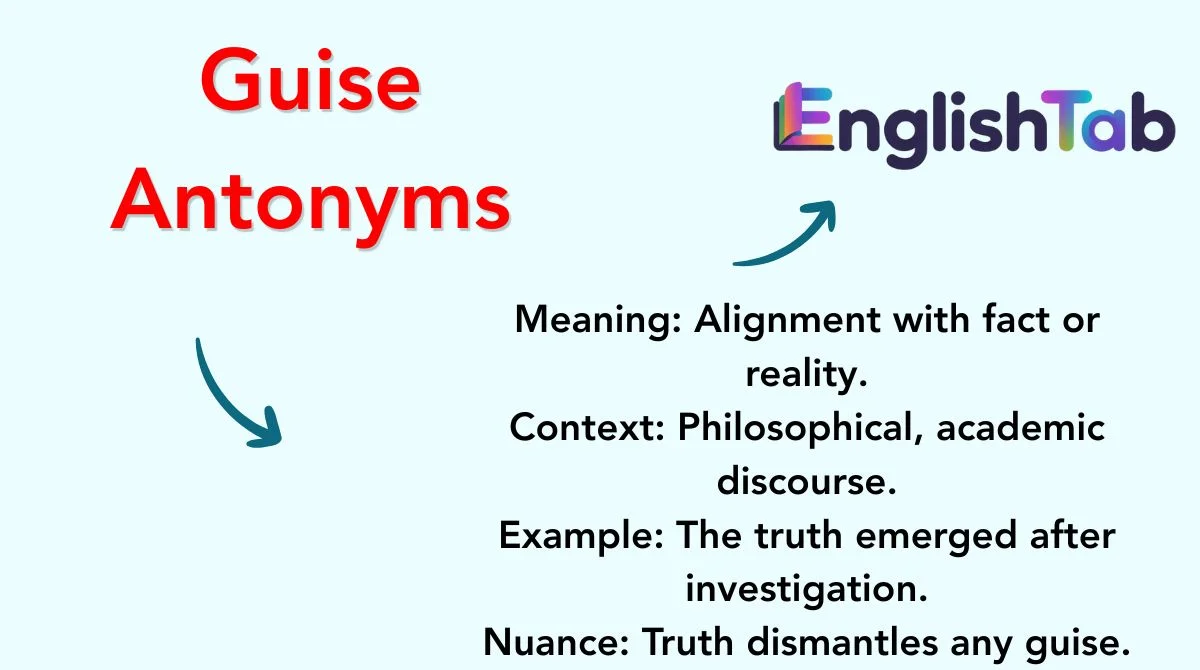
Truth
Meaning: Alignment with fact or reality.
Context: Philosophical, academic discourse.
Example: The truth emerged after investigation.
Nuance: Truth dismantles any guise.
Reality
Meaning: Actual state of things.
Context: Analytical writing.
Example: The reality differed from the public image.
Nuance: Reality stands behind—or against—a guise.
Exposure
Meaning: The act of uncovering hidden information.
Context: Journalism, investigative research.
Example: The exposure of corruption changed policy.
Nuance: Exposure is forceful revelation; guise is protective masking.
Openness
Meaning: Willingness to be transparent.
Context: Leadership communication.
Example: Openness encourages dialogue.
Nuance: Openness removes hidden layers.
Candor
Meaning: Honest expression without reservation.
Context: Professional feedback.
Example: She spoke with refreshing candor.
Nuance: Candor is direct; guise is indirect.
Sincerity
Meaning: Genuine intention without deceit.
Context: Interpersonal communication.
Example: His apology showed sincerity.
Nuance: Sincerity eliminates false presentation.
Genuineness
Meaning: Authentic and real nature.
Context: Character evaluation.
Example: Genuineness builds trust.
Nuance: Guise questions reality; genuineness confirms it.
Directness
Meaning: Clear and straightforward communication.
Context: Business writing.
Example: Directness avoids misunderstanding.
Nuance: Directness contrasts strategic masking.
Clarity
Meaning: Freedom from ambiguity.
Context: Academic writing.
Example: Clarity improves comprehension.
Nuance: Guise introduces ambiguity; clarity removes it.
Frankness
Meaning: Honest and open expression.
Context: Personal communication.
Example: He answered with frankness.
Nuance: Frankness removes emotional concealment.
Unmasking
Meaning: Revealing the true identity.
Context: Investigative contexts.
Example: The unmasking shocked the audience.
Nuance: Unmasking is the dramatic opposite of guise.
Manifestation
Meaning: Clear display of reality.
Context: Abstract discussions.
Example: The protest was a manifestation of anger.
Nuance: Manifestation shows openly what guise hides.
Declaration
Meaning: Public statement of intent.
Context: Political or legal discourse.
Example: The declaration clarified policy.
Nuance: Declaration signals openness.
Plainness
Meaning: Simplicity without ornament or concealment.
Context: Writing style analysis.
Example: Plainness enhances readability.
Nuance: Plainness rejects artificial presentation.
Antonym Comparison Table
| Antonym | Strength of Opposition | Emotional Tone | Formal Usage | Exposure Level |
|---|---|---|---|---|
| Revelation | Very Strong | Neutral | High | Complete |
| Disclosure | Strong | Neutral | Very High | Controlled |
| Transparency | Strong | Positive | High | Ongoing |
| Authenticity | Moderate-Strong | Positive | Medium | Identity-based |
| Exposure | Very Strong | Intense | High | Forceful |
| Candor | Moderate | Positive | Medium | Personal |
| Clarity | Moderate | Neutral | High | Conceptual |
| Sincerity | Moderate | Positive | Medium | Emotional |
| Unmasking | Very Strong | Dramatic | Medium | Sudden |
Academic Writing Examples
Original sentence:
The organization operated under the guise of charity.
Revised with antonyms:
The organization operated with full transparency.
The organization acted with authentic charitable intent.
The organization maintained public disclosure of all activities.
Each replacement shifts tone from suspicion to credibility.
Another example:
Under the guise of reform, funding was redirected.
Contrast:
Through open declaration, funding priorities were revised.
The reform was implemented with clear transparency.
The semantic shift is significant.
When Not to Replace the Word
Do not replace “guise” when:
- The context specifically implies deception.
- Irony or critique is intentional.
- Historical quotations require accuracy.
- Legal language demands precision.
Replacing “guise” with “transparency” would reverse meaning entirely, potentially distorting analysis.
Practice Exercises
Rewrite using an appropriate antonym:
- The leader acted under the guise of concern.
- The decision was made under the guise of urgency.
- The proposal appeared under the guise of innovation.
Suggested revisions:
- The leader acted with sincerity.
- The decision was made with full disclosure.
- The proposal was introduced with transparency.
Critical thinking task:
Explain how replacing “guise” changes reader perception in political writing.
FAQs
What is the strongest antonym of “guise”?
“Revelation” and “exposure” are among the strongest because they completely reverse concealment.
Is transparency always the best opposite?
No. Transparency emphasizes process, while authenticity emphasizes character. Context determines choice.
Can honesty replace guise in formal writing?
Yes, when discussing ethical conduct. However, in legal writing, “disclosure” may be more precise.
Does guise always imply deception?
Not always. It can suggest strategic presentation without full dishonesty. Tone determines interpretation.
Which antonym is best for academic essays?
“Transparency,” “disclosure,” and “clarity” are often strongest in academic contexts.
Conclusion
Understanding the antonyms of “guise” deepens analytical writing. The word itself signals concealment, presentation, or masked intention.
Its opposites—revelation, disclosure, transparency, authenticity, and honesty—signal exposure and truth.
Mastering these contrasts allows writers to:
- Sharpen arguments
- Control tone
- Clarify ethical stance
- Strengthen persuasive impact
Precision in vocabulary transforms vague suspicion into exact analysis. When you know how to oppose a word, you understand it fully.

Dorian Hale is an English language enthusiast and content creator dedicated to making vocabulary and grammar learning simple, engaging, and accessible for everyone.