Oppoites sharpen language.
In academic and professional writing, clarity often depends on contrast. When we understand a word’s opposite, we understand the word itself more deeply. Antonyms help writers:
- Avoid repetition
- Clarify emotional tone
- Strengthen arguments
- Improve precision
- Enhance rhetorical balance
The word “guilty” carries moral, emotional, and legal weight. It appears in courtrooms, psychological discussions, ethical debates, literature, and everyday conversation.
Because it operates across so many contexts, its opposites are equally nuanced.
This article presents 16+ guilty antonyms, explained through contrast analysis, tone comparison, and contextual precision.
Each term is explored in depth so you can use it confidently in academic writing, creative work, or professional communication.
Definition and Core Meaning of “Guilty”
The adjective guilty generally means:
- Responsible for a wrongdoing or crime
- Feeling remorse or self-blame
- Morally at fault
- Legally convicted
The word functions in three major domains:
- Legal context: A person declared guilty by a court.
- Moral context: A person who has done something wrong.
- Emotional context: A person feeling regret or shame.
Because “guilty” combines responsibility and emotion, its opposites differ depending on whether we focus on law, ethics, or psychology.
Understanding this layered meaning is essential before selecting the correct antonym.
Direct Opposites (Clear Contrasts)
These antonyms provide the strongest and most immediate contrast to “guilty”:
Innocent
Blameless
Not guilty
Faultless
Exonerated
Absolved
Acquitted
Clear
Unliable
Irresponsible (in legal sense)
Uninvolved
Justified
Vindicated
Uncharged
Pure
Virtuous
Each of these words directly removes responsibility, wrongdoing, or moral fault.
Contextual Opposites
Some words oppose “guilty” only in specific situations:
- Justified (when guilt suggests wrongdoing)
- Righteous (when guilt implies moral failure)
- Excused (when responsibility is lifted)
- Forgiven (when moral guilt is removed emotionally but not factually)
- Lawful (when guilt relates to criminality)
- Ethical (when guilt relates to moral violation)
These words are not always perfect substitutes. They depend on situational meaning.
Emotional & Tone-Based Opposites
When “guilty” refers to internal feeling, the antonyms shift emotionally:
- Unashamed
- Unremorseful
- Proud
- Confident
- Self-assured
- Carefree
Here, the contrast is psychological rather than legal.
For example:
- “She felt guilty about the mistake.”
- “She felt confident about her decision.”
The second sentence removes emotional burden.
16+ Antonyms Explained in Detail
Below are detailed analyses of the strongest guilty antonyms.
Innocent
Meaning: Not responsible for wrongdoing.
Context: Legal, moral, or emotional.
Example: The jury found the defendant innocent.
Nuance Difference: “Innocent” denies both action and responsibility, whereas “guilty” confirms them.
Blameless
Meaning: Free from blame.
Context: Moral or social situations.
Example: The child was blameless in the accident.
Nuance Difference: “Blameless” focuses on social judgment rather than legal verdict.
Not Guilty
Meaning: Formally declared free of criminal responsibility.
Context: Court decisions.
Example: The judge declared the accused not guilty.
Nuance Difference: Unlike “innocent,” it does not necessarily prove purity—only lack of sufficient evidence.
Acquitted
Meaning: Officially cleared in court.
Context: Legal.
Example: She was acquitted due to lack of evidence.
Nuance Difference: “Acquitted” suggests a trial occurred; “innocent” may not.
Exonerated
Meaning: Officially freed from blame after investigation.
Context: Legal or institutional.
Example: The scientist was exonerated after new data emerged.
Nuance Difference: Implies previous suspicion.
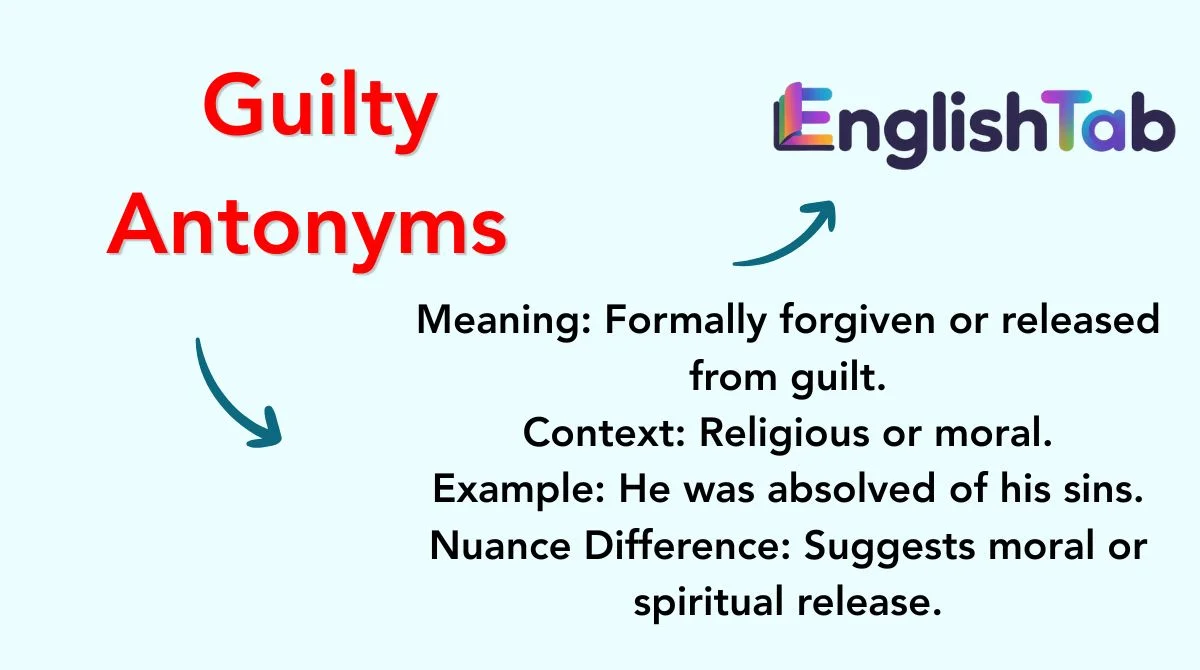
Absolved
Meaning: Formally forgiven or released from guilt.
Context: Religious or moral.
Example: He was absolved of his sins.
Nuance Difference: Suggests moral or spiritual release.
Faultless
Meaning: Without error.
Context: Performance or character evaluation.
Example: Her conduct was faultless.
Nuance Difference: Focuses on perfection rather than legal innocence.
Pure
Meaning: Morally clean.
Context: Ethical or emotional.
Example: She maintained a pure conscience.
Nuance Difference: Emphasizes internal morality.
Virtuous
Meaning: Morally excellent.
Context: Ethical discussion.
Example: A virtuous leader acts fairly.
Nuance Difference: Stronger moral praise than simple innocence.
Vindicated
Meaning: Proven right after criticism.
Context: Debate or accusation.
Example: The researcher was vindicated by later studies.
Nuance Difference: Suggests earlier blame was incorrect.
Clear
Meaning: Free from suspicion.
Context: Informal or legal.
Example: He is clear of all charges.
Nuance Difference: Less formal than “exonerated.”
Uninvolved
Meaning: Not connected to the wrongdoing.
Context: Social or legal.
Example: She was uninvolved in the conflict.
Nuance Difference: Focuses on absence of participation.
Justified
Meaning: Having a valid reason.
Context: Ethical debate.
Example: Her actions were justified under the circumstances.
Nuance Difference: Admits action occurred but defends it.
Righteous
Meaning: Morally correct.
Context: Religious or ethical writing.
Example: He believed his decision was righteous.
Nuance Difference: Strong moral self-confidence.
Unashamed
Meaning: Not feeling guilt.
Context: Emotional state.
Example: She remained unashamed of her choices.
Nuance Difference: Opposes emotional guilt, not factual responsibility.
Confident
Meaning: Self-assured.
Context: Emotional or social.
Example: He felt confident about his testimony.
Nuance Difference: Removes emotional burden but not necessarily factual guilt.
Forgiven
Meaning: Pardoned emotionally.
Context: Personal relationships.
Example: She was forgiven for her mistake.
Nuance Difference: Guilt existed but is emotionally resolved.
Antonym Comparison Table
| Word | Legal Use | Moral Use | Emotional Use | Strength of Contrast |
|---|---|---|---|---|
| Innocent | Strong | Strong | Moderate | Very High |
| Acquitted | Very Strong | Weak | None | High (legal only) |
| Blameless | Moderate | Strong | Moderate | High |
| Pure | None | Strong | Strong | Moderate |
| Justified | Weak | Strong | Moderate | Contextual |
| Vindicated | Moderate | Moderate | Moderate | Medium |
| Unashamed | None | Weak | Strong | Emotional Only |
| Forgiven | Weak | Strong | Strong | Complex Contrast |
This table shows that not all antonyms operate equally across domains.
Academic Writing Examples
Legal Analysis:
The defendant was declared guilty; however, later DNA evidence proved him innocent.
Ethics Essay:
A virtuous leader acts transparently, avoiding behavior that would make others feel guilty.
Psychology Paper:
Participants reported feeling guilty after dishonest behavior, while control subjects remained emotionally unaffected and confident.
Sociology Discussion:
Although initially blamed, the organization was later exonerated through independent review.
Using precise antonyms strengthens analytical writing by reducing ambiguity.
When Not to Replace the Word
Avoid replacing “guilty” when:
- Legal precision is required (use “not guilty,” not “pure”).
- Emotional context matters (do not substitute “innocent” for “unashamed”).
- The distinction between evidence and moral truth is important.
- Tone shift would distort meaning.
For example:
Incorrect: The jury declared him pure.
Correct: The jury declared him not guilty.
Precision protects credibility.
Practice Exercises
- Replace “guilty” with the most accurate antonym:
The court found her ______. - Choose the best contrast word:
He felt guilty about lying, but his sister remained ______. - Academic rewrite:
The manager was guilty of negligence. Rewrite using a direct opposite. - Identify whether the antonym is legal, moral, or emotional in this sentence:
She was vindicated after the investigation. - Explain the difference between “acquitted” and “innocent.”
FAQs
What is the strongest antonym of guilty?
“Innocent” is the strongest general opposite because it removes both blame and responsibility.
Is “not guilty” the same as innocent?
No. “Not guilty” is a legal verdict that may reflect insufficient evidence, while “innocent” suggests factual purity.
Can “confident” be an antonym of guilty?
Yes, but only in emotional contexts where guilt refers to inner shame.
Is “forgiven” an opposite of guilty?
Partially. Forgiveness removes emotional burden but does not erase past action.
Which antonym works best in academic writing?
“Innocent,” “acquitted,” “exonerated,” and “blameless” are most appropriate in formal contexts.
Conclusion
Understanding 16+ guilty antonyms expands more than vocabulary—it deepens analytical thinking.
“Guilty” operates across legal, moral, and emotional dimensions. Therefore, its opposites must be selected with precision.
“Innocent” provides the strongest universal contrast. “Acquitted” and “exonerated” serve legal writing.
“Virtuous” and “pure” enhance ethical discussion. “Unashamed” and “confident” shift emotional tone.
In advanced writing, the power of contrast shapes clarity. Choosing the right antonym ensures that your argument remains accurate, persuasive, and intellectually rigorous in 2K26 and beyond.

Dorian Hale is an English language enthusiast and content creator dedicated to making vocabulary and grammar learning simple, engaging, and accessible for everyone.