In academic writing and advanced communication, clarity often depends on contrast. Opposites sharpen meaning. They define emotional tone.
They strengthen arguments. When readers understand what something is not, they better grasp what it is.
The word grateful carries emotional warmth, humility, and appreciation. But what happens when that gratitude disappears? What words capture its absence?
More importantly, how do those opposite terms differ from each other?
This article provides a deep contrast analysis of 24+ grateful antonyms, examining their meanings, emotional intensity, contextual usage, and nuanced distinctions.
Whether you are writing academically, creatively, or professionally, understanding these opposites will elevate precision and tone control.
Definition and Core Meaning of “Grateful”
Grateful describes a feeling of appreciation or thankfulness for kindness, help, benefits, or positive outcomes.
Core elements of the word include:
- Recognition of benefit
- Positive emotional response
- Humility
- Acknowledgment of another’s effort
Gratitude implies relational awareness. It assumes that someone or something contributed positively to your life.
Therefore, antonyms of grateful may indicate:
- Lack of appreciation
- Rejection of help
- Resentment
- Entitlement
- Emotional coldness
- Hostility
Understanding these categories helps organize the contrasts logically.
Direct Opposites (Clear Contrasts)
These are the strongest and most straightforward antonyms of grateful:
- Ungrateful
- Thankless
- Unappreciative
- Ingrate
- Indifferent
- Resentful
- Discontent
- Dissatisfied
- Entitled
- Unthankful
- Critical
- Bitter
- Complaining
- Displeased
- Disgruntled
- Hostile
- Cold
- Detached
- Negative
- Cynical
- Apathetic
- Disrespectful
- Rebellious
- Arrogant
- Unmoved
- Offended
These words directly challenge appreciation, acknowledgment, or positive recognition.
Contextual Opposites
Some words oppose grateful only depending on situation:
- Proud – can reduce acknowledgment of help
- Self-sufficient – implies no reliance on others
- Independent – may reject gratitude dynamics
- Neutral – lacks emotional warmth
- Objective – emotionally detached
- Reserved – not expressive
These are not inherently negative, but in relational contexts, they contrast with gratitude.
Example:
She felt grateful for the support.
She felt self-sufficient and needed no help.
The second statement removes the relational appreciation component.
Emotional & Tone-Based Opposites
Antonyms vary in emotional intensity:
Mild Opposition:
- Indifferent
- Unmoved
- Neutral
- Detached
Moderate Opposition:
- Unappreciative
- Displeased
- Dissatisfied
- Critical
Strong Opposition:
- Ungrateful
- Bitter
- Resentful
- Hostile
- Entitled
The stronger the emotional force, the sharper the contrast with gratitude’s warmth.
24+ Antonyms Explained in Detail
Below are detailed explanations with meaning, usage, examples, and nuance.
Ungrateful
Meaning: Not showing appreciation for kindness.
Context: Direct emotional opposite.
Example: He was ungrateful for the scholarship he received.
Nuance: Suggests moral failure or character flaw.
Thankless
Meaning: Failing to express thanks.
Context: Often describes a person or situation.
Example: She felt her work was thankless.
Nuance: Can describe a task as well as a person.
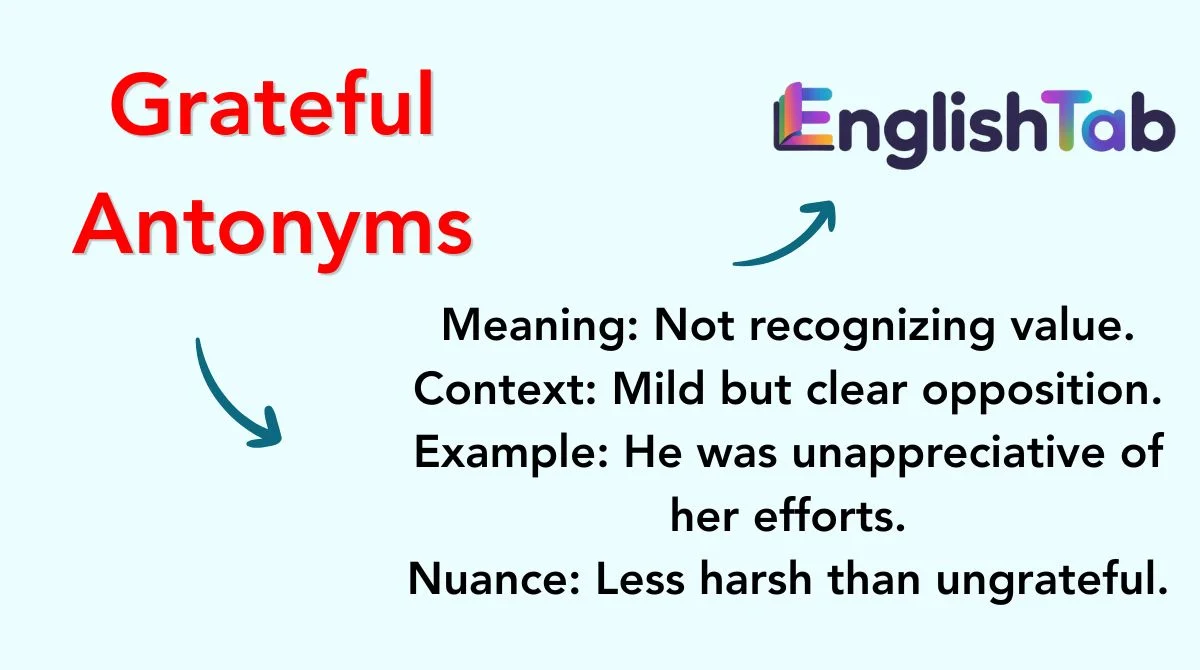
Unappreciative
Meaning: Not recognizing value.
Context: Mild but clear opposition.
Example: He was unappreciative of her efforts.
Nuance: Less harsh than ungrateful.
Ingrate
Meaning: A person who shows no gratitude.
Context: Noun form; strong criticism.
Example: After all the help, he acted like an ingrate.
Nuance: Personal insult.
Indifferent
Meaning: Showing no interest or concern.
Context: Emotional absence rather than hostility.
Example: She was indifferent to the support offered.
Nuance: Lack of feeling, not active negativity.
Resentful
Meaning: Feeling bitterness about help or circumstances.
Context: Emotional opposition.
Example: He felt resentful about needing assistance.
Nuance: Implies internal anger.
Discontent
Meaning: Not satisfied.
Context: General dissatisfaction.
Example: She remained discontent despite the gift.
Nuance: Focuses on unmet expectations.
Dissatisfied
Meaning: Not pleased with results.
Context: Outcome-focused contrast.
Example: He was dissatisfied with the reward.
Nuance: Practical rather than emotional.
Entitled
Meaning: Believing one deserves special treatment.
Context: Strong social contrast.
Example: She acted entitled instead of grateful.
Nuance: Suggests arrogance.
Unthankful
Meaning: Not thankful.
Context: Direct but less common.
Example: He appeared unthankful for the help.
Nuance: Slightly formal tone.
Critical
Meaning: Expressing disapproval.
Context: Evaluative opposition.
Example: He was critical of the assistance provided.
Nuance: Focuses on judgment rather than emotion.
Bitter
Meaning: Filled with resentment.
Context: Strong emotional contrast.
Example: She felt bitter instead of grateful.
Nuance: Long-term emotional negativity.
Complaining
Meaning: Expressing dissatisfaction.
Context: Behavioral opposition.
Example: He kept complaining about the gift.
Nuance: Active negativity.
Displeased
Meaning: Not pleased.
Context: Formal tone.
Example: She seemed displeased by the gesture.
Nuance: Mild emotional contrast.
Disgruntled
Meaning: Irritated or annoyed.
Context: Workplace or social settings.
Example: He appeared disgruntled about receiving help.
Nuance: Suggests irritation.
Hostile
Meaning: Actively unfriendly.
Context: Strong emotional contrast.
Example: She reacted in a hostile manner.
Nuance: Implies aggression.
Cold
Meaning: Emotionally distant.
Context: Tone-based contrast.
Example: His response was cold rather than grateful.
Nuance: Absence of warmth.
Detached
Meaning: Emotionally uninvolved.
Context: Formal writing.
Example: She remained detached after the favor.
Nuance: Neutral but distant.
Negative
Meaning: Focused on flaws.
Context: General contrast.
Example: He gave a negative reaction.
Nuance: Attitude-based.
Cynical
Meaning: Distrustful of sincerity.
Context: Philosophical tone.
Example: She was cynical about the generosity.
Nuance: Implies skepticism.
Apathetic
Meaning: Lacking interest or emotion.
Context: Psychological tone.
Example: He appeared apathetic about the support.
Nuance: Emotional numbness.
Disrespectful
Meaning: Showing lack of respect.
Context: Social interaction.
Example: His reply was disrespectful.
Nuance: Focuses on behavior.
Rebellious
Meaning: Resisting authority or kindness.
Context: Youth or power dynamics.
Example: She acted rebellious instead of grateful.
Nuance: Active opposition.
Arrogant
Meaning: Overly proud and dismissive.
Context: Character-based contrast.
Example: He seemed arrogant about receiving help.
Nuance: Ego-centered opposition.
Unmoved
Meaning: Not emotionally affected.
Context: Subtle contrast.
Example: She remained unmoved by the gesture.
Nuance: Emotional stillness.
Offended
Meaning: Feeling insulted.
Context: Reaction-based contrast.
Example: He felt offended rather than grateful.
Nuance: Suggests misinterpretation.
Antonym Comparison Table
| Word | Emotional Intensity | Moral Judgment | Focus |
|---|---|---|---|
| Ungrateful | High | Strong | Character |
| Unappreciative | Moderate | Mild | Recognition |
| Indifferent | Low | Neutral | Emotion absence |
| Entitled | High | Strong | Attitude |
| Bitter | Very High | Emotional | Internal feeling |
| Displeased | Low | Neutral | Satisfaction |
| Hostile | Very High | Strong | Behavior |
| Cynical | Moderate | Intellectual | Belief system |
| Apathetic | Low | Neutral | Emotional absence |
Academic Writing Examples
- The participants appeared grateful for institutional support, while others remained indifferent to administrative assistance.
- Instead of expressing appreciation, the subject adopted a cynical perspective toward philanthropic efforts.
- The contrast between grateful acknowledgment and entitled expectation highlights social value systems.
- Her response shifted from gratitude to resentment after repeated dependency.
These examples demonstrate tone shifts in formal writing.
When Not to Replace the Word
Do not replace grateful when:
- Emotional warmth is essential
- Formal gratitude statements are required
- Expressing humility
- Writing acknowledgments
- Communicating professional thanks
Replacing “grateful” with weaker or stronger terms may distort tone.
For example:
“I am grateful for your support” cannot become
“I am pleased with your support” — tone shifts.
Precision matters.
Practice Exercises
- Replace “grateful” with a stronger antonym in this sentence:
She was grateful for the assistance. - Choose the mildest antonym for academic tone.
- Identify which antonym implies arrogance.
- Rewrite:
He felt grateful for the opportunity.
(Change tone to resentment.) - Match intensity levels:
Apathetic, Bitter, Ungrateful, Indifferent.
FAQs
What is the strongest antonym of grateful?
“Hostile” and “bitter” represent strong emotional opposition, but “ungrateful” is the most direct semantic opposite.
Is indifferent always an antonym of grateful?
Not always. Indifference means emotional neutrality, not necessarily rejection.
Can entitled replace ungrateful?
In some contexts, yes. Entitlement often implies lack of gratitude, but it adds arrogance.
Are all antonyms negative?
Most are negative in tone, but some like “detached” or “neutral” simply remove emotional warmth.
Which antonym is best for academic writing?
“Indifferent,” “critical,” or “displeased” are safer in formal contexts.
Conclusion
Understanding 24+ grateful antonyms enhances clarity, tone control, and analytical precision. Opposites define boundaries. They deepen contrast. They refine argumentation.
Gratitude represents warmth, acknowledgment, and relational humility. Its opposites range from mild indifference to intense hostility. Choosing the correct antonym depends on:
- Emotional intensity
- Context
- Moral implication
- Academic tone
Mastering these distinctions ensures accurate communication and stylistic sophistication in 2K26 and beyond.

Dorian Hale is an English language enthusiast and content creator dedicated to making vocabulary and grammar learning simple, engaging, and accessible for everyone.