Opposites sharpen meaning. In academic writing, policy analysis, and political theory, the strategic use of antonyms strengthens contrast, improves argument clarity, and prevents vague expression.
When discussing government, writers often require precise counter-terms to distinguish systems of authority from systems of independence, order from disorder, or centralized power from individual autonomy.
Understanding the antonyms of “government” is not merely a vocabulary exercise. It is a conceptual tool.
Opposites reveal assumptions. They frame ideological debate. They help scholars compare governance models across time and geography.
This article presents 19+ government antonyms, grouped and analyzed with academic precision.
Each term is explained in context, with nuance differences and applied examples suitable for academic writing in 2026 and beyond.
Definition and Core Meaning of “Government”
Before identifying antonyms, we must clarify the root concept.
Government refers to:
- A system or body that exercises authority over a state or community
- An organized structure responsible for making laws and enforcing them
- A central authority that administers public policy and order
Core elements of government include:
- Authority
- Structure
- Regulation
- Control
- Public administration
- Sovereignty
Therefore, antonyms must contrast one or more of these core elements—especially authority, order, control, or centralization.
Direct Opposites (Clear Contrasts)
The following are the strongest conceptual opposites of government because they directly negate centralized authority or structured control:
Anarchy
Chaos
Disorder
Lawlessness
Autonomy
Independence
Self-rule
Statelessness
Liberty
Freedom
Decentralization
Deregulation
Nonintervention
Sovereign individualism
Disorganization
Fragmentation
Rebellion
Insurrection
Revolution
These terms oppose government by rejecting, resisting, dissolving, or decentralizing authority.
Contextual Opposites
Some words function as opposites only in specific contexts. They do not always negate government but can contrast it depending on framing.
Examples include:
- Community
- Market
- Corporation
- Using
- Private sector
- Civil society
- Individual
- Family
- Enterprise
- Voluntarism
For example, in economic discourse, “market” may oppose “government regulation.” In sociological discourse, “civil society” may contrast with “state power.”
Context determines opposition.
Emotional & Tone-Based Opposites
Not all antonyms carry the same emotional intensity. Compare:
- Freedom (neutral-positive)
- Liberty (philosophical)
- Autonomy (academic)
- Anarchy (radical or chaotic tone)
- Insurrection (violent tone)
- Rebellion (resistant tone)
Tone matters in academic writing. Choosing “decentralization” instead of “anarchy” significantly shifts interpretation. Emotional weight can either strengthen argumentation or distort it.
19+ Antonyms Explained in Detail
Below are detailed explanations of 19+ government antonyms with meaning, usage, examples, and nuance distinctions.
Anarchy
Meaning: Absence of formal government or authority.
Context: Political theory, radical philosophy.
Example: The collapse of the regime led to anarchy.
Nuance: Suggests total absence of authority, often associated with instability.
Chaos
Meaning: Complete disorder or confusion.
Context: Used when governmental structure collapses.
Example: Without leadership, the nation descended into chaos.
Nuance: Focuses on disorder rather than political theory.
Lawlessness
Meaning: Lack of legal control.
Context: Crime studies, post-conflict zones.
Example: The border region experienced widespread lawlessness.
Nuance: Emphasizes absence of law enforcement.
Autonomy
Meaning: Self-governing capacity.
Context: Regional or institutional independence.
Example: The university maintains academic autonomy.
Nuance: Suggests structured independence, not disorder.
Independence
Meaning: Freedom from external control.
Context: Colonial history, political movements.
Example: The territory fought for independence from imperial rule.
Nuance: Focuses on separation from larger authority.
Self-rule
Meaning: Governance by one’s own people.
Context: Decolonization, federal structures.
Example: The province demanded self-rule.
Nuance: Structured autonomy within broader systems.
Statelessness
Meaning: Absence of recognized state authority.
Context: International law, political philosophy.
Example: Statelessness complicates citizenship rights.
Nuance: Legal-political condition rather than chaos.
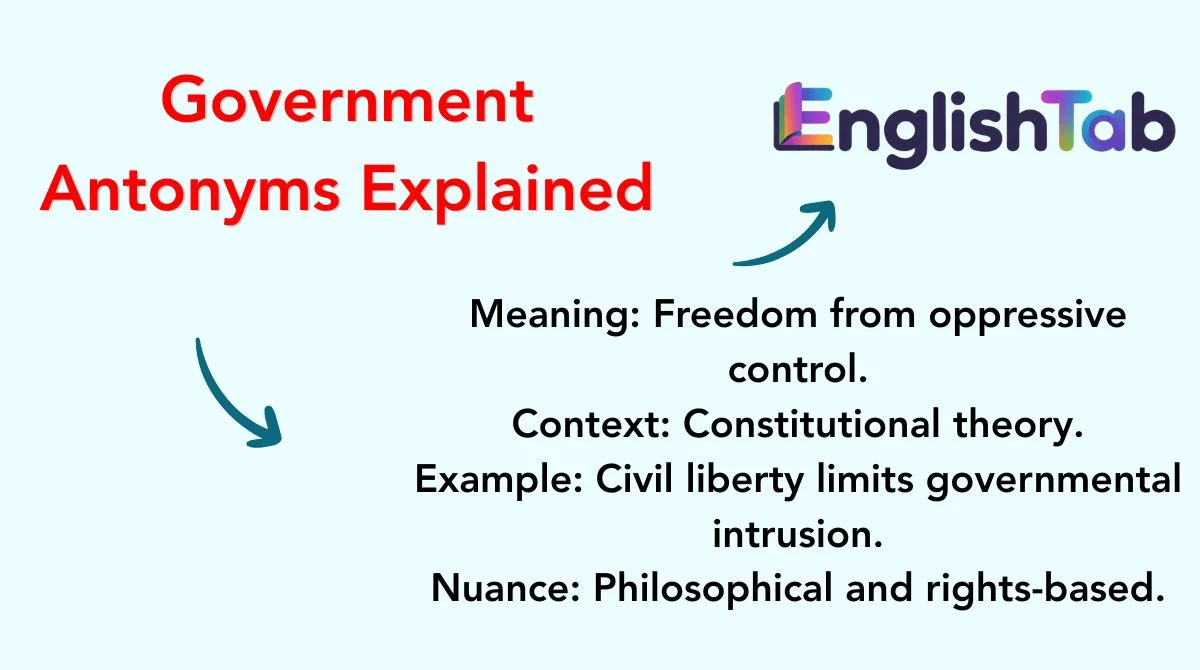
Liberty
Meaning: Freedom from oppressive control.
Context: Constitutional theory.
Example: Civil liberty limits governmental intrusion.
Nuance: Philosophical and rights-based.
Freedom
Meaning: Ability to act without restriction.
Context: Broad moral-political discourse.
Example: Freedom of speech restricts government censorship.
Nuance: Broader and more emotional than “liberty.”
Decentralization
Meaning: Distribution of power away from central authority.
Context: Administrative reform.
Example: Decentralization improved local participation.
Nuance: Reformative opposite, not abolition.
Deregulation
Meaning: Removal of government regulations.
Context: Economic policy.
Example: Deregulation stimulated competition.
Nuance: Sector-specific contrast.
Nonintervention
Meaning: Refusal to interfere.
Context: Foreign policy.
Example: The state adopted a nonintervention approach.
Nuance: Limited to specific domains.
Disorganization
Meaning: Lack of organized structure.
Context: Administrative breakdown.
Example: Disorganization weakened governance efficiency.
Nuance: Functional opposite, not ideological.
Fragmentation
Meaning: Division into smaller units.
Context: Political instability.
Example: Ethnic conflict led to national fragmentation.
Nuance: Suggests weakening of central authority.
Rebellion
Meaning: Organized resistance against authority.
Context: Political uprisings.
Example: The rebellion challenged state power.
Nuance: Active opposition.
Insurrection
Meaning: Violent uprising.
Context: Revolutionary theory.
Example: The insurrection sought regime change.
Nuance: More intense than rebellion.
Revolution
Meaning: Fundamental change in political power.
Context: Historical transformations.
Example: The revolution dismantled the monarchy.
Nuance: Often replaces one government with another.
Voluntarism
Meaning: Action based on free choice rather than state control.
Context: Social theory.
Example: Voluntarism encourages civic participation without compulsion.
Nuance: Philosophical contrast to centralized authority.
Individualism
Meaning: Prioritizing individual freedom over collective control.
Context: Political philosophy.
Example: Individualism resists expansive government oversight.
Nuance: Ideological rather than structural opposite.
Antonym Comparison Table
| Antonym | Core Focus | Intensity | Structured Alternative? | Violent Implication? |
|---|---|---|---|---|
| Anarchy | No authority | High | No | No |
| Chaos | Disorder | High | No | No |
| Autonomy | Self-control | Moderate | Yes | No |
| Independence | Separation | Moderate | Yes | No |
| Decentralization | Power distribution | Low | Yes | No |
| Rebellion | Resistance | High | Possibly | Sometimes |
| Insurrection | Violent revolt | Very High | No | Yes |
| Liberty | Rights-based freedom | Moderate | Yes | No |
| Deregulation | Policy removal | Low | Yes | No |
This table demonstrates that not all antonyms function equally. Some negate authority entirely; others merely limit it.
Academic Writing Examples
- The debate contrasts centralized government with regional autonomy.
- Excessive regulation may provoke demands for deregulation.
- Political fragmentation often precedes systemic collapse.
- Movements advocating liberty seek constitutional restraint of authority.
- Insurrection differs fundamentally from decentralization in method and intent.
Each sentence uses an antonym strategically to sharpen contrast.
When Not to Replace the Word
Do not substitute “government” when:
- Referring to a specific institutional body
- Discussing constitutional roles
- Analyzing legal frameworks
- Comparing types of governments
Using “anarchy” where “limited government” is intended creates distortion. Precision matters in academic contexts.
Practice Exercises
- Rewrite the sentence using a strong antonym:
“The policy reduced central government influence.” - Identify whether the antonym is structural or emotional:
Liberty, Insurrection, Decentralization - Compare autonomy and independence in two academic sentences.
- Replace “government control” with an appropriate contextual opposite in an economic essay.
- Explain why chaos is not always equivalent to anarchy.
FAQs
What is the strongest antonym of government?
Anarchy is the most direct conceptual opposite because it denotes absence of governing authority.
Are freedom and anarchy the same?
No. Freedom refers to individual rights, while anarchy implies absence of structured authority.
Is decentralization anti-government?
Not necessarily. It redistributes power rather than abolishing government.
Can rebellion exist within a government system?
Yes. Rebellion challenges authority but does not automatically eliminate governance.
Why does context matter when choosing antonyms?
Because words like “market” or “civil society” only oppose government in specific theoretical frameworks.
Conclusion
Understanding 19+ government antonyms reveals that opposition to authority operates across multiple dimensions: structural, ideological, emotional, and procedural.
Some antonyms eliminate authority entirely, such as anarchy and statelessness. Others redistribute it, such as decentralization and autonomy. Still others resist it actively, like rebellion or insurrection.
In academic writing, the effective use of antonyms enhances clarity, sharpens contrast, and prevents conceptual confusion.
The key is not merely knowing opposites, but understanding their nuance, intensity, and contextual precision.
Careful word choice strengthens argumentation. When discussing governance in 2026 and beyond, the disciplined use of precise antonyms ensures analytical depth and scholarly authority.

Dorian Hale is an English language enthusiast and content creator dedicated to making vocabulary and grammar learning simple, engaging, and accessible for everyone.