Opposites are not merely vocabulary tools; they are structural pillars of clarity. In academic and professional writing, contrast sharpens arguments, defines boundaries, and clarifies scope.
When writers use antonyms strategically, they prevent ambiguity and establish precise meaning.
The word “global” is frequently used in research, journalism, economics, environmental studies, and social sciences.
However, its meaning shifts depending on context. Because of this flexibility, identifying accurate antonyms requires more than listing surface-level opposites.
This article provides a deep contrast analysis of 16+ global antonyms, exploring direct, contextual, and emotional opposites.
Each antonym is examined for nuance, usage, and appropriateness in academic writing.
By the end, you will not only understand what opposes “global,” but also when and why to choose each alternative.
Definition and Core Meaning of “Global”
The adjective “global” primarily means:
- Relating to the whole world
- Worldwide in scope
- Comprehensive or universal
- Inclusive of all parts
In academic contexts, “global” may refer to:
- Global economy (worldwide economic system)
- Global warming (planet-wide climate trend)
- Global perspective (broad, international viewpoint)
- Global variable (in programming, accessible everywhere)
Thus, “global” contains three key dimensions:
- Geographic breadth (worldwide)
- Scope or scale (all-encompassing)
- Conceptual totality (complete or universal)
Any true antonym must challenge at least one of these dimensions.
Direct Opposites (Clear Contrasts)
These are the 16 strongest antonyms of “global” when referring to worldwide or all-encompassing scope:
- Local
- Regional
- National
- Domestic
- Provincial
- Parochial
- Limited
- Restricted
- Narrow
- Specific
- Isolated
- Fragmented
- Partial
- Individual
- Internal
- Micro
Each directly contrasts the scale, reach, or inclusiveness of “global.”
Contextual Opposites
In some situations, the antonym of “global” depends on subject matter.
- In economics: Domestic or national
- In politics: Local governance
- In computing: Local variable
- In environmental science: Regional climate
- In sociology: Community-based
Contextual opposition arises when the contrast is scale-based rather than meaning-based. “Global” may not always mean worldwide—it may simply mean “comprehensive,” in which case “partial” becomes the better antonym.
Emotional & Tone-Based Opposites
“Global” often carries a tone of magnitude, seriousness, or importance. Emotional contrasts may include:
- Insignificant
- Minor
- Trivial
- Small-scale
- Private
While not literal opposites, these words reduce intensity and scale. In persuasive writing, replacing “global crisis” with “minor issue” dramatically shifts emotional impact.
16+ Antonyms Explained in Detail
Local
Meaning: Limited to a specific area or community.
Context: Geography, business, governance.
Example: The company shifted from a global strategy to a local focus.
Nuance: “Local” implies small-scale but does not necessarily imply isolation.
Regional
Meaning: Relating to a particular region.
Context: Climate, politics, trade.
Example: Regional trade agreements differ from global treaties.
Nuance: Larger than local but smaller than global.
National
Meaning: Within one country.
Context: Policy, identity, economy.
Example: National interests sometimes conflict with global priorities.
Nuance: Politically bounded; emphasizes sovereignty.
Domestic
Meaning: Internal to one country.
Context: Law, economics.
Example: Domestic markets are separate from global exports.
Nuance: Often used in contrast with international trade.
Provincial
Meaning: Narrow or limited in outlook.
Context: Cultural criticism.
Example: His provincial mindset resisted global perspectives.
Nuance: Suggests intellectual limitation, not just geography.
Parochial
Meaning: Extremely narrow or limited in scope.
Context: Academic critique.
Example: The research was criticized as parochial rather than global.
Nuance: Strongly negative; implies closed-mindedness.
Limited
Meaning: Restricted in extent.
Context: Scope analysis.
Example: The study had limited rather than global relevance.
Nuance: Focuses on scope rather than geography.
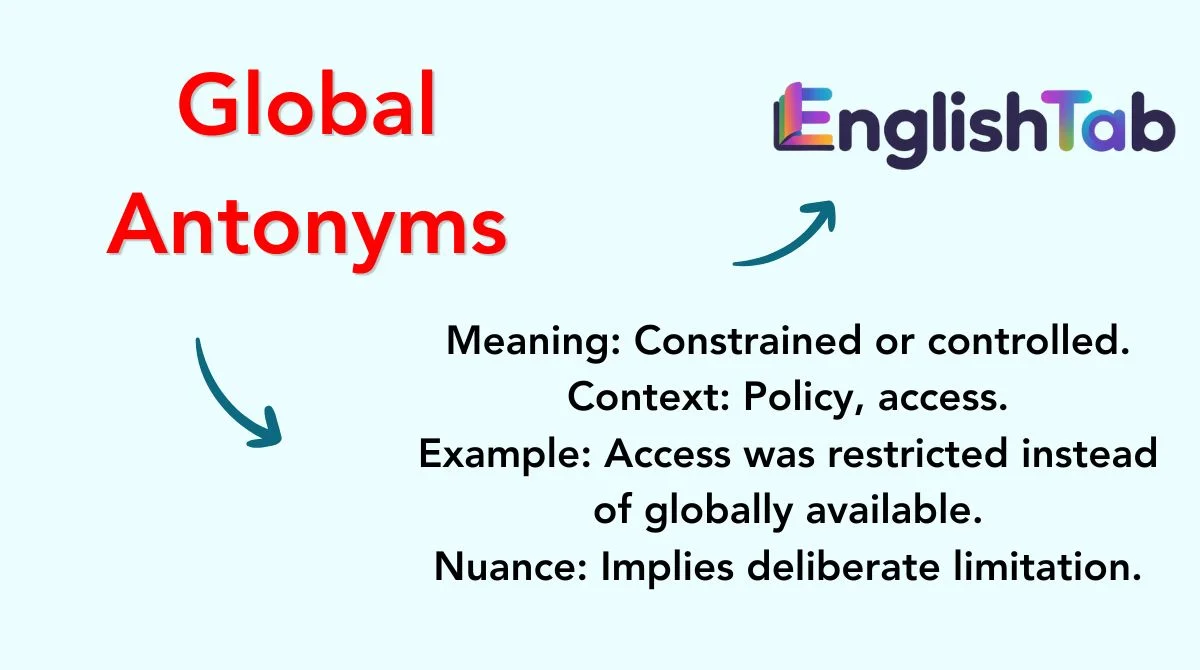
Restricted
Meaning: Constrained or controlled.
Context: Policy, access.
Example: Access was restricted instead of globally available.
Nuance: Implies deliberate limitation.
Narrow
Meaning: Limited in range or perspective.
Context: Argument analysis.
Example: A narrow approach cannot replace global understanding.
Nuance: Often intellectual rather than geographic.
Specific
Meaning: Clearly defined or particular.
Context: Research focus.
Example: The paper examines a specific issue instead of global trends.
Nuance: Precision rather than scale.
Isolated
Meaning: Separated or disconnected.
Context: Social, geographic analysis.
Example: The region remained isolated from global networks.
Nuance: Suggests separation.
Fragmented
Meaning: Broken into parts.
Context: Political science.
Example: The policy response was fragmented, not global.
Nuance: Opposes unity rather than scale.
Partial
Meaning: Incomplete.
Context: Academic writing.
Example: The report provided a partial rather than global assessment.
Nuance: Opposes comprehensiveness.
Individual
Meaning: Pertaining to one person or unit.
Context: Psychology, sociology.
Example: Individual actions differ from global movements.
Nuance: Micro-level focus.
Internal
Meaning: Inside an organization or country.
Context: Business analysis.
Example: Internal issues differ from global challenges.
Nuance: Organizational boundary.
Micro
Meaning: Extremely small scale.
Context: Economics, biology.
Example: Micro analysis contrasts with global evaluation.
Nuance: Often technical or academic.
Antonym Comparison Table
| Antonym | Scale Level | Geographic? | Emotional Tone | Academic Use |
|---|---|---|---|---|
| Local | Small | Yes | Neutral | High |
| Regional | Medium | Yes | Neutral | High |
| National | Country | Yes | Neutral | High |
| Domestic | Country | Yes | Neutral | High |
| Provincial | Small | No | Negative | Moderate |
| Parochial | Very Small | No | Strong Negative | Moderate |
| Limited | Restricted | No | Neutral | Very High |
| Partial | Incomplete | No | Neutral | Very High |
| Fragmented | Broken | No | Negative | High |
| Micro | Tiny | No | Neutral | High |
Academic Writing Examples
- Global cooperation is necessary to address climate change, while local initiatives implement solutions.
- The research provides a global overview but lacks regional specificity.
- National policies often conflict with global agreements.
- A partial analysis cannot substitute for a global assessment.
- The argument shifts from a global claim to a narrow interpretation.
These examples demonstrate contrast clarity in scholarly tone.
When Not to Replace the Word
Avoid replacing “global” when:
- Referring to official terms (Global South, Global GDP)
- Discussing scientific concepts (Global warming)
- Writing technical programming terms (global variable)
- The emphasis is totality rather than geography
Replacing inaccurately can distort meaning. For example, “global maximum” in mathematics cannot be replaced with “regional maximum” without changing the concept.
Precision is more important than variation.
Practice Exercises
- Replace “global” with the most accurate antonym:
The study provides a ______ analysis of rural education. - Choose the strongest contrast:
Global perspective vs. ______ mindset. - Identify the tone shift:
Global crisis → ______ issue. - Rewrite:
The policy requires global coordination.
(Use an antonym to show contrast.) - Which antonym fits computing?
Global variable vs. ______ variable.
FAQs
What is the strongest antonym of global?
“Local” is the most direct geographic opposite. However, “partial” may be stronger in academic contexts involving completeness.
Is national the opposite of global?
Yes, when discussing sovereignty or policy scale. National refers to one country, while global refers to all countries.
Can parochial replace local?
Not always. Parochial implies narrow-mindedness, while local is neutral.
Is micro always the opposite of global?
Only in analytical scale contexts, such as economics or biology.
What is the opposite of global in programming?
Local variable is the correct technical antonym.
Conclusion
Understanding global antonyms requires conceptual precision. “Global” represents breadth, inclusiveness, and comprehensiveness. Its opposites reduce scale, restrict scope, fragment unity, or narrow perspective.
The strongest direct contrasts include local, regional, national, and partial. However, contextual accuracy determines the best choice.
Effective academic writing depends on controlled contrast. By mastering these 16+ global antonyms, writers can sharpen arguments, clarify boundaries, and enhance analytical depth in 2K26 and beyond.

Dorian Hale is an English language enthusiast and content creator dedicated to making vocabulary and grammar learning simple, engaging, and accessible for everyone.