Precision in language depends not only on selecting the right word, but also on understanding its opposite. Antonyms do more than reverse meaning—they clarify intention, sharpen contrast, and define boundaries of thought.
In academic and professional writing, contrast is a structural tool. It helps writers position arguments, highlight differences, and establish conceptual depth.
The word focus is central to modern communication. It appears in academic essays, business strategy, psychology research, classroom instruction, and creative writing.
Yet many writers overuse it without fully understanding its conceptual range—or the spectrum of meanings that oppose it.
This comprehensive guide explores 20+ focus antonyms with deep contrast analysis. You will learn not only what the opposites are, but when and why to use them.
Each antonym is explained with meaning, context, nuance, and example sentences to ensure academic clarity.
Definition and Core Meaning of “Focus”
Focus refers to the act of directing attention, concentration, or effort toward a specific object, task, idea, or goal.
In academic and analytical contexts, focus involves:
- Mental concentration
- Clear prioritization
- Cognitive direction
- Purposeful attention
- Structured engagement
For example:
The study focuses on environmental policy reforms.
Here, focus indicates intellectual concentration and narrowing of scope.
Because focus implies clarity and directed energy, its antonyms often suggest diffusion, confusion, distraction, disorder, or emotional disturbance.
Direct Opposites (Clear Contrasts)
The strongest antonyms of focus directly contradict concentration and directed attention. These words represent loss of mental control, scattered thought, or lack of direction.
Here are 20 of the strongest direct antonyms:
- Distraction
- Confusion
- Chaos
- Disorder
- Diffusion
- Scatter
- Diversion
- Inattention
- Neglect
- Carelessness
- Aimlessness
- Disorganization
- Turmoil
- Disarray
- Uncertainty
- Indifference
- Blur
- Vagueness
- Distraction
- Fragmentation
Each of these reverses a core aspect of focus—either mentally, structurally, or emotionally.
Contextual Opposites
Some words oppose focus depending on context. The meaning of focus changes across disciplines, and so do its antonyms.
For example:
- In photography, focus contrasts with blur.
- In management, focus contrasts with diversification.
- In psychology, focus contrasts with dissociation.
- In debate, focus contrasts with digression.
- In productivity, focus contrasts with multitasking.
These contextual opposites may not be universal antonyms, but they represent meaningful conceptual contrasts in specific settings.
Emotional & Tone-Based Opposites
Focus implies stability, calm, and mental control. Emotionally, its opposites often suggest agitation, overwhelm, or instability.
Tone-based contrasts include:
- Anxiety
- Panic
- Restlessness
- Agitation
- Overwhelm
- Frustration
For example:
Under pressure, her focus shifted into panic.
Here, panic does not merely mean lack of focus—it signals emotional disruption of concentration.
Understanding emotional intensity helps writers select the right antonym for tone control.
20+ Antonyms Explained in Detail
Below are 22 carefully analyzed antonyms of focus. Each entry includes meaning, context, example, and nuance difference.
Distraction
Meaning: Something that diverts attention.
Context: Productivity, learning, cognitive science.
Example: Social media notifications caused constant distraction.
Nuance: Distraction is temporary and often external, while lack of focus may be internal.
Confusion
Meaning: Lack of clarity or understanding.
Context: Academic reasoning, communication breakdown.
Example: The unclear instructions created confusion among students.
Nuance: Confusion affects comprehension; focus affects attention.
Chaos
Meaning: Complete disorder and unpredictability.
Context: Organizational failure, crisis situations.
Example: Without leadership, the project fell into chaos.
Nuance: Chaos is structural disorder; lack of focus may still exist within structure.
Disorder
Meaning: Absence of organization.
Context: Planning, systems, documentation.
Example: The office was in disorder after the relocation.
Nuance: Disorder concerns arrangement; focus concerns attention.
Scatter
Meaning: Spread widely without direction.
Context: Thought patterns, research scope.
Example: His ideas scatter across unrelated topics.
Nuance: Scatter suggests physical or conceptual spreading.
Diffusion
Meaning: Spread over a wide area.
Context: Academic writing, strategic planning.
Example: Diffusion of effort reduced productivity.
Nuance: Diffusion is gradual spreading; distraction is abrupt.
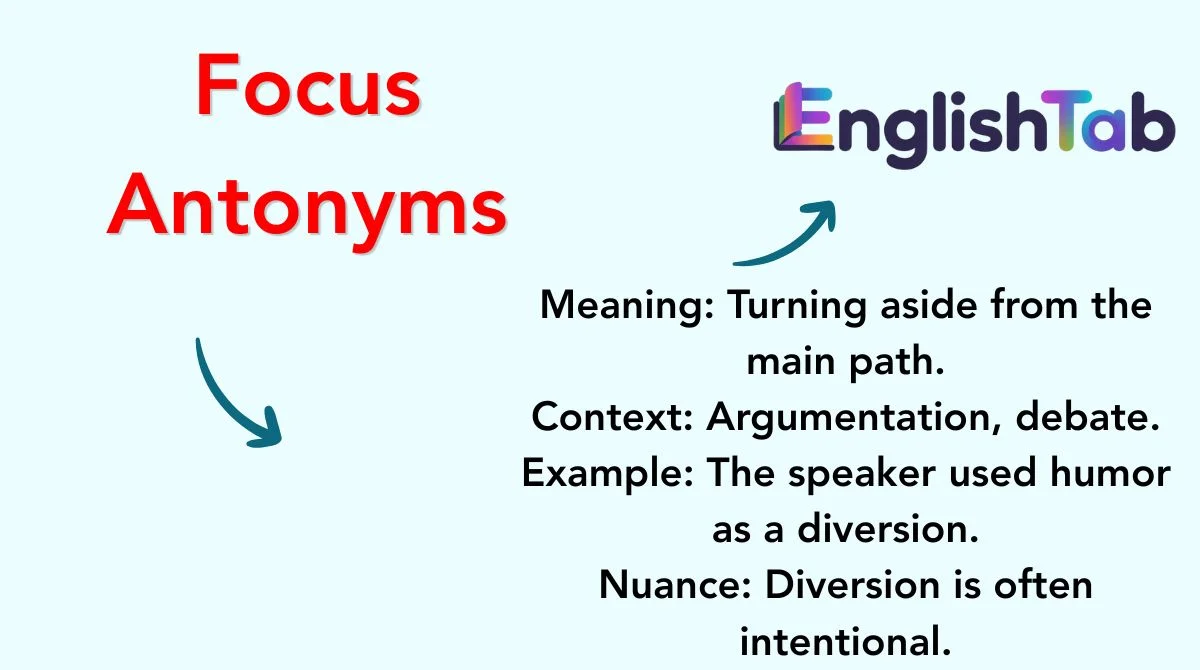
Diversion
Meaning: Turning aside from the main path.
Context: Argumentation, debate.
Example: The speaker used humor as a diversion.
Nuance: Diversion is often intentional.
Inattention
Meaning: Failure to notice or observe carefully.
Context: Education, workplace errors.
Example: Inattention led to mistakes in calculation.
Nuance: Inattention is passive; distraction may be active.
Neglect
Meaning: Failure to give proper attention.
Context: Responsibility, duty.
Example: Neglect of details damaged the report’s credibility.
Nuance: Neglect implies carelessness over time.
Carelessness
Meaning: Lack of careful thought.
Context: Academic mistakes.
Example: Carelessness resulted in spelling errors.
Nuance: Carelessness reflects attitude; focus reflects skill.
Aimlessness
Meaning: Lack of clear purpose.
Context: Personal development.
Example: Aimlessness weakened his academic progress.
Nuance: Aimlessness is goal-related, not purely attention-related.
Disorganization
Meaning: Poor arrangement or planning.
Context: Project management.
Example: Disorganization slowed the team.
Nuance: Disorganization affects structure more than mental focus.
Turmoil
Meaning: State of confusion or disturbance.
Context: Emotional stress.
Example: Emotional turmoil affected her focus.
Nuance: Turmoil carries emotional intensity.
Disarray
Meaning: Messy condition.
Context: Physical and metaphorical settings.
Example: The notes were in complete disarray.
Nuance: Similar to disorder but often visual.
Uncertainty
Meaning: Lack of certainty.
Context: Decision-making.
Example: Uncertainty prevented strategic focus.
Nuance: Uncertainty is cognitive doubt.
Indifference
Meaning: Lack of interest or concern.
Context: Motivation.
Example: Indifference reduced student focus.
Nuance: Indifference concerns emotion, not ability.
Blur
Meaning: Lack of sharpness.
Context: Photography, perception.
Example: The image appears as a blur.
Nuance: Literal opposite in visual contexts.
Vagueness
Meaning: Lack of clear definition.
Context: Writing clarity.
Example: Vagueness weakens arguments.
Nuance: Vagueness affects language precision.
Fragmentation
Meaning: Breaking into parts.
Context: Thought patterns, organizations.
Example: Fragmentation of tasks reduced efficiency.
Nuance: Fragmentation suggests structural separation.
Restlessness
Meaning: Inability to remain still or attentive.
Context: Classroom behavior.
Example: Restlessness disrupted focus.
Nuance: Restlessness is physical and mental.
Overwhelm
Meaning: Excessive stress or pressure.
Context: Workload management.
Example: Overwhelm destroyed his ability to focus.
Nuance: Overwhelm results from intensity overload.
Multitasking
Meaning: Performing multiple tasks simultaneously.
Context: Productivity studies.
Example: Multitasking reduced deep focus.
Nuance: Not inherently negative but contrasts single-task focus.
Antonym Comparison Table
| Antonym | Mental vs Structural | Emotional Intensity | Temporary or Ongoing | Academic Use |
|---|---|---|---|---|
| Distraction | Mental | Low–Medium | Temporary | High |
| Confusion | Cognitive | Medium | Temporary | High |
| Chaos | Structural | High | Ongoing | Medium |
| Neglect | Behavioral | Low | Ongoing | High |
| Aimlessness | Goal-related | Medium | Ongoing | Medium |
| Indifference | Emotional | Low | Ongoing | High |
| Blur | Visual | Low | Temporary | Medium |
| Overwhelm | Emotional | High | Temporary | High |
Academic Writing Examples
- The research lacks focus due to excessive thematic diffusion.
- Student performance declined because of distraction and multitasking.
- Strategic disorganization prevented institutional focus.
- Emotional turmoil interfered with cognitive concentration.
These examples show that replacing focus requires contextual sensitivity.
When Not to Replace the Word
Avoid replacing focus when:
- It refers to optical clarity.
- It appears in technical terminology.
- It carries neutral, precise academic meaning.
- The replacement would exaggerate emotional tone.
Overusing dramatic antonyms like chaos or turmoil can distort meaning.
Practice Exercises
- Replace focus with an antonym:
The meeting lost its focus due to side discussions. - Choose the best antonym:
His academic decline resulted from ______ (neglect / clarity). - Rewrite using contrast:
Strong focus leads to success; ______ leads to failure. - Identify tone difference between distraction and chaos.
- Create a sentence using fragmentation as an antonym.
FAQs
What is the strongest antonym of focus?
The strongest general antonym is distraction, but in structural contexts, chaos may be stronger.
Is multitasking always the opposite of focus?
Not always. It contrasts deep focus but can be productive in simple tasks.
Can confusion replace focus in academic writing?
Yes, but only when discussing clarity of understanding rather than attention control.
What is the emotional opposite of focus?
Overwhelm, panic, and turmoil represent emotional contrasts.
Why is selecting the right antonym important?
Because each antonym carries a different nuance, tone, and conceptual implication.
Conclusion
Understanding 20+ focus antonyms enhances linguistic precision and analytical depth. Focus represents direction, clarity, and concentration.
Its opposites—ranging from distraction and confusion to chaos and fragmentation—define the boundaries of cognitive control.
Effective academic writing depends on choosing the correct contrast. Not all opposites are equal.
Some challenge attention, others challenge structure, and others challenge emotional stability.
Mastering these distinctions ensures sharper arguments, clearer analysis, and stronger rhetorical impact in 2026 and beyond.

Dorian Hale is an English language enthusiast and content creator dedicated to making vocabulary and grammar learning simple, engaging, and accessible for everyone.