Strong writing depends on contrast. When readers clearly see what something is not, they better understand what it is.
Opposites sharpen meaning, create emotional balance, and help writers control tone. Without contrast, language becomes flat. With it, ideas gain precision and depth.
The word enthusiasm expresses energy, passion, eagerness, and emotional intensity.
But in academic, professional, and literary writing, it is often more important to describe the absence—or reversal—of that energy.
Choosing the correct antonym allows a writer to signal boredom, reluctance, skepticism, or emotional coldness with accuracy.
This article provides a deep contrast analysis of 22+ enthusiasm antonyms.
You will find clear explanations, contextual comparisons, emotional distinctions, and practical writing examples to help you choose the most precise opposite in any situation.
Definition and Core Meaning of “Enthusiasm”
Enthusiasm refers to strong excitement, eager interest, or passionate engagement toward a person, idea, or activity. It suggests:
- Emotional energy
- Motivated involvement
- Positive intensity
- Visible engagement
Enthusiasm is not merely interest. It includes emotional force and active participation. A student who is enthusiastic does more than listen; they contribute eagerly. A researcher who shows enthusiasm expresses active curiosity and motivation.
Understanding this core meaning helps identify accurate opposites.
Direct Opposites (Clear Contrasts)
The strongest antonyms of enthusiasm directly negate energy, eagerness, and emotional engagement:
Apathy
Indifference
Disinterest
Unconcern
Detachment
Aloofness
Coldness
Listlessness
Passivity
Reluctance
Unwillingness
Aversion
Resentment
Weariness
Boredom
Dullness
Lethargy
Disapproval
Skepticism
Cynicism
Disdain
Hostility
These words clearly move in the opposite emotional direction from excitement and passion.
Contextual Opposites
Some words function as antonyms depending on the situation. They do not always oppose enthusiasm, but often contrast with it in tone or effect:
Reserve
Restraint
Composure
Calmness
Neutrality
Hesitation
Prudence
Caution
Formalism
For example, calmness is not negative, but it contrasts with visible excitement. In academic writing, calmness may be preferable to enthusiasm.
Emotional & Tone-Based Opposites
Enthusiasm carries warmth and vitality. Emotional opposites often vary in intensity:
- Mild contrast: Disinterest, calmness
- Moderate contrast: Indifference, reluctance
- Strong contrast: Cynicism, hostility
- Extreme contrast: Resentment, aversion
A key distinction: not all antonyms imply negativity. Some imply emotional control rather than emotional absence.
22+ Antonyms Explained in Detail
Below are detailed analyses of 22 strong enthusiasm antonyms.
Apathy
Meaning: Complete lack of interest or emotion.
Context: Used when someone shows no concern or motivation.
Example: The team responded with apathy instead of excitement.
Nuance: Stronger than indifference; suggests emotional emptiness.
Indifference
Meaning: Absence of preference or concern.
Context: Common in academic and professional discussions.
Example: Public indifference weakened the campaign.
Nuance: Less extreme than apathy; suggests neutrality rather than emptiness.
Disinterest
Meaning: Lack of curiosity or engagement.
Context: Classroom, workplace, or audience settings.
Example: The lecture was met with visible disinterest.
Nuance: Often situational and temporary.
Unconcern
Meaning: Lack of worry or involvement.
Context: Can be neutral or mildly negative.
Example: He showed unconcern about the results.
Nuance: May imply calm detachment rather than emotional absence.
Detachment
Meaning: Emotional distance.
Context: Academic tone or psychological discussion.
Example: She responded with professional detachment.
Nuance: Often intentional and controlled.
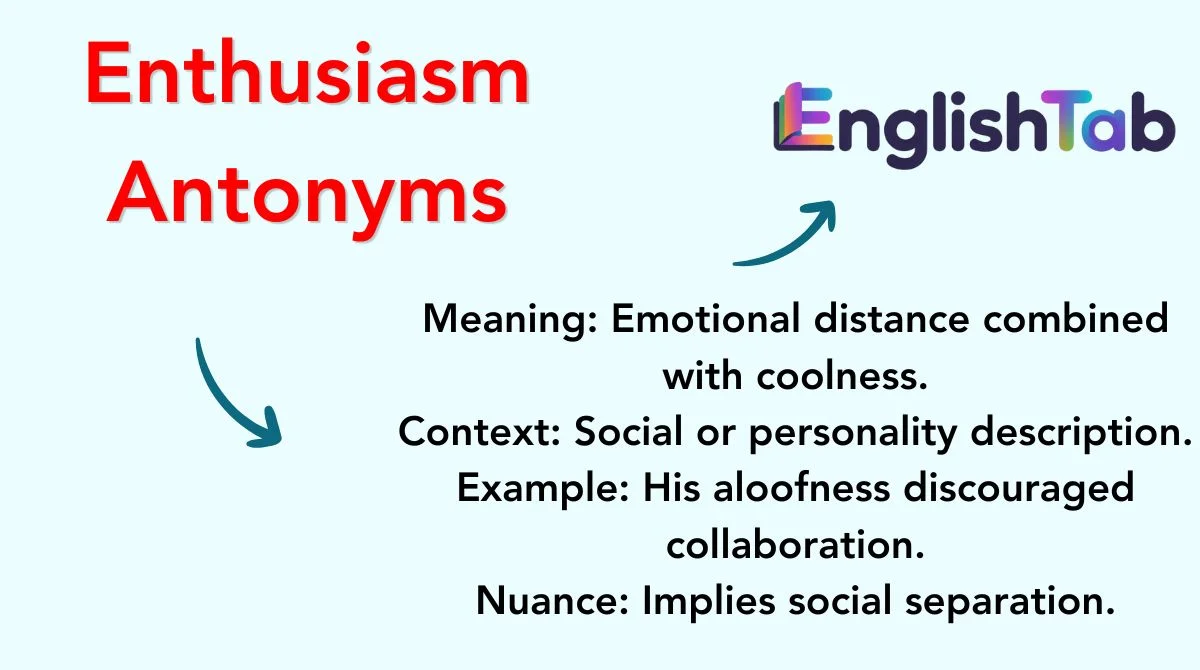
Aloofness
Meaning: Emotional distance combined with coolness.
Context: Social or personality description.
Example: His aloofness discouraged collaboration.
Nuance: Implies social separation.
Coldness
Meaning: Lack of warmth or feeling.
Context: Personal interactions.
Example: Her coldness replaced earlier enthusiasm.
Nuance: Suggests emotional hardness.
Listlessness
Meaning: Lack of energy or spirit.
Context: Physical or emotional fatigue.
Example: The crowd reacted with listlessness.
Nuance: Focuses on low energy rather than attitude.
Passivity
Meaning: Lack of active participation.
Context: Academic behavior analysis.
Example: Student passivity hindered discussion.
Nuance: Behavioral rather than emotional.
Reluctance
Meaning: Hesitation due to unwillingness.
Context: Decision-making situations.
Example: He agreed with reluctance.
Nuance: Suggests internal resistance.
Unwillingness
Meaning: Refusal or lack of desire.
Context: Formal writing.
Example: Their unwillingness stalled progress.
Nuance: Stronger than reluctance.
Aversion
Meaning: Strong dislike or opposition.
Context: Psychological or personal preference.
Example: She felt aversion toward the proposal.
Nuance: Intense negative reaction.
Resentment
Meaning: Persistent anger or bitterness.
Context: Workplace or relationship conflict.
Example: Resentment replaced initial enthusiasm.
Nuance: Emotionally charged and long-term.
Weariness
Meaning: Mental or physical exhaustion.
Context: Long-term projects.
Example: Weariness overtook the team.
Nuance: Suggests fatigue rather than disapproval.
Boredom
Meaning: Lack of stimulation or interest.
Context: Educational or entertainment settings.
Example: The speech created boredom.
Nuance: Passive disengagement.
Dullness
Meaning: Lack of excitement or sharpness.
Context: Descriptive evaluation.
Example: The event was marked by dullness.
Nuance: Focuses on external stimulus.
Lethargy
Meaning: Sluggishness or low energy.
Context: Health or morale discussions.
Example: Lethargy spread through the staff.
Nuance: Physical and emotional dimension.
Disapproval
Meaning: Negative judgment.
Context: Academic critique.
Example: Faculty disapproval cooled enthusiasm.
Nuance: Intellectual opposition.
Skepticism
Meaning: Doubt regarding truth or value.
Context: Research and debate.
Example: Skepticism replaced early excitement.
Nuance: Rational rather than emotional.
Cynicism
Meaning: Distrust of motives or sincerity.
Context: Political or social commentary.
Example: Public cynicism reduced participation.
Nuance: Deep-rooted disbelief.
Disdain
Meaning: Contemptuous rejection.
Context: Social hierarchy discussions.
Example: He spoke with open disdain.
Nuance: Implies superiority.
Hostility
Meaning: Open opposition or aggression.
Context: Conflict analysis.
Example: Hostility replaced cooperative enthusiasm.
Nuance: Active negative energy.
Antonym Comparison Table
Word | Emotional Intensity | Active or Passive | Typical Context | Degree of Opposition
Apathy | High absence | Passive | Social, political | Very strong
Indifference | Moderate | Passive | Academic | Strong
Reluctance | Moderate | Active resistance | Decisions | Strong
Skepticism | Low emotional | Intellectual | Research | Contextual
Cynicism | High | Active distrust | Politics | Strong
Boredom | Low | Passive | Education | Moderate
Hostility | Very high | Active | Conflict | Extreme
Detachment | Low | Controlled | Professional | Mild to moderate
Academic Writing Examples
- The committee’s enthusiasm gradually shifted to skepticism after reviewing the data.
- Initial excitement turned into reluctance once financial risks were identified.
- Public apathy limited policy implementation efforts.
- Student passivity contrasted sharply with the instructor’s enthusiasm.
- Investor cynicism replaced earlier optimism.
These examples demonstrate how selecting precise antonyms enhances analytical clarity.
When Not to Replace the Word
Do not replace enthusiasm with an antonym when:
- The tone requires emotional neutrality rather than opposition.
- The context demands professionalism without negativity.
- The absence of excitement is irrelevant to the argument.
- The focus is on logic rather than emotion.
Replacing enthusiasm carelessly may exaggerate meaning. For example, skepticism does not always imply emotional coldness; it may reflect critical thinking.
Practice Exercises
- Replace enthusiasm with the most accurate antonym:
The audience showed little interest in the presentation. - Choose between skepticism and cynicism:
The scientist questioned the results but remained open to evidence. - Identify the strongest opposite:
She refused angrily and rejected the idea completely. - Rewrite the sentence using an antonym:
His enthusiasm faded after repeated failures. - Select the contextual opposite:
The lawyer maintained calm emotional control during the debate.
FAQs
What is the strongest antonym of enthusiasm?
Apathy and hostility represent extreme opposites, depending on whether the absence of emotion or active opposition is intended.
Is skepticism always an antonym of enthusiasm?
No. Skepticism opposes enthusiasm only when enthusiasm implies unquestioned acceptance.
Can calmness be an antonym?
In emotional contrast, yes. Calmness lacks the energetic intensity of enthusiasm, but it is not negative.
Which antonym is best for academic writing?
Indifference, skepticism, and detachment are common in formal contexts because they maintain professional tone.
Are boredom and apathy the same?
No. Boredom is situational and temporary. Apathy suggests deeper emotional disengagement.
Conclusion
Mastering enthusiasm antonyms strengthens clarity, analytical depth, and tonal precision.
While enthusiasm conveys energy and passion, its opposites reveal emotional absence, resistance, doubt, or hostility.
The key is nuance. Not all antonyms signal negativity; some express rational restraint or professional distance.
Writers who understand these distinctions gain greater control over argumentation, emotional balance, and reader perception.
Selecting the correct antonym transforms vague contrast into sharp, authoritative communication.

Dorian Hale is an English language enthusiast and content creator dedicated to making vocabulary and grammar learning simple, engaging, and accessible for everyone.