Opposites are more than vocabulary tools—they are clarity instruments. In academic and professional writing, precision depends not only on choosing the right word but also on understanding its contrast.
When writers know the antonyms of a word, they gain sharper control over tone, argument strength, and emotional direction.
The word encourage is commonly used in education, leadership, psychology, parenting, and workplace communication.
However, misusing its opposite can weaken a statement or distort meaning.
Understanding the full range of encourage antonyms helps writers avoid oversimplification and instead select the most accurate contrasting term for a given context.
This guide provides an in-depth academic exploration of 18+ antonyms of encourage, including direct opposites, contextual contrasts, emotional variations, detailed explanations, comparative analysis, writing examples, and practice exercises.
Definition and Core Meaning of “Encourage”
The verb encourage means:
- To give support, confidence, or hope to someone
- To promote the development or progress of something
- To inspire action or persistence
At its core, encourage involves positive reinforcement—emotionally, socially, or strategically. It suggests boosting morale, strengthening belief, or increasing motivation.
For example:
- Teachers encourage students to ask questions.
- Policies encourage investment.
- Parents encourage healthy habits.
To understand its antonyms, we must identify what it reverses: discouragement, suppression, obstruction, intimidation, and emotional weakening.
Direct Opposites (Clear Contrasts)
These are the strongest and most direct antonyms of encourage:
discourage
deter
prevent
hinder
inhibit
suppress
block
restrain
forbid
prohibit
dishearten
demoralize
depress
intimidate
threaten
undermine
oppose
criticize
These words clearly move in the opposite direction—reducing motivation, blocking action, or weakening confidence.
Contextual Opposites
Some words function as antonyms only depending on context. They may not always oppose encourage, but in specific situations, they reverse its effect.
neglect
ignore
doubt
question
reject
deny
abandon
interrupt
withdraw
devalue
For example:
- A manager who ignores suggestions may discourage innovation.
- Doubting someone’s ability can discourage effort.
These words indirectly counter encouragement by removing support rather than actively attacking.
Emotional & Tone-Based Opposites
Encouragement carries emotional warmth. Some antonyms differ based on intensity:
Mild Emotional Contrast
- doubt
- question
- hesitate
Moderate Emotional Contrast
- discourage
- criticize
- undermine
Strong Emotional Contrast
- intimidate
- threaten
- demoralize
Extreme Emotional Contrast
- crush
- devastate
- destroy confidence
Choosing the correct antonym depends on emotional weight. Academic writing requires careful calibration.
18+ Antonyms Explained in Detail
Discourage
Meaning: To reduce confidence or enthusiasm.
Context: Common opposite in academic or social settings.
Example: Harsh feedback may discourage participation.
Nuance: Direct emotional opposite; most balanced contrast.
Deter
Meaning: To prevent action through fear or doubt.
Context: Legal, policy, and safety discussions.
Example: Strict penalties deter crime.
Nuance: Focuses on prevention rather than emotional harm.
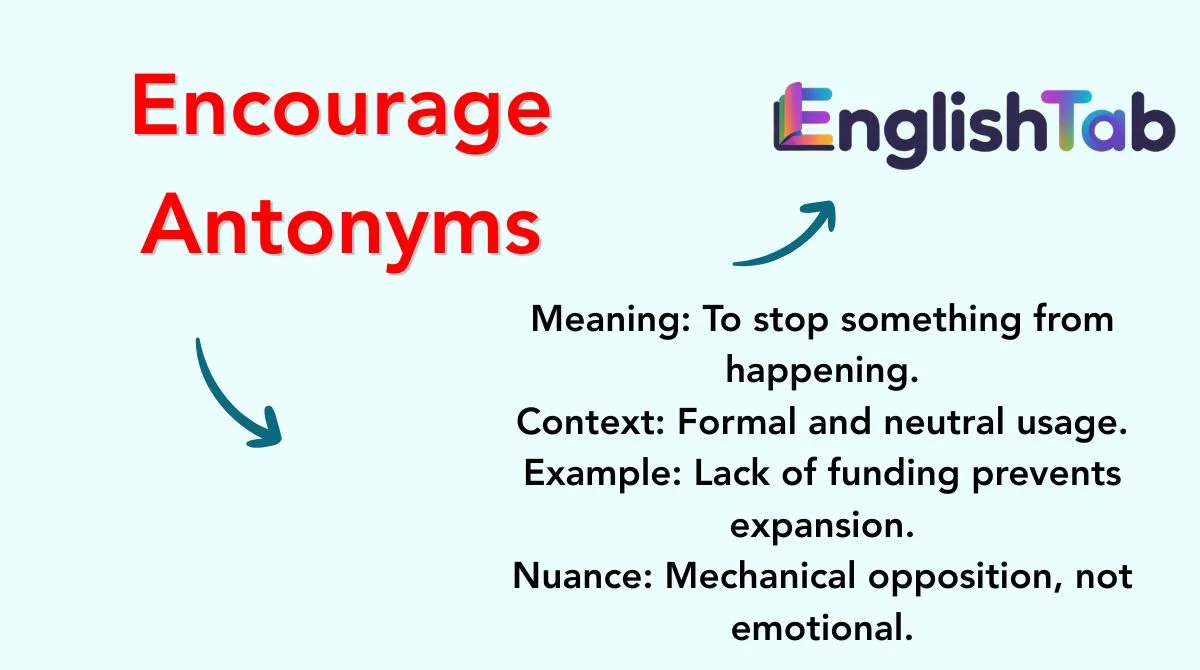
Prevent
Meaning: To stop something from happening.
Context: Formal and neutral usage.
Example: Lack of funding prevents expansion.
Nuance: Mechanical opposition, not emotional.
Hinder
Meaning: To make progress difficult.
Context: Academic and research writing.
Example: Poor data quality hinders analysis.
Nuance: Slows progress rather than destroying motivation.
Inhibit
Meaning: To restrain behavior or expression.
Context: Psychology and science.
Example: Anxiety inhibits performance.
Nuance: Internal restriction rather than external attack.
Suppress
Meaning: To forcibly put down or control.
Context: Political or psychological discussions.
Example: Authorities suppressed dissent.
Nuance: Stronger than inhibit; suggests force.
Block
Meaning: To obstruct progress.
Context: Physical or metaphorical barriers.
Example: Bureaucracy blocks innovation.
Nuance: Direct obstruction without emotional focus.
Restrain
Meaning: To hold back.
Context: Legal or emotional control.
Example: Regulations restrain spending.
Nuance: Controlled limitation.
Forbid
Meaning: To officially not allow.
Context: Formal authority situations.
Example: The policy forbids outside employment.
Nuance: Strong authoritative contrast.
Prohibit
Meaning: To formally prevent by rule or law.
Context: Legal writing.
Example: The law prohibits discrimination.
Nuance: More formal than forbid.
Dishearten
Meaning: To cause loss of hope.
Context: Emotional and literary writing.
Example: Repeated failures dishearten researchers.
Nuance: Softer emotional weakening.
Demoralize
Meaning: To destroy morale.
Context: Military, organizational psychology.
Example: Public criticism demoralized the team.
Nuance: Stronger emotional collapse.
Depress
Meaning: To lower spirits or mood.
Context: Emotional or economic contexts.
Example: Economic decline depressed investor confidence.
Nuance: Broader emotional lowering.
Intimidate
Meaning: To frighten into submission.
Context: Workplace or social conflict.
Example: Aggressive behavior intimidates employees.
Nuance: Fear-based opposition.
Threaten
Meaning: To express intent to cause harm.
Context: Political or social settings.
Example: Funding cuts threaten research programs.
Nuance: Creates fear rather than reducing hope directly.
Undermine
Meaning: To weaken gradually.
Context: Academic argument analysis.
Example: Inconsistent data undermines credibility.
Nuance: Subtle weakening rather than open discouragement.
Oppose
Meaning: To actively resist.
Context: Debates and policy.
Example: Critics oppose the reform.
Nuance: Logical contrast rather than emotional.
Criticize
Meaning: To point out faults.
Context: Academic review.
Example: Scholars criticized the theory.
Nuance: May discourage, but can also improve.
Neglect
Meaning: To fail to support.
Context: Institutional contexts.
Example: Neglecting training discourages growth.
Nuance: Passive contrast.
Reject
Meaning: To refuse acceptance.
Context: Academic publishing.
Example: The journal rejected the submission.
Nuance: Final refusal rather than motivational impact.
Antonym Comparison Table
| Word | Emotional Strength | Formality | Focus Type | Degree of Opposition |
|---|---|---|---|---|
| Discourage | Medium | Neutral | Emotional | Direct |
| Deter | Medium | Formal | Preventive | Strong |
| Prevent | Low | Formal | Mechanical | Direct |
| Hinder | Low | Formal | Process | Moderate |
| Inhibit | Medium | Academic | Internal | Moderate |
| Suppress | High | Formal | Forceful | Strong |
| Demoralize | High | Neutral | Emotional | Strong |
| Intimidate | High | Neutral | Fear-based | Strong |
| Undermine | Medium | Academic | Gradual | Subtle |
| Oppose | Low | Neutral | Logical | Contextual |
Academic Writing Examples
Encourage:
- The study encourages further investigation.
Discourage:
- Ethical concerns discourage further experimentation.
Inhibit:
- Resource limitations inhibit development.
Undermine:
- Methodological flaws undermine the validity of the findings.
Deter:
- Legal restrictions deter unethical conduct.
These examples demonstrate how antonyms shift meaning from supportive progression to restriction or weakening.
When Not to Replace the Word
Do not replace encourage when:
- The focus is emotional uplift rather than prevention.
- The contrast requires subtle nuance.
- The tone demands neutral academic phrasing.
For example, replacing discourage with destroy exaggerates meaning. Replacing inhibit with prevent may remove psychological nuance.
Precision matters more than variation.
Practice Exercises
- Replace encourage with the most accurate antonym:
The policy aims to encourage innovation.
(Hint: legal prevention context.) - Choose between undermine and demoralize:
Constant public criticism may ______ employee morale. - Identify emotional intensity:
Which is stronger—discourage or intimidate? - Rewrite:
The teacher encouraged participation.
Convert into a negative version using a suitable antonym. - Academic selection:
Which antonym best fits research writing—block or inhibit?
FAQs
What is the strongest antonym of encourage?
The strongest depends on context. Emotionally, demoralize and intimidate are powerful. Structurally, prevent and prohibit are strongest in formal contexts.
Is discourage the only true opposite?
No. It is the most common, but many words express different dimensions of opposition such as deter, suppress, and undermine.
Can criticize be an antonym?
Yes, but conditionally. Criticism may discourage, yet constructive criticism can still motivate.
Which antonym fits academic research best?
Inhibit, undermine, and hinder are most common in scholarly writing due to their precise nuance.
Are prevent and discourage interchangeable?
Not always. Prevent stops action entirely, while discourage reduces motivation but does not eliminate possibility.
Conclusion
Mastering 18+ encourage antonyms equips writers with precision, depth, and tonal control.
While encourage promotes action and confidence, its opposites operate across emotional, structural, and contextual dimensions—from mild doubt to forceful suppression.
The most effective writers do not merely swap words; they evaluate emotional intensity, formal setting, and intended impact.
Understanding these contrasts allows for stronger academic arguments, clearer communication, and more persuasive writing in 2K26 and beyond.

Dorian Hale is an English language enthusiast and content creator dedicated to making vocabulary and grammar learning simple, engaging, and accessible for everyone.