Opposites sharpen meaning. In academic and professional writing, contrast is not decoration—it is structure. A single well-chosen antonym can clarify an argument, refine tone, and expose nuance that vague language conceals.
When writers understand how opposing terms function, they gain control over emphasis, emotional temperature, and conceptual boundaries.
The word “embrace” carries warmth, acceptance, and inclusion. Yet precision often requires its opposite: rejection, resistance, avoidance, or denial.
Knowing the right antonym prevents oversimplification and strengthens analytical clarity.
This article explores 24+ embrace antonyms in depth—distinguishing direct opposites from contextual and emotional contrasts, analyzing subtle differences, and demonstrating usage in academic writing.
Definition and Core Meaning of “Embrace”
The verb embrace has several interrelated meanings:
- To hold physically with affection
- To accept willingly or enthusiastically
- To adopt an idea, belief, or opportunity
- To include or contain
In abstract discourse, the most common usage refers to acceptance and adoption. For example:
- Scholars may embrace a theory.
- A community may embrace reform.
- An organization may embrace innovation.
Thus, the core semantic elements are:
- Acceptance
- Willingness
- Inclusion
- Positive reception
Antonyms of “embrace” therefore negate or oppose one or more of these elements.
Direct Opposites (Clear Contrasts)
These antonyms most clearly oppose the central meaning of “embrace” as acceptance or adoption:
reject
refuse
resist
oppose
deny
repudiate
renounce
spurn
dismiss
exclude
avoid
shun
discard
abandon
withdraw
repel
object
disapprove
decline
boycott
protest
condemn
defy
rescind
Each of these terms expresses resistance or refusal, though with varying intensity and tone.
Contextual Opposites
Some words function as antonyms only in specific situations:
- Ignore – opposite when embrace means “give attention to.”
- Overlook – contrasts with “embrace fully.”
- Evade – opposes engagement.
- Suppress – contradicts welcoming expression.
- Contain – opposite when embrace means “expand to include.”
- Distance – socially or emotionally contrasts with embrace.
- Alienate – reverses inclusion.
- Exclude – contextual when embrace means “include.”
These words depend on how “embrace” is used in a sentence.
Emotional & Tone-Based Opposites
Not all opposites carry equal emotional weight. Compare:
- Reject (firm refusal)
- Spurn (emotional contempt)
- Dismiss (casual disregard)
- Condemn (moral judgment)
- Defy (active resistance)
- Shun (social avoidance)
When replacing “embrace,” tone matters. Saying a scholar “dismissed” a theory differs significantly from saying they “condemned” it.
24+ Antonyms Explained in Detail
Reject
Meaning: To refuse to accept.
Context: Used in academic critique and decision-making.
Example: The committee rejected the proposal.
Nuance: Neutral but firm; lacks emotional hostility.
Refuse
Meaning: To decline to accept or comply.
Context: Personal or institutional decision.
Example: The agency refused to endorse the policy.
Nuance: Slightly more personal than “reject.”
Resist
Meaning: To withstand or oppose actively.
Context: Ideological or political discourse.
Example: Communities resisted external control.
Nuance: Implies ongoing effort.
Oppose
Meaning: To be against something.
Context: Formal debate or structured disagreement.
Example: Scholars opposed the interpretation.
Nuance: More formal than “resist.”
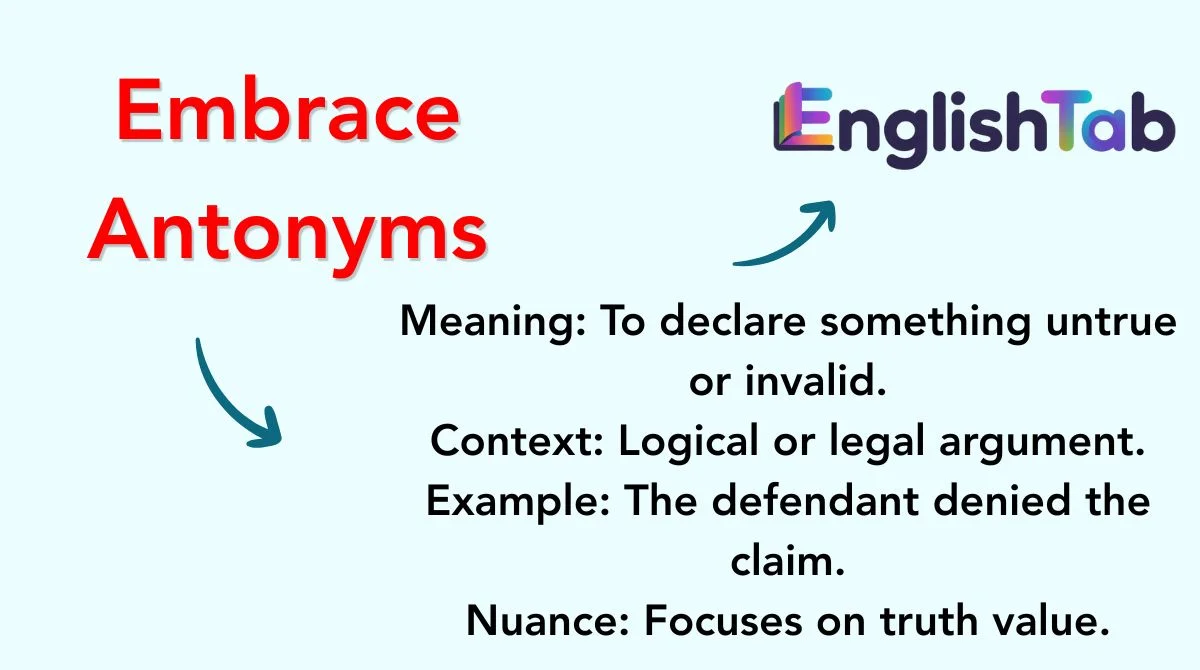
Deny
Meaning: To declare something untrue or invalid.
Context: Logical or legal argument.
Example: The defendant denied the claim.
Nuance: Focuses on truth value.
Repudiate
Meaning: To reject formally or publicly.
Context: Political or legal contexts.
Example: The party repudiated earlier statements.
Nuance: Strong and formal.
Renounce
Meaning: To formally give up.
Context: Religious or ideological settings.
Example: He renounced former beliefs.
Nuance: Suggests previous acceptance.
Spurn
Meaning: To reject with disdain.
Context: Emotional or literary usage.
Example: She spurned the offer.
Nuance: Conveys contempt.
Dismiss
Meaning: To treat as unworthy of consideration.
Context: Academic criticism.
Example: Critics dismissed the findings.
Nuance: Suggests casual disregard.
Exclude
Meaning: To leave out intentionally.
Context: Policy or structural design.
Example: The law excludes certain groups.
Nuance: Opposite when embrace means “include.”
Avoid
Meaning: To stay away from.
Context: Behavioral description.
Example: He avoided controversial topics.
Nuance: Passive resistance.
Shun
Meaning: To deliberately avoid socially.
Context: Social relationships.
Example: The group shunned the dissenter.
Nuance: Strong social rejection.
Discard
Meaning: To throw away or abandon.
Context: Methodology or ideas.
Example: Researchers discarded flawed data.
Nuance: Practical rather than emotional.
Abandon
Meaning: To give up completely.
Context: Strategic decisions.
Example: The project was abandoned.
Nuance: Suggests finality.
Withdraw
Meaning: To remove support.
Context: Institutional action.
Example: Funding was withdrawn.
Nuance: Often procedural.
Repel
Meaning: To drive away.
Context: Physical or emotional.
Example: The idea repelled voters.
Nuance: Strong emotional aversion.
Object
Meaning: To express disagreement.
Context: Formal meetings.
Example: Several members objected.
Nuance: Polite resistance.
Disapprove
Meaning: To judge negatively.
Context: Moral evaluation.
Example: The board disapproved of the conduct.
Nuance: Moral but restrained.
Decline
Meaning: To politely refuse.
Context: Invitations or proposals.
Example: She declined the offer.
Nuance: Courteous tone.
Boycott
Meaning: To refuse engagement collectively.
Context: Economic or political action.
Example: Consumers boycotted the brand.
Nuance: Organized resistance.
Protest
Meaning: To express strong objection.
Context: Social movements.
Example: Citizens protested the reform.
Nuance: Public opposition.
Condemn
Meaning: To express strong disapproval.
Context: Ethical judgment.
Example: Leaders condemned corruption.
Nuance: Moral intensity.
Defy
Meaning: To openly resist authority.
Context: Conflict or rebellion.
Example: Workers defied regulations.
Nuance: Confrontational.
Rescind
Meaning: To revoke formally.
Context: Legal or contractual.
Example: The order was rescinded.
Nuance: Administrative reversal.
Antonym Comparison Table
| Word | Intensity | Formality | Emotional Tone | Implies Previous Acceptance |
|---|---|---|---|---|
| Reject | Medium | Neutral | Neutral | No |
| Repudiate | High | Formal | Strong | Sometimes |
| Renounce | High | Formal | Serious | Yes |
| Dismiss | Low | Neutral | Casual | No |
| Condemn | High | Formal | Moral | No |
| Decline | Low | Polite | Neutral | No |
| Abandon | High | Neutral | Final | Yes |
| Shun | High | Neutral | Socially Cold | No |
| Object | Low | Formal | Mild | No |
Academic Writing Examples
- Rather than embrace the hypothesis, the researchers rejected it due to insufficient data.
- The administration resisted reform despite public pressure.
- The court repudiated earlier precedents.
- Scholars dismissed the interpretation as methodologically flawed.
- Activists opposed the legislation on ethical grounds.
Each sentence demonstrates how replacing “embrace” alters argumentative direction.
When Not to Replace the Word
Do not substitute an antonym when:
- The tone requires neutrality.
- The contrast is implicit rather than explicit.
- The context involves physical affection.
- The sentence requires inclusion rather than acceptance.
Example:
Incorrect: The mother rejected her child in greeting.
Correct: The mother embraced her child warmly.
Context determines accuracy.
Practice Exercises
Exercise 1: Replace “embrace” with a precise antonym.
The board chose not to embrace the proposal.
Exercise 2: Identify the strongest antonym.
The leader publicly renounced the ideology.
Exercise 3: Select the most polite antonym.
She declined the invitation.
Exercise 4: Rewrite for academic tone.
The theory was dismissed after peer review.
FAQs
What is the strongest antonym of embrace?
“Repudiate” and “condemn” are among the strongest because they imply formal and moral rejection.
Is “ignore” always an antonym of embrace?
No. It is contextual and depends on whether embrace means “engage with.”
Which antonym is most polite?
“Decline” is typically the most courteous form of refusal.
Are emotional opposites always negative?
Yes, because they reverse acceptance into rejection or resistance.
Can embrace and reject appear in the same argument?
Yes. Academic writing often contrasts what scholars embrace with what they reject.
Conclusion
Understanding 24+ embrace antonyms enhances precision, tonal control, and analytical depth. While “embrace” signals acceptance, inclusion, and enthusiasm, its opposites range from polite refusal to forceful condemnation.
Effective writers select antonyms not merely for contrast, but for nuance—considering formality, emotional weight, and contextual relevance.
Mastering these distinctions transforms writing from general to exact, from descriptive to analytical. In advanced academic discourse, that precision is not optional—it is essential.

Dorian Hale is an English language enthusiast and content creator dedicated to making vocabulary and grammar learning simple, engaging, and accessible for everyone.