Precision in language shapes clarity in thought. In academic writing, philosophy, politics, religion, and law, the word doctrine carries strong intellectual weight.
When used carefully, it signals structured belief, codified principles, and institutional authority. Yet effective writing does not rely only on strong terms—it depends equally on contrast.
Opposites sharpen meaning. They create tension. They define boundaries.
When we understand the antonyms of doctrine, we better grasp what doctrine truly represents: rigidity versus flexibility, authority versus independence, structure versus spontaneity.
This in-depth 2K26 guide explores more than 20 doctrine antonyms through clear definition, contextual comparison, tone analysis, academic examples, and nuanced distinctions.
The goal is not to list random opposites, but to analyze how each alternative meaningfully contrasts with doctrine in scholarly and professional contexts.
Definition and Core Meaning of “Doctrine”
Doctrine refers to a formally established system of beliefs, principles, or teachings that are officially endorsed by an institution, religion, political movement, or authority.
Core characteristics of doctrine:
- Structured and organized
- Authoritative or officially sanctioned
- Prescriptive (tells people what to believe or follow)
- Often resistant to change
- Systematic rather than casual
In religion, doctrine may define theological truth.
In politics, it may define national strategy.
In law, it may guide interpretation.
Doctrine implies codified belief backed by authority. Therefore, its antonyms often involve:
- Freedom from rigid belief
- Lack of structure
- Skepticism
- Individual interpretation
- Flexibility
- Informality
Understanding these opposites allows writers to signal intellectual positioning with greater accuracy.
Direct Opposites (Clear Contrasts)
Below are 20 strong antonyms that directly contrast with doctrine’s core meaning:
- Individualism
- Flexibility
- Open-mindedness
- Skepticism
- Doubt
- Innovation
- Experimentation
- Pragmatism
- Freedom
- Independence
- Improvisation
- Relativism
- Nonconformity
- Liberalism
- Agnosticism
- Secularism
- Unorthodoxy
- Spontaneity
- Autonomy
- Inquiry
- Questioning
- Fluidity
Each of these reduces or removes the idea of fixed, authoritative belief.
Contextual Opposites
Some words oppose doctrine only depending on context.
For example:
- Pragmatism opposes doctrine when doctrine is rigid. However, some doctrines can be pragmatic.
- Tradition may support doctrine in religious settings but oppose revolutionary doctrine in political contexts.
- Opinion contrasts with doctrine when doctrine represents institutional authority, yet a doctrine may begin as opinion.
Context determines whether the opposition is conceptual, emotional, or structural.
Writers must evaluate:
- Is the doctrine rigid or adaptive?
- Is it institutional or personal?
- Is the contrast intellectual or emotional?
Opposites are rarely mechanical. They function rhetorically.
Emotional & Tone-Based Opposites
Doctrine often carries a tone of certainty, authority, and finality. Emotional opposites shift tone dramatically.
- Curiosity contrasts with dogmatic certainty.
- Humility opposes intellectual rigidity.
- Tolerance contrasts with exclusionary doctrine.
- Creativity challenges rigid structure.
- Doubt softens authoritative claims.
Tone-based antonyms are powerful in persuasive writing. Instead of attacking doctrine directly, writers may frame alternatives as compassionate, flexible, or open.
For example:
The institution upheld strict doctrine.
The reform movement promoted intellectual openness.
The emotional contrast shapes reader perception.
20+ Antonyms Explained in Detail
Below are 22 carefully analyzed antonyms with meaning, context, example, and nuance difference.
Individualism
Meaning: Emphasis on personal belief rather than institutional teaching.
Context: Political philosophy, ethics, cultural studies.
Example: The movement rejected doctrine in favor of individualism.
Nuance: Doctrine requires shared structure; individualism prioritizes personal autonomy.
Flexibility
Meaning: Willingness to adapt or change.
Context: Organizational theory, education.
Example: The new curriculum emphasized flexibility instead of rigid doctrine.
Nuance: Doctrine suggests fixed principles; flexibility implies modification.
Open-mindedness
Meaning: Readiness to consider new ideas.
Context: Academic discourse.
Example: Scholars value open-mindedness over doctrinal rigidity.
Nuance: Doctrine may limit perspective; open-mindedness expands it.
Skepticism
Meaning: Doubt toward accepted belief.
Context: Philosophy, science.
Example: Scientific inquiry depends on skepticism rather than doctrine.
Nuance: Doctrine asserts truth; skepticism questions it.
Doubt
Meaning: Uncertainty or lack of conviction.
Context: Theology, existential studies.
Example: Doubt challenges established doctrine.
Nuance: Doctrine demands confidence; doubt introduces hesitation.
Innovation
Meaning: Introduction of new ideas.
Context: Technology, education reform.
Example: Innovation replaced outdated doctrine.
Nuance: Doctrine preserves tradition; innovation disrupts it.
Experimentation
Meaning: Testing new methods.
Context: Scientific research.
Example: The lab encouraged experimentation over rigid doctrine.
Nuance: Doctrine implies predetermined truth; experimentation seeks discovery.
Pragmatism
Meaning: Practical decision-making based on results.
Context: Political science.
Example: Pragmatism guided policy instead of ideological doctrine.
Nuance: Doctrine prioritizes principles; pragmatism prioritizes outcomes.
Freedom
Meaning: Absence of imposed belief.
Context: Civil rights discourse.
Example: The constitution protects freedom from state doctrine.
Nuance: Doctrine imposes; freedom liberates.
Independence
Meaning: Self-governance in thought.
Context: Education theory.
Example: Students developed intellectual independence rather than memorizing doctrine.
Nuance: Doctrine directs belief; independence forms belief.
Improvisation
Meaning: Spontaneous adaptation.
Context: Leadership studies.
Example: Crisis management required improvisation instead of fixed doctrine.
Nuance: Doctrine is predetermined; improvisation is situational.
Relativism
Meaning: Truth varies by context.
Context: Philosophy.
Example: Relativism stands in contrast to universal doctrine.
Nuance: Doctrine claims universal truth; relativism denies absolutes.
Nonconformity
Meaning: Refusal to follow established norms.
Context: Cultural studies.
Example: Artists embraced nonconformity over artistic doctrine.
Nuance: Doctrine expects adherence; nonconformity resists it.
Liberalism
Meaning: Openness to reform and change.
Context: Political theory.
Example: Liberalism opposed conservative doctrine.
Nuance: Doctrine can be restrictive; liberalism encourages expansion.
Agnosticism
Meaning: Suspension of belief.
Context: Religious philosophy.
Example: Agnosticism contrasts sharply with religious doctrine.
Nuance: Doctrine affirms belief; agnosticism withholds it.
Secularism
Meaning: Separation from religious authority.
Context: Governance.
Example: Secularism challenges theological doctrine in state affairs.
Nuance: Doctrine may be faith-based; secularism removes faith from policy.
Unorthodoxy
Meaning: Departure from accepted beliefs.
Context: Intellectual history.
Example: Her unorthodoxy questioned established doctrine.
Nuance: Doctrine defines orthodoxy; unorthodoxy defies it.
Spontaneity
Meaning: Acting without predetermined rule.
Context: Creative arts.
Example: Spontaneity replaced strict doctrinal method.
Nuance: Doctrine is systematic; spontaneity is unstructured.
Autonomy
Meaning: Self-rule or self-direction.
Context: Ethics.
Example: Moral autonomy conflicts with imposed doctrine.
Nuance: Doctrine governs externally; autonomy governs internally.
Inquiry
Meaning: Active investigation.
Context: Academic research.
Example: Universities value inquiry over memorized doctrine.
Nuance: Doctrine transmits answers; inquiry seeks them.
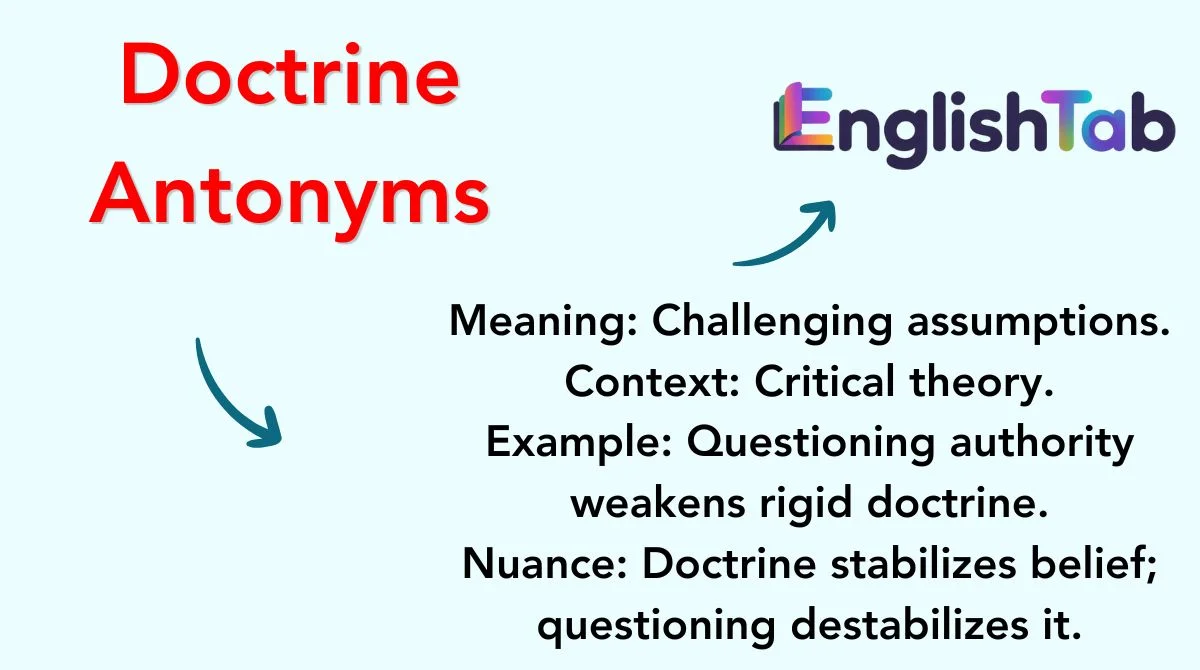
Questioning
Meaning: Challenging assumptions.
Context: Critical theory.
Example: Questioning authority weakens rigid doctrine.
Nuance: Doctrine stabilizes belief; questioning destabilizes it.
Fluidity
Meaning: Capacity to shift and evolve.
Context: Sociological analysis.
Example: Modern ethics shows fluidity rather than fixed doctrine.
Nuance: Doctrine implies permanence; fluidity implies change.
Antonym Comparison Table
| Antonym | Level of Opposition | Emotional Tone | Structural Contrast | Best Context |
|---|---|---|---|---|
| Skepticism | Strong | Critical | Challenges truth | Science |
| Freedom | Strong | Liberating | Removes authority | Politics |
| Innovation | Moderate | Energetic | Introduces change | Technology |
| Pragmatism | Contextual | Practical | Outcome-based | Policy |
| Autonomy | Strong | Empowering | Self-governed | Ethics |
| Doubt | Emotional | Uncertain | Weakens certainty | Theology |
| Inquiry | Strong | Curious | Process-driven | Academia |
| Nonconformity | Strong | Rebellious | Rejects norms | Culture |
| Fluidity | Moderate | Adaptive | Flexible structure | Sociology |
This comparison helps writers select the most precise contrast.
Academic Writing Examples
- Political Theory
The regime enforced ideological doctrine, whereas reformists promoted political pluralism and inquiry. - Religious Studies
Medieval doctrine emphasized divine authority, while emerging humanism encouraged skepticism and individualism. - Education
Traditional classrooms prioritized doctrinal memorization; progressive models foster autonomy and experimentation. - Law
Judicial doctrine may guide interpretation, but pragmatic rulings sometimes prioritize practical outcomes. - Sociology
Social movements often arise when rigid doctrine fails to accommodate cultural fluidity.
Each example shows how antonyms refine analytical contrast.
When Not to Replace the Word
Replacing doctrine with an antonym is not always appropriate.
Avoid substitution when:
- Referring to official legal doctrines
- Discussing established theological systems
- Quoting historical terminology
- Describing structured military strategy
In these contexts, doctrine has technical meaning. Substitution may distort accuracy.
Instead of replacing, contrast explicitly:
Incorrect: The court followed freedom.
Correct: The court followed established legal doctrine.
Precision matters more than stylistic variation.
Practice Exercises
- Rewrite the sentence using a strong antonym:
The institution strictly enforced doctrine. - Identify the best antonym for academic debate:
a) Freedom
b) Inquiry
c) Spontaneity - Choose which antonym best contrasts religious doctrine in governance:
a) Secularism
b) Innovation
c) Improvisation - Write one paragraph comparing doctrine and skepticism.
- Analyze how autonomy differs from nonconformity.
These exercises build contrast-awareness skills.
FAQs
What is the strongest antonym of doctrine?
Skepticism and autonomy are among the strongest because they directly challenge imposed belief systems.
Is pragmatism always opposite of doctrine?
No. Some doctrines incorporate pragmatic elements. The opposition depends on rigidity.
Can freedom replace doctrine in academic writing?
Not directly. Freedom removes authority, but doctrine describes structured belief. They contrast rather than substitute.
Is doctrine always negative?
No. In law and theology, doctrine provides stability and consistency. It becomes negative when inflexible.
How do I choose the best antonym?
Identify what aspect of doctrine you are contrasting: authority, rigidity, structure, or certainty.
Conclusion
Understanding doctrine antonyms is not a vocabulary exercise—it is an intellectual strategy. Doctrine represents structured, authoritative belief.
Its opposites represent independence, inquiry, skepticism, and adaptability.
By analyzing more than twenty contrasting terms, we see that opposition operates across structural, emotional, philosophical, and contextual levels. Strong writing depends on this precision.
In 2K26 and beyond, academic clarity will increasingly rely on nuanced contrast rather than simplistic synonym replacement.
Mastering doctrine antonyms equips writers, scholars, and students with sharper analytical tools and deeper rhetorical control.

Dorian Hale is an English language enthusiast and content creator dedicated to making vocabulary and grammar learning simple, engaging, and accessible for everyone.