Many people search for “divisive synonyms” when they want stronger, clearer words in their writing. The word divisive shows up in news articles, school essays, debates, business reports, and even social media posts.
But using the same word again and again can make writing dull.
Good writers use word variety. It keeps readers interested. It also helps you match the right tone. In academic writing, you may need a formal word.
In professional settings, you may want something neutral. In casual writing, you might prefer a softer or more natural option.
Choosing the right synonym can improve clarity and impact. It can change how your message feels. It can make your writing sound smarter, more thoughtful, or more persuasive.
In this guide, you’ll learn over 21 strong alternatives to divisive, plus when to use them, when to avoid them, and how to pick the best one for your audience.
What Does “Divisive” Mean?
The word divisive describes something that causes people to disagree or split into groups. It creates conflict, tension, or separation.
It often carries a slightly negative tone. When something is called divisive, it suggests that it leads to arguments, strong opinions, or emotional reactions.
Common situations where it’s used:
- Politics: “The policy was divisive.”
- Social issues: “It remains a divisive topic.”
- Workplace decisions: “The new rule proved divisive.”
- Public figures: “He is a divisive leader.”
The word does not always mean “bad,” but it usually signals disagreement or conflict between groups.
21+ Best Synonyms for “Divisive”
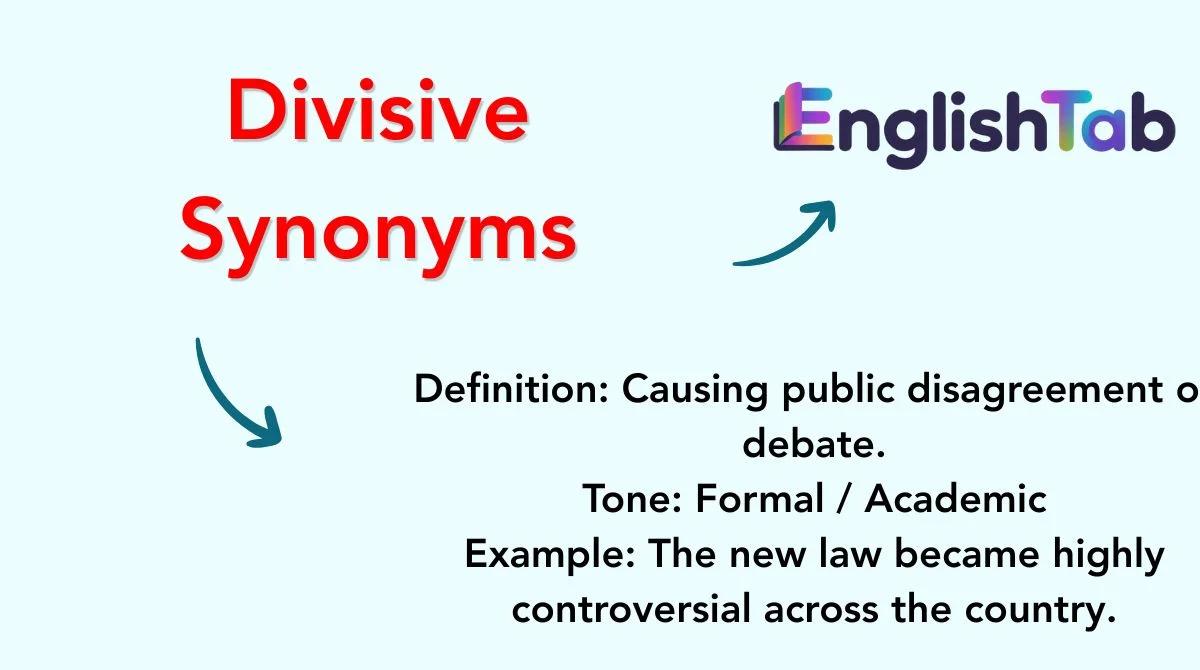
1. Controversial
Definition: Causing public disagreement or debate.
Tone: Formal / Academic
Example: The new law became highly controversial across the country.
2. Polarizing
Definition: Forcing people into two opposite sides.
Tone: Formal
Example: The speaker’s remarks were deeply polarizing.
3. Contentious
Definition: Likely to cause argument.
Tone: Academic
Example: Funding for the project remains a contentious issue.
4. Discordant
Definition: Lacking harmony; full of disagreement.
Tone: Literary
Example: The meeting ended on a discordant note.
5. Inflammatory
Definition: Likely to cause anger or strong reaction.
Tone: Formal
Example: His inflammatory comments upset many listeners.
6. Provocative
Definition: Designed to stir emotion or reaction.
Tone: Neutral
Example: The article presented a provocative argument.
7. Fracturing
Definition: Causing a split within a group.
Tone: Formal
Example: The decision had a fracturing effect on the team.
8. Splitting
Definition: Causing separation or division.
Tone: Casual
Example: The issue is splitting the community apart.
9. Separating
Definition: Creating distance between people or groups.
Tone: Neutral
Example: The debate is separating families and friends.
10. Disruptive
Definition: Causing disturbance or disorder.
Tone: Professional
Example: The policy proved disruptive in the workplace.
11. Combative
Definition: Ready to argue or fight.
Tone: Informal
Example: His combative style made discussions tense.
12. Opposing
Definition: In disagreement with others.
Tone: Neutral
Example: Two opposing views emerged during the debate.
13. Schismatic
Definition: Causing a formal split, especially in organizations.
Tone: Academic
Example: The leadership change led to a schismatic divide.
14. Conflict-driven
Definition: Based on disagreement or struggle.
Tone: Professional
Example: The campaign became conflict-driven and hostile.
15. Antagonistic
Definition: Actively hostile or opposed.
Tone: Formal
Example: The tone of the speech was antagonistic.
16. Partisan
Definition: Strongly supporting one side only.
Tone: Political / Academic
Example: The debate turned sharply partisan.
17. Clashing
Definition: Strongly conflicting.
Tone: Casual
Example: Clashing opinions filled the room.
18. Disuniting
Definition: Breaking unity apart.
Tone: Formal
Example: The proposal was seen as disuniting.
19. Split-inducing
Definition: Causing division.
Tone: Informal
Example: The issue was split-inducing among voters.
20. Disagreeable
Definition: Leading to disagreement.
Tone: Neutral
Example: The topic remains disagreeable in public forums.
21. Disputed
Definition: Questioned or challenged by others.
Tone: Academic
Example: The disputed results sparked debate.
Stronger Alternatives (More Intense Options)
These words are stronger than divisive. Use them when conflict is serious or emotional.
- Explosive – When reactions are intense and immediate.
- Incendiary – When words may cause anger or unrest.
- Rift-causing – When a long-term split happens.
- Hostile – When emotions are aggressive.
- Deeply polarizing – When society is sharply divided.
- Bitterly contested – When conflict is ongoing and strong.
Use these carefully. They suggest high tension or serious disagreement.
Softer or Polite Alternatives
Sometimes you need a gentler word.
- Debated – Neutral and common.
- Sensitive – Suggests emotional importance.
- Complex – Avoids blaming.
- Challenging – Professional and calm.
- Open to discussion – Diplomatic tone.
- Unsettled – Suggests issue isn’t resolved.
- Under discussion – Safe in business writing.
These work well in workplaces or formal writing.
Academic & IELTS-Friendly Alternatives
These options are ideal for essays, research, and exams.
- Controversial
- Polarizing
- Contentious
- Schismatic
- Ideologically split
- Socially fragmented
- Politically charged
- Highly disputed
- Ethically debated
- Socially divisive
- Factional
- Polarized
These words show advanced vocabulary and improve academic tone.
Synonyms You Should Avoid (Context Warning)
Some words seem similar but can mislead readers.
1. Different
This only means “not the same.” It does not suggest conflict.
2. Separate
This describes physical distance, not emotional or social division.
3. Unique
This has no connection to disagreement.
4. Individual
This refers to one person, not division.
5. Opposite
Opposite ideas are not always divisive.
Using these in place of divisive may confuse readers.
How to Choose the Right Synonym in Writing
Choosing the best synonym depends on four things:
1. Context
Is the situation political? Social? Personal? Academic?
For politics, “polarizing” works well.
For essays, “contentious” sounds stronger.
2. Tone
Do you want neutral or dramatic?
“Debated” is soft.
“Incendiary” is strong.
3. Audience
Professional readers prefer calm language.
General audiences understand simpler words.
4. Clarity
Never choose a word just because it sounds smart.
If readers may not understand it, use something simpler.
The right word makes your message clear and powerful.
Example Paragraph Rewritten Using Synonyms
Original:
The new policy is divisive and has caused strong reactions among citizens.
Rewritten Version 1:
The new policy is controversial and has triggered intense debate among citizens.
Rewritten Version 2:
The new policy is polarizing and has split public opinion.
Rewritten Version 3:
The new policy has become a contentious issue across the country.
Rewritten Version 4:
The new policy is politically charged and continues to divide communities.
Each version changes tone slightly but keeps the meaning.
FAQs
What is the best synonym for divisive?
“Controversial” is the most common and flexible synonym. It works in academic, professional, and news writing.
Is polarizing stronger than divisive?
Yes. “Polarizing” suggests two extreme sides with little middle ground.
Can I use divisive in academic writing?
Yes, but words like “contentious” or “controversial” often sound more formal.
What is a softer word for divisive?
“Debated” or “sensitive” are softer and more neutral.
Is divisive always negative?
Not always, but it usually suggests tension or conflict.
What is a business-friendly alternative?
“Challenging,” “under discussion,” or “complex” are safer in professional settings.
What is an IELTS synonym for divisive?
“Contentious,” “polarizing,” and “controversial” are strong IELTS vocabulary choices.
Conclusion
The word divisive is useful, but relying on one word limits your writing power. Strong writers choose the right synonym based on tone, audience, and context.
Whether you need a formal academic term like contentious, a political word like polarizing, or a softer business-friendly option like debated, you now have more than 21 strong alternatives ready to use.
Better vocabulary leads to clearer thinking. Clear thinking leads to stronger writing.
Start replacing basic words with precise ones today—and watch your writing improve instantly in 2026 and beyond.

Dorian Hale is an English language enthusiast and content creator dedicated to making vocabulary and grammar learning simple, engaging, and accessible for everyone.