Precision in language is not merely stylistic; it is structural. In academic, professional, and creative writing, clarity depends heavily on contrast. Opposites sharpen meaning.
When we describe a state of confusion, instability, or cognitive disruption, we often use the word disoriented.
However, the ability to express its opposite with nuance allows writers to convey stability, awareness, and composure with greater authority.
Understanding disoriented antonyms strengthens analytical writing, psychological descriptions, character development, and even scientific reporting.
The opposite of mental confusion may be clarity, but it may also be composure, grounding, certainty, or alertness—depending on context.
This article explores 17+ carefully analyzed antonyms of “disoriented,” categorizing them by strength, context, and emotional tone for maximum clarity and precision.
Definition and Core Meaning of “Disoriented”
The word disoriented refers to a state in which a person lacks awareness of direction, position, time, identity, or situation. It can describe:
- Physical confusion (not knowing where one is)
- Cognitive confusion (difficulty processing information)
- Emotional imbalance (feeling mentally unsettled)
- Sensory disarray (loss of spatial awareness)
At its core, disorientation implies a breakdown of internal order—mental, spatial, or emotional. Therefore, its antonyms restore that order in varying degrees.
Direct Opposites (Clear Contrasts)
These are the strongest and most literal antonyms of disoriented—they directly restore clarity and awareness.
- Oriented
- Clearheaded
- Focused
- Grounded
- Aware
- Alert
- Composed
- Balanced
- Centered
- Steady
- Certain
- Organized
- Directed
- Conscious
- Mindful
- Attentive
- Rational
- Coherent
Each of these words counters confusion, instability, or lack of awareness.
Contextual Opposites
Certain words function as antonyms only in specific situations. For example:
- Stable opposes emotional disorientation but not necessarily spatial confusion.
- Informed counters cognitive disorientation in academic writing.
- Settled may oppose emotional disturbance rather than mental confusion.
- Synchronized contrasts with sensory disorientation in physical contexts.
Context determines whether the antonym is cognitive, spatial, emotional, or psychological.
Emotional & Tone-Based Opposites
Not all antonyms are equal in emotional intensity.
- Calm softens emotional chaos.
- Confident adds assertive stability.
- Self-assured implies strong psychological grounding.
- Serene suggests deep internal peace rather than mere clarity.
- Collected conveys control under pressure.
Tone matters. A medical report prefers oriented. A leadership speech may favor confident or centered.
17+ Antonyms Explained in Detail
Below are 18 fully analyzed antonyms of disoriented, each explained for academic and professional precision.
Oriented
Meaning: Aware of time, place, and identity.
Context: Common in medical and psychological settings.
Example: The patient was fully oriented after regaining consciousness.
Nuance: Most technical and clinically accurate opposite.
Clearheaded
Meaning: Thinking clearly without confusion.
Context: Intellectual or decision-making scenarios.
Example: She remained clearheaded during the crisis.
Nuance: Implies mental sharpness rather than just awareness.
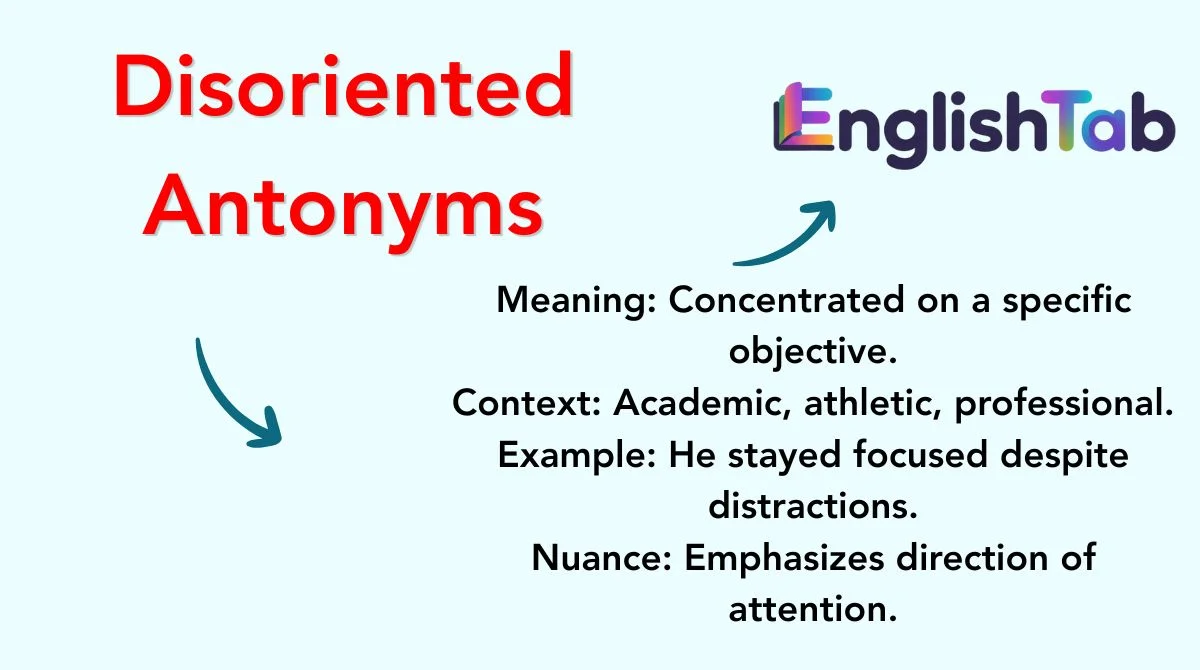
Focused
Meaning: Concentrated on a specific objective.
Context: Academic, athletic, professional.
Example: He stayed focused despite distractions.
Nuance: Emphasizes direction of attention.
Grounded
Meaning: Emotionally stable and realistic.
Context: Psychological or personal growth writing.
Example: Meditation helped her feel grounded again.
Nuance: Emotional stability more than cognitive clarity.
Aware
Meaning: Conscious of surroundings or facts.
Context: General usage.
Example: She was fully aware of her surroundings.
Nuance: Broad and versatile antonym.
Alert
Meaning: Actively attentive and responsive.
Context: Safety or emergency contexts.
Example: The guard remained alert throughout the night.
Nuance: Suggests readiness and vigilance.
Composed
Meaning: Calm and in control emotionally.
Context: Stressful situations.
Example: He remained composed under pressure.
Nuance: Emotional steadiness rather than spatial clarity.
Balanced
Meaning: Emotionally or mentally stable.
Context: Personality or psychology.
Example: She maintained a balanced perspective.
Nuance: Implies equilibrium.
Centered
Meaning: Internally stable and self-aware.
Context: Mindfulness and personal development.
Example: He felt centered after reflection.
Nuance: Deep internal stability.
Steady
Meaning: Firm and stable without wavering.
Context: Physical or emotional strength.
Example: Her voice remained steady.
Nuance: Suggests reliability.
Certain
Meaning: Free from doubt.
Context: Decision-making or analysis.
Example: He was certain of his answer.
Nuance: Opposes confusion in judgment.
Organized
Meaning: Structurally ordered.
Context: Work or thought processes.
Example: Her notes were organized and clear.
Nuance: External structure rather than internal awareness.
Directed
Meaning: Guided with purpose.
Context: Strategic planning.
Example: The team maintained a directed approach.
Nuance: Implies purposeful movement.
Conscious
Meaning: Awake and aware.
Context: Medical or philosophical writing.
Example: The patient remained conscious.
Nuance: Basic awareness, not necessarily clarity.
Mindful
Meaning: Actively attentive to the present moment.
Context: Psychological or reflective writing.
Example: She was mindful of her reactions.
Nuance: Reflective awareness.
Attentive
Meaning: Paying careful attention.
Context: Classroom or workplace.
Example: Students were attentive during the lecture.
Nuance: Focus on listening and observation.
Rational
Meaning: Guided by logic and reason.
Context: Academic debate.
Example: His response was rational and measured.
Nuance: Logical stability.
Coherent
Meaning: Logically connected and understandable.
Context: Speech or writing.
Example: Her explanation was coherent and precise.
Nuance: Opposes mental fragmentation.
Antonym Comparison Table
| Word | Cognitive Clarity | Emotional Stability | Physical Awareness | Formal Tone |
|---|---|---|---|---|
| Oriented | High | Moderate | High | Very High |
| Clearheaded | Very High | Moderate | Low | High |
| Grounded | Moderate | Very High | Low | Medium |
| Alert | High | Low | High | Medium |
| Composed | Moderate | High | Low | High |
| Focused | Very High | Moderate | Moderate | High |
| Rational | Very High | Moderate | Low | Very High |
| Coherent | High | Low | Low | High |
| Balanced | Moderate | Very High | Low | Medium |
Academic Writing Examples
- Instead of writing “The participant appeared disoriented,” write “The participant appeared cognitively impaired and unable to remain oriented to time and place.”
- “The leader remained composed and focused despite operational challenges.”
- “Students demonstrated coherent reasoning during the evaluation.”
- “The subject was alert and fully aware of environmental stimuli.”
Each revision replaces confusion with precise stability.
When Not to Replace the Word
Do not substitute an antonym when:
- The text requires medical accuracy (use “oriented” instead of emotional synonyms).
- Emotional grounding differs from spatial awareness.
- The original meaning involves trauma or neurological damage.
- Clarity is required without emotional implication.
For example, “calm” does not fully oppose “disoriented” in neurological reports.
Practice Exercises
- Replace “disoriented” with a stronger antonym:
- The executive felt disoriented during the merger discussion.
- Suggested answer: focused or composed.
- Choose the best antonym:
- After the accident, he was finally ______ to his surroundings.
- Correct answer: oriented.
- Identify nuance:
- Which word emphasizes emotional stability?
- Grounded.
- Rewrite:
- The speaker seemed confused and scattered.
- The speaker appeared coherent and composed.
FAQs
What is the strongest antonym of disoriented?
Oriented is the most technically accurate opposite, especially in medical and psychological contexts.
Are calm and disoriented opposites?
Not always. Calm addresses emotional state, while disoriented involves awareness or cognition.
Which antonym is best for academic writing?
Oriented, coherent, rational, and focused are most suitable in formal contexts.
Can confident replace disoriented?
Only in emotional contexts. Confidence relates to self-belief, not spatial or cognitive clarity.
Is grounded stronger than balanced?
Grounded implies deeper emotional stability, while balanced suggests equilibrium.
Conclusion
Mastering 17+ disoriented antonyms equips writers with strategic linguistic precision. While “disoriented” implies cognitive, spatial, or emotional instability, its opposites vary in intensity and scope.
From the clinical precision of oriented to the psychological strength of grounded and the intellectual clarity of rational, each antonym restores order differently.
Effective writing depends on deliberate contrast. By selecting the most contextually appropriate opposite, writers enhance clarity, authority, and analytical depth.
In 2K26 and beyond, precision vocabulary is not optional—it is essential.

Dorian Hale is an English language enthusiast and content creator dedicated to making vocabulary and grammar learning simple, engaging, and accessible for everyone.