In academic writing, precision is power. One misplaced word can distort an argument. One vague concept can weaken an entire paragraph. This is especially true when discussing abstract ideas like destiny.
Understanding antonyms—the opposites of a word—sharpens clarity. When writers contrast ideas, they strengthen reasoning.
Opposites create tension, highlight meaning, and deepen interpretation. In philosophy, literature, psychology, and theology, the word destiny carries heavy conceptual weight.
Therefore, knowing its strongest opposites allows scholars and students to argue with accuracy.
This article provides a deep, contrast-based exploration of 19+ destiny antonyms, analyzing meaning, nuance, tone, and usage.
The goal is not just to list opposites—but to examine how they function in context.
Definition and Core Meaning of “Destiny”
Destiny refers to a predetermined course of events believed to be shaped by fate, divine will, cosmic order, or inevitable forces. It suggests that outcomes are fixed in advance and beyond human control.
Core characteristics of destiny:
- Implies inevitability
- Suggests predetermination
- Often carries spiritual or philosophical weight
- Reduces the role of human choice
In literature, destiny frequently appears as an unstoppable force guiding characters toward specific outcomes. In theology, it may imply divine design. In psychology, it may reflect belief in external control.
Because destiny implies lack of control and inevitability, its antonyms generally emphasize:
- Choice
- Freedom
- Randomness
- Uncertainty
- Human agency
- Self-determination
Direct Opposites (Clear Contrasts)
These are the strongest and most structurally opposite words to destiny:
- Choice
- Free will
- Self-determination
- Autonomy
- Freedom
- Volition
- Agency
- Independence
- Control
- Self-direction
- Randomness
- Accident
- Coincidence
- Chance
- Uncertainty
- Chaos
- Spontaneity
- Flexibility
- Improvisation
Each directly counters the idea of inevitability or predetermination.
Contextual Opposites
Some words function as antonyms only depending on context:
- Responsibility (when destiny removes accountability)
- Planning (when destiny implies no planning is required)
- Effort (when destiny suggests outcomes are fixed regardless of effort)
- Strategy (when events are not preordained)
- Experimentation (implies open outcomes)
- Adaptability (contrasts fixed outcomes)
These words oppose destiny not by dictionary definition, but by conceptual contrast.
Emotional & Tone-Based Opposites
Destiny often carries emotional gravity, solemnity, and inevitability. Tone-based opposites shift emotional intensity.
Destiny feels:
- Serious
- Final
- Heavy
- Grand
- Cosmic
Emotional opposites include:
- Playfulness
- Casualness
- Flexibility
- Lightness
- Openness
For example:
“Her destiny was sealed” sounds dramatic and irreversible.
“Her choices shaped her path” sounds empowered and flexible.
Tone matters as much as meaning.
19+ Antonyms Explained in Detail
Choice
Meaning: The act of selecting between options.
Context: Emphasizes human decision-making.
Example: She made a choice to pursue science.
Nuance: Choice implies control; destiny removes it.
Free Will
Meaning: The ability to act independently of predetermined forces.
Context: Used in philosophy and theology.
Example: Humans possess free will to shape their future.
Nuance: Free will directly contradicts predetermined fate.
Self-Determination
Meaning: The power to control one’s own outcomes.
Context: Political, psychological, and personal growth discussions.
Example: Self-determination leads to personal empowerment.
Nuance: Focuses on ownership of outcomes.
Autonomy
Meaning: Independence in decision-making.
Context: Academic, ethical, and legal writing.
Example: The patient exercised autonomy.
Nuance: Autonomy emphasizes internal authority.
Freedom
Meaning: Absence of constraint.
Context: Political and philosophical writing.
Example: Freedom allows individuals to shape their future.
Nuance: Broad and powerful contrast to inevitability.
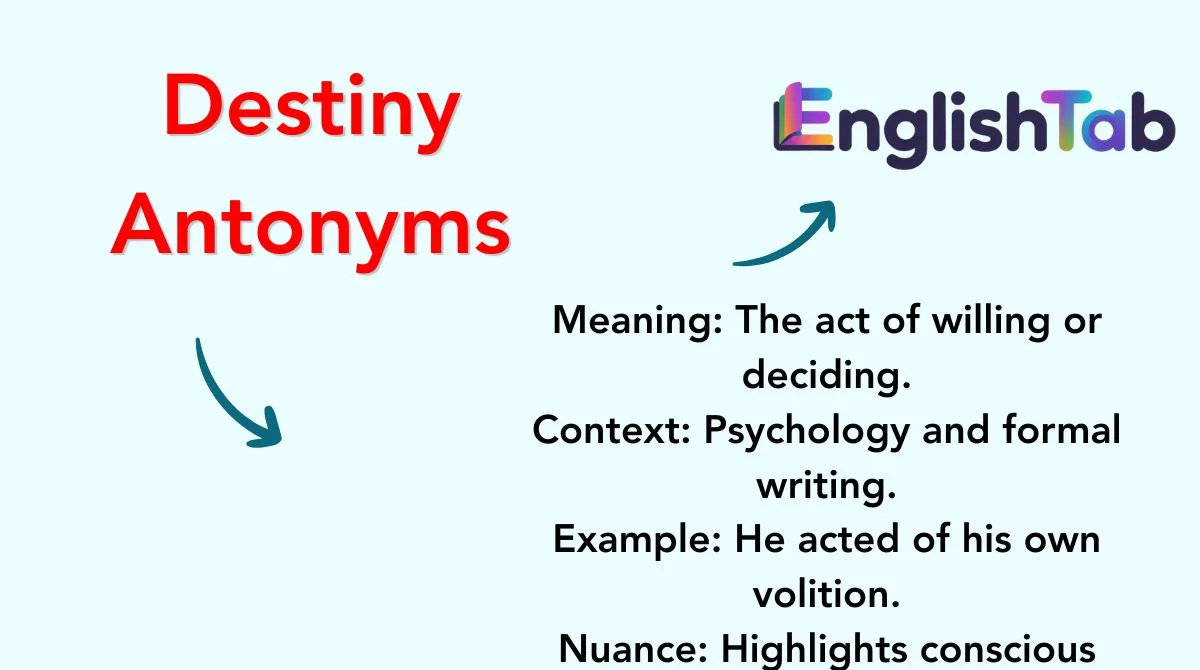
Volition
Meaning: The act of willing or deciding.
Context: Psychology and formal writing.
Example: He acted of his own volition.
Nuance: Highlights conscious intention.
Agency
Meaning: The capacity to act and influence events.
Context: Sociology and literary analysis.
Example: The character regains agency.
Nuance: Agency emphasizes power to affect outcomes.
Independence
Meaning: Freedom from control by others or external forces.
Context: Political and personal contexts.
Example: Independence allowed her to design her life.
Nuance: Suggests self-governance.
Control
Meaning: The power to influence events.
Context: Management, psychology, leadership.
Example: She maintained control over her career.
Nuance: Opposes the inevitability of destiny.
Randomness
Meaning: Lack of pattern or predetermined order.
Context: Science and probability discussions.
Example: Success sometimes depends on randomness.
Nuance: Directly opposes intentional cosmic design.
Accident
Meaning: An unplanned event.
Context: Everyday and legal writing.
Example: The meeting was an accident.
Nuance: Suggests absence of planning or destiny.
Coincidence
Meaning: A remarkable but accidental occurrence.
Context: Narrative and conversational writing.
Example: Their reunion was a coincidence.
Nuance: Weakens the idea of fate.
Chance
Meaning: Possibility occurring without intention.
Context: Probability and informal writing.
Example: It happened by chance.
Nuance: Less dramatic than destiny.
Uncertainty
Meaning: Lack of predictability.
Context: Academic and economic writing.
Example: The future remains uncertain.
Nuance: Opposes inevitability.
Chaos
Meaning: Complete disorder.
Context: Scientific and literary writing.
Example: Chaos replaced structure.
Nuance: Destiny implies order; chaos implies disorder.
Spontaneity
Meaning: Acting without planning.
Context: Behavioral and lifestyle contexts.
Example: Spontaneity shaped the journey.
Nuance: Highlights unpredictability.
Flexibility
Meaning: Ability to change or adapt.
Context: Organizational writing.
Example: Flexibility leads to resilience.
Nuance: Opposes fixed pathways.
Improvisation
Meaning: Creating without preparation.
Context: Performance and strategy discussions.
Example: Success required improvisation.
Nuance: Suggests adaptability rather than fate.
Self-Direction
Meaning: Guiding oneself independently.
Context: Education and psychology.
Example: Self-direction enhances growth.
Nuance: Focuses on internal guidance instead of external design.
Antonym Comparison Table
| Word | Implies Human Control | Implies Randomness | Emotional Tone | Academic Usage Strength |
|---|---|---|---|---|
| Choice | Yes | No | Neutral | High |
| Free Will | Yes | No | Philosophical | Very High |
| Agency | Yes | No | Empowering | Very High |
| Randomness | No | Yes | Neutral | High |
| Chaos | No | Yes | Dramatic | Moderate |
| Chance | No | Yes | Casual | Moderate |
| Autonomy | Yes | No | Formal | Very High |
| Coincidence | No | Yes | Light | Moderate |
| Control | Yes | No | Strong | High |
| Flexibility | Yes | No | Positive | High |
Academic Writing Examples
Philosophy:
“The concept of destiny assumes inevitability, whereas free will presupposes moral responsibility.”
Literary Analysis:
“The protagonist rejects destiny and asserts agency through deliberate action.”
Psychology:
“Belief in destiny correlates with an external locus of control, while self-determination reflects internal control.”
Political Science:
“National independence challenges the idea of historical destiny.”
When Not to Replace the Word
Do not replace destiny when:
- Discussing religious doctrines of predestination
- Analyzing classical tragedy
- Referring to mythological prophecy
- Preserving stylistic solemnity
Replacing destiny with “chance” in a tragic epic would weaken dramatic intensity.
Context determines appropriateness.
Practice Exercises
Rewrite the sentences using suitable antonyms:
- She believed it was her destiny to lead.
- Their meeting was destiny.
- History moves by destiny alone.
Suggested Answers:
- She exercised self-determination to lead.
- Their meeting was a coincidence.
- History evolves through human agency.
FAQs
What is the strongest antonym of destiny?
Free will and self-determination are the most conceptually opposite.
Is chance always the opposite of destiny?
Not always. Chance implies randomness, while destiny implies design. The contrast depends on context.
Can chaos replace destiny?
Only when contrasting order versus disorder.
Why is agency important in academic writing?
Agency clarifies responsibility and control.
Conclusion
Destiny represents inevitability, cosmic design, and predetermined outcomes. Its antonyms emphasize freedom, control, randomness, and human authority.
Mastering these 19+ destiny antonyms strengthens analytical writing, philosophical argument, and literary interpretation. Opposites are not merely vocabulary tools—they are conceptual instruments.
By choosing the right antonym, writers shift meaning, tone, and intellectual direction.
Precision transforms writing. Contrast deepens thought.

Dorian Hale is an English language enthusiast and content creator dedicated to making vocabulary and grammar learning simple, engaging, and accessible for everyone.