Strong writing depends on contrast. When readers clearly understand what something is not, they better understand what it is.
Opposites sharpen meaning, reduce confusion, and improve academic precision.
The word “demand” is powerful. It signals authority, urgency, and expectation.
But in many contexts—academic, professional, emotional, or diplomatic—using its opposite can soften tone, clarify relationships, or create balance in argumentation.
In this comprehensive guide, we explore 20+ demand antonyms, analyze their nuance, and demonstrate when each is most effective.
Whether you’re a student, researcher, content writer, or educator, mastering these contrasts will improve clarity and rhetorical control.
Definition and Core Meaning of “Demand”
The word demand generally means:
- To insist firmly
- To require something as necessary
- To claim something as a right
- To ask forcefully without leaving room for refusal
In academic and professional settings, “demand” implies authority, urgency, and expectation of compliance.
Example:
The supervisor demanded immediate revisions.
Key characteristics of “demand”:
- Strong authority
- High expectation
- Little flexibility
- Often urgent
Understanding this core meaning helps us identify true opposites—not just weaker synonyms.
Direct Opposites (Clear Contrasts)
These antonyms directly contrast the force and authority of “demand.” They represent softness, permission, passivity, or withdrawal.
- Request
- Ask
- Suggest
- Propose
- Recommend
- Offer
- Plead
- Beg
- Yield
- Surrender
- Concede
- Withdraw
- Relinquish
- Release
- Decline
- Refuse
- Accept
- Allow
- Permit
- Appeal
Each removes or reduces forcefulness in a different way.
Contextual Opposites
Some words function as opposites depending on context. They may not always contradict “demand,” but in certain situations, they clearly reverse its meaning.
- Ignore (opposite of actively demanding attention)
- Overlook (failure to insist)
- Disregard (choosing not to require)
- Forgo (intentionally giving up)
- Abandon (ending a requirement)
- Compromise (softening rigid expectations)
- Negotiate (seeking mutual agreement instead of imposing)
- Hesitate (lack of assertiveness)
- Comply (opposite role in interaction)
- Acquiesce (accept without protest)
These opposites depend on perspective: Are we viewing the authority or the receiver?
Emotional & Tone-Based Opposites
“Demand” often carries emotional weight—authority, frustration, urgency. Tone-based antonyms reduce intensity.
| High Intensity | Lower Intensity Opposite |
|---|---|
| Demand | Request |
| Insist | Suggest |
| Command | Recommend |
| Require | Prefer |
| Order | Invite |
For example:
The manager demanded silence.
The manager requested silence.
The second sentence preserves professionalism and reduces hostility.
Tone control is crucial in academic and diplomatic writing.
20+ Antonyms Explained in Detail
Below are detailed explanations of key demand antonyms, including meaning, context, examples, and nuance.
Request
Meaning: To ask politely or formally.
Context: Used in professional and academic communication.
Example:
The professor requested revisions.
Nuance: Maintains authority without aggression.
Ask
Meaning: To inquire or seek information.
Context: Informal and neutral.
Example:
She asked for clarification.
Nuance: Softer than “request” and much softer than “demand.”
Suggest
Meaning: To propose an idea gently.
Context: Collaborative environments.
Example:
The committee suggested changes.
Nuance: Leaves room for discussion.
Propose
Meaning: To formally put forward an idea.
Context: Academic or policy writing.
Example:
The researcher proposed a new framework.
Nuance: Structured but non-forceful.
Recommend
Meaning: To advise based on reasoning.
Context: Professional guidance.
Example:
Doctors recommend regular exercise.
Nuance: Persuasive, not compulsory.
Offer
Meaning: To present voluntarily.
Context: Reverses direction of power.
Example:
She offered assistance.
Nuance: Completely opposite authority dynamic.
Plead
Meaning: To ask emotionally or urgently.
Context: Personal or legal settings.
Example:
He pleaded for mercy.
Nuance: Emotional vulnerability instead of authority.
Beg
Meaning: To request desperately.
Context: Informal or emotional.
Example:
The child begged for forgiveness.
Nuance: Loss of power.
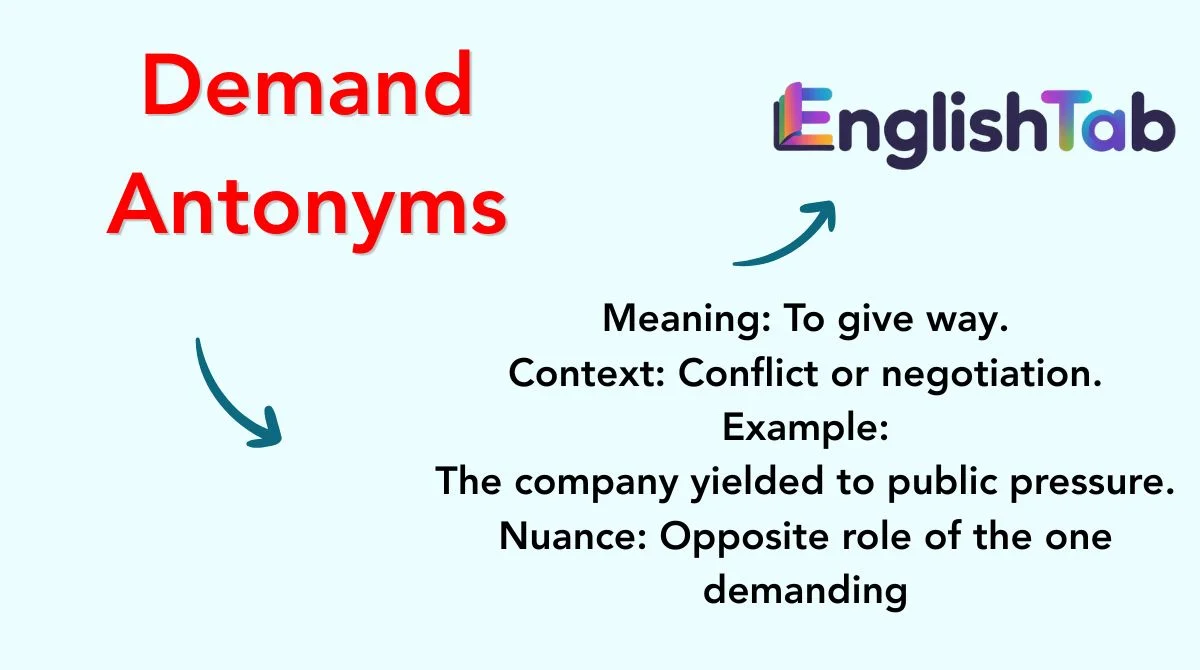
Yield
Meaning: To give way.
Context: Conflict or negotiation.
Example:
The company yielded to public pressure.
Nuance: Opposite role of the one demanding.
Surrender
Meaning: To give up control.
Context: Military or symbolic.
Example:
The army surrendered.
Nuance: Total reversal of authority.
Concede
Meaning: To admit reluctantly.
Context: Academic debate.
Example:
The author conceded the limitation.
Nuance: Intellectual humility.
Withdraw
Meaning: To remove or pull back.
Context: Formal decisions.
Example:
The organization withdrew its claim.
Nuance: Opposite of asserting force.
Relinquish
Meaning: To voluntarily give up.
Context: Legal or ownership situations.
Example:
He relinquished control.
Nuance: Formal surrender of authority.
Release
Meaning: To set free.
Context: Physical or metaphorical.
Example:
The company released its hold on the policy.
Nuance: Ends constraint.
Decline
Meaning: To politely refuse.
Context: Invitations or offers.
Example:
She declined the proposal.
Nuance: Controlled rejection.
Refuse
Meaning: To reject firmly.
Context: Defensive response.
Example:
He refused the request.
Nuance: Counter-action to demand.
Accept
Meaning: To agree willingly.
Context: Opposite interaction role.
Example:
They accepted the terms.
Nuance: Passive compliance.
Allow
Meaning: To permit something.
Context: Authority granting freedom.
Example:
The teacher allowed discussion.
Nuance: Encourages instead of compels.
Permit
Meaning: To authorize.
Context: Legal or formal setting.
Example:
The law permits access.
Nuance: Institutional approval.
Appeal
Meaning: To make a respectful request.
Context: Legal or persuasive writing.
Example:
The lawyer appealed the decision.
Nuance: Structured and procedural.
Compromise
Meaning: To find middle ground.
Context: Negotiation.
Example:
Both parties compromised.
Nuance: Replaces rigid insistence with flexibility.
Antonym Comparison Table
| Word | Force Level | Formality | Emotional Tone | Best Used In |
|---|---|---|---|---|
| Request | Low | High | Neutral | Academic |
| Ask | Low | Medium | Neutral | Conversation |
| Suggest | Low | Medium | Collaborative | Team settings |
| Recommend | Medium | High | Advisory | Reports |
| Beg | Very Low | Low | Emotional | Personal context |
| Yield | None | Medium | Passive | Conflict |
| Concede | None | High | Analytical | Debate |
| Allow | Low | Medium | Neutral | Policy |
| Permit | Low | High | Institutional | Legal writing |
| Compromise | Balanced | High | Cooperative | Negotiation |
Academic Writing Examples
- Instead of: The author demands attention to this issue. Use: The author suggests greater attention to this issue.
- Instead of: The data demands revision of the theory. Use: The data supports reconsideration of the theory.
- Instead of: The committee demanded compliance. Use: The committee requested compliance.
These substitutions reduce emotional intensity and improve scholarly tone.
When Not to Replace the Word
You should not replace “demand” when:
- Describing economic demand (technical term)
- Quoting legal or contractual language
- Referring to explicit authority (military orders)
- Expressing urgency intentionally
Example:
Market demand increased by 12%.
Replacing here would distort meaning.
Practice Exercises
- Replace “demand” with a softer antonym:
- The manager demanded immediate feedback.
- Choose the best opposite:
- The company ______ control of the project.
(relinquished / demanded)
- The company ______ control of the project.
- Rewrite formally:
- She demanded help.
- Identify tone difference:
- The teacher demanded silence.
- The teacher requested silence.
- Replace in academic tone:
- The evidence demands further investigation.
FAQs
What is the strongest antonym of demand?
“Yield” or “surrender” represent the strongest reversal because they shift power completely.
Is “request” always an antonym of demand?
In most contexts, yes. However, both involve asking. The difference lies in force.
Can “ignore” be an antonym?
Contextually, yes. If someone fails to demand something, they may ignore it.
Is “refuse” an opposite?
From the receiver’s perspective, yes. It counters a demand.
Why does tone matter when replacing demand?
Because tone affects reader perception. Academic writing requires neutrality.
Conclusion
Understanding 20+ demand antonyms gives writers control over tone, authority, and clarity. “Demand” expresses force and expectation. Its opposites range from polite requests to complete surrender.
Mastering these distinctions improves:
- Academic credibility
- Professional communication
- Emotional nuance
- Persuasive writing
In 2026 and beyond, precision is power. Choose the right opposite—and your writing becomes sharper, more strategic, and more effective.

Dorian Hale is an English language enthusiast and content creator dedicated to making vocabulary and grammar learning simple, engaging, and accessible for everyone.