Precision in language shapes authority in writing. When a writer chooses the correct word, ideas become sharp and persuasive.
When the wrong word is used, clarity fades. One of the most powerful tools for strengthening writing is understanding opposites.
Antonyms do more than create contrast. They refine tone, signal intention, and guide interpretation. In academic, legal, and analytical writing, the word decree carries strong authority.
Replacing it with the correct opposite can completely change the power dynamic of a sentence.
This guide explores 22+ decree antonyms with deep comparison, contextual nuance, tone shifts, and practical usage examples.
It is designed for writers, students, and researchers who want precise vocabulary control in 2026 and beyond.
Definition and Core Meaning of “Decree”
A decree is a formal, authoritative order issued by a person or institution with recognized power. It usually implies:
- Top-down authority
- Finality
- Legal or official force
- Lack of negotiation
A decree may come from a court, government, monarch, or institutional authority. It often carries binding consequences.
Example:
The court issued a decree prohibiting further construction.
Core characteristics:
- It is imposed, not negotiated.
- It assumes authority over others.
- It leaves little room for debate.
Understanding this structure helps us identify its strongest opposites.
Direct Opposites (Clear Contrasts)
These antonyms directly oppose the authoritative, unilateral nature of a decree.
- Agreement
- Consent
- Request
- Appeal
- Suggestion
- Proposal
- Plea
- Negotiation
- Discussion
- Recommendation
- Advice
- Permission
- Allowance
- Compromise
- Vote
- Referendum
- Petition
- Inquiry
- Consultation
- Dialogue
- Submission
- Objection
Each of these weakens or reverses the idea of imposed authority.
Contextual Opposites
Some words oppose decree depending on situation and power dynamics.
- Debate (opposes final authority through open exchange)
- Deliberation (contrasts immediate command)
- Question (challenges authority)
- Protest (resists imposed decision)
- Reversal (undoes decree)
- Rejection (denies decree’s authority)
- Withdrawal (removes binding force)
These words are not pure antonyms in all contexts, but they counteract the power, finality, or direction of a decree.
Emotional & Tone-Based Opposites
Tone matters as much as structure. A decree feels firm, rigid, and formal. Tone-based opposites reduce that intensity.
- Gentle suggestion
- Friendly request
- Open invitation
- Informal advice
- Mutual understanding
The emotional shift moves from force to cooperation.
22+ Antonyms Explained in Detail
Below are 24 carefully analyzed decree antonyms with meaning, context, example, and nuance comparison.
Agreement
Meaning: A mutual decision between parties.
Context: Used in cooperative settings.
Example: The two companies reached an agreement.
Nuance: A decree imposes; an agreement requires consent from all sides.
Consent
Meaning: Permission granted voluntarily.
Context: Legal, medical, personal decisions.
Example: The procedure required written consent.
Nuance: Consent flows upward or horizontally; decree flows downward.
Request
Meaning: A polite asking.
Context: Everyday and formal communication.
Example: She made a request for more time.
Nuance: A request invites compliance; a decree demands it.
Appeal
Meaning: A formal challenge or plea.
Context: Legal systems.
Example: The defendant filed an appeal.
Nuance: An appeal questions authority; a decree asserts it.
Suggestion
Meaning: An idea offered for consideration.
Context: Collaborative environments.
Example: He offered a suggestion during the meeting.
Nuance: A suggestion is optional; a decree is binding.
Proposal
Meaning: A plan put forward for discussion.
Context: Business, politics, research.
Example: The proposal was reviewed by the board.
Nuance: A proposal precedes decision; a decree concludes it.
Plea
Meaning: Earnest request.
Context: Emotional or legal settings.
Example: The citizen made a plea for help.
Nuance: A plea seeks mercy; a decree delivers command.
Negotiation
Meaning: Process of discussion to reach agreement.
Context: Diplomacy, contracts.
Example: Negotiation lasted several weeks.
Nuance: Negotiation involves compromise; decree allows none.
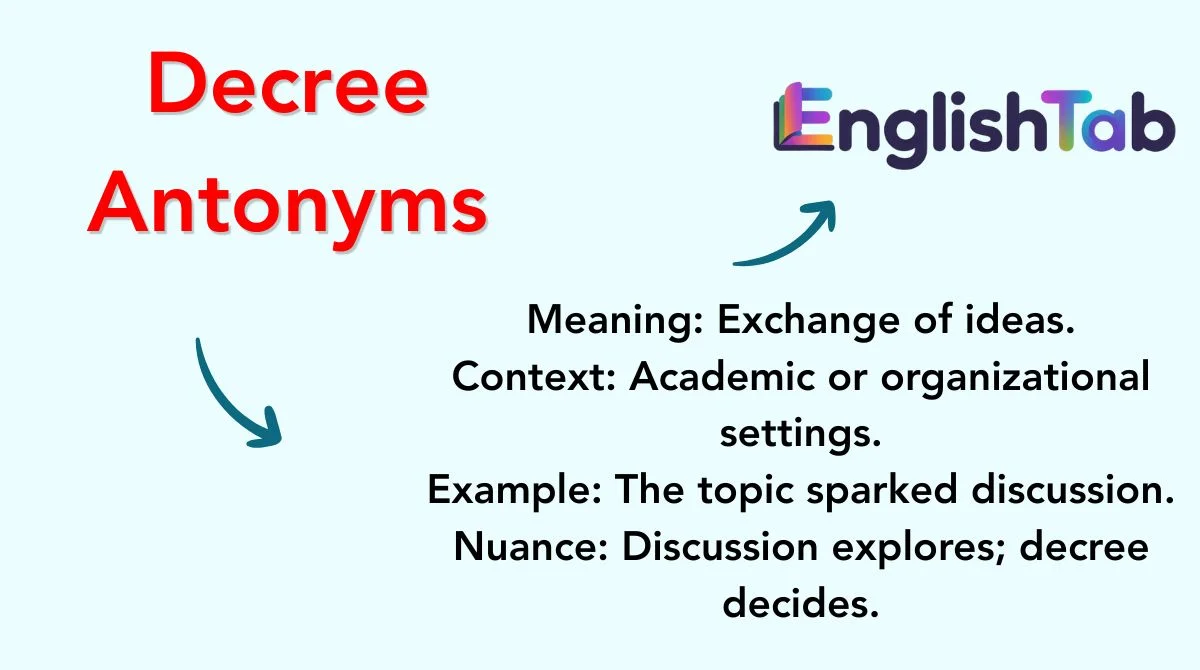
Discussion
Meaning: Exchange of ideas.
Context: Academic or organizational settings.
Example: The topic sparked discussion.
Nuance: Discussion explores; decree decides.
Recommendation
Meaning: Advice or endorsement.
Context: Policy and reports.
Example: The committee issued a recommendation.
Nuance: Recommendation suggests; decree enforces.
Advice
Meaning: Guidance offered.
Context: Informal or professional.
Example: She gave helpful advice.
Nuance: Advice respects autonomy; decree overrides it.
Permission
Meaning: Approval to do something.
Context: Authority granting freedom.
Example: He asked for permission to leave.
Nuance: Permission grants choice; decree removes it.
Allowance
Meaning: Grant or concession.
Context: Rules and policies.
Example: The policy allows special allowance.
Nuance: Allowance softens rules; decree hardens them.
Compromise
Meaning: Settlement with concessions.
Context: Conflict resolution.
Example: They reached a compromise.
Nuance: Compromise balances power; decree centralizes it.
Vote
Meaning: Expression of choice by group.
Context: Democratic systems.
Example: The issue was decided by vote.
Nuance: A vote distributes authority; decree concentrates it.
Referendum
Meaning: Public vote on issue.
Context: National decisions.
Example: The law passed after a referendum.
Nuance: Referendum empowers citizens; decree bypasses them.
Petition
Meaning: Formal written request.
Context: Civic activism.
Example: Citizens signed a petition.
Nuance: Petition challenges authority; decree exercises it.
Inquiry
Meaning: Investigation or request for information.
Context: Academic or legal review.
Example: An inquiry was launched.
Nuance: Inquiry questions; decree finalizes.
Consultation
Meaning: Seeking advice before decision.
Context: Policy making.
Example: The government held public consultation.
Nuance: Consultation precedes action; decree ignores it.
Dialogue
Meaning: Two-way communication.
Context: Diplomacy and conflict resolution.
Example: Dialogue restored peace.
Nuance: Dialogue fosters equality; decree implies hierarchy.
Submission
Meaning: Presentation for review.
Context: Legal or academic.
Example: The submission was evaluated.
Nuance: Submission invites judgment; decree issues it.
Objection
Meaning: Expression of disagreement.
Context: Court or debate.
Example: The lawyer raised an objection.
Nuance: Objection resists; decree imposes.
Reversal
Meaning: Official cancellation.
Context: Legal contexts.
Example: The ruling was reversed.
Nuance: Reversal undoes decree’s power.
Protest
Meaning: Public expression of opposition.
Context: Political or social resistance.
Example: Citizens organized a protest.
Nuance: Protest directly challenges decree authority.
Antonym Comparison Table
| Word | Authority Level | Cooperation Required | Emotional Tone | Binding Force |
|---|---|---|---|---|
| Agreement | Shared | Yes | Neutral | Moderate |
| Request | Low | Yes | Polite | None |
| Suggestion | Low | Yes | Gentle | None |
| Proposal | Moderate | Yes | Neutral | None |
| Negotiation | Shared | Yes | Strategic | Conditional |
| Vote | Distributed | Yes | Democratic | Strong |
| Petition | Low | Yes | Urgent | None |
| Protest | Oppositional | No | Emotional | None |
| Permission | Moderate | No | Neutral | Conditional |
Academic Writing Examples
Authoritative form:
The council issued a decree banning the activity.
Collaborative alternative:
The council reached an agreement to restrict the activity.
Legal resistance form:
The decision faced immediate protest from citizens.
Democratic contrast:
The matter was resolved through a public vote rather than executive decree.
Analytical comparison improves clarity and rhetorical precision.
When Not to Replace the Word
Do not replace decree when:
- Writing about official court rulings
- Referring to monarchic or executive authority
- Describing historically accurate terminology
- Maintaining legal precision
Substituting decree with softer words in legal writing may reduce accuracy.
Example where replacement fails:
Incorrect: The judge made a suggestion dissolving the marriage.
Correct: The judge issued a decree dissolving the marriage.
Practice Exercises
- Replace decree with a softer antonym in this sentence:
The president issued a decree restricting imports. - Choose the strongest contrast:
a) Advice
b) Protest
c) Proposal - Identify tone shift:
The board’s decree vs The board’s recommendation. - Rewrite sentence democratically:
The ruler decreed new tax laws. - Which antonym best fits civic activism context?
FAQs
What is the strongest antonym of decree?
Agreement and negotiation are strong structural opposites because they remove unilateral authority.
Is request always an antonym?
Yes in tone, but not in power structure. A request lacks binding force.
Can protest be considered an antonym?
In political context, yes. Protest directly resists decree authority.
Is suggestion too weak as an opposite?
It depends on tone. Suggestion contrasts sharply in emotional intensity.
Are legal reversals true antonyms?
Yes in effect. A reversal cancels a decree’s authority.
Conclusion
Understanding 22+ decree antonyms strengthens analytical writing, legal precision, and rhetorical clarity. A decree represents authority, finality, and imposed power.
Its opposites shift tone toward cooperation, negotiation, resistance, or shared decision-making.
Choosing the correct antonym depends on:
- Power structure
- Emotional intensity
- Legal binding force
- Contextual purpose
Writers who master contrast do more than substitute words. They control authority, shape tone, and clarify intention.
In 2026 and beyond, vocabulary precision is intellectual power.

Dorian Hale is an English language enthusiast and content creator dedicated to making vocabulary and grammar learning simple, engaging, and accessible for everyone.