Precision in language is not optional in academic and professional writing. It is essential. One of the strongest tools for clarity is contrast.
When writers understand not only what a word means but also what it does not mean, their arguments become sharper, more persuasive, and more credible.
The word “declare” carries authority, intention, and public visibility. Yet, in many contexts, it may be inaccurate, too strong, or misleading.
Knowing its antonyms helps writers choose the correct tone—whether they want to express silence, denial, secrecy, hesitation, or neutrality.
This comprehensive 2026 guide explores 19+ declare antonyms, examining their meaning, context, emotional tone, and academic application.
The goal is not to list random opposites, but to build deep understanding through contrast analysis.
Definition and Core Meaning of “Declare”
To declare means:
- To state something openly and formally
- To make an official or public announcement
- To express something clearly and firmly
- To assert with authority or confidence
Core features of the word include:
- Public expression
- Certainty
- Formal tone
- Intentional communication
- Often legal, political, or institutional weight
For example:
“The government declared a national emergency.”
Here, the word signals official authority and public recognition.
Understanding these core traits helps us identify true antonyms—words that remove publicity, certainty, authority, or intention.
Direct Opposites (Clear Contrasts)
These are the strongest and most immediate antonyms of “declare.” They oppose its meaning clearly and directly:
Conceal
Hide
Suppress
Deny
Withdraw
Retract
Withhold
Silence
Neglect
Ignore
Disavow
Repudiate
Renounce
Recant
Oppose
Contradict
Refute
Reject
Invalidate
Each of these words challenges at least one major element of declaring: publicity, certainty, authority, or affirmation.
Contextual Opposites
Some words act as antonyms only in certain situations. Their opposition depends on context.
Imply – Instead of stating openly, the speaker suggests indirectly.
Hint – Communicates subtly rather than clearly.
Murmur – Expresses softly, not formally.
Question – Challenges instead of asserting.
Doubt – Signals uncertainty rather than confidence.
Hesitate – Shows reluctance rather than firmness.
Remain silent – Absence of public statement.
Delay – Postpones instead of announcing.
For example:
A company may declare bankruptcy publicly, but it might delay announcing internal restructuring.
Context determines whether the word truly opposes declaration.
Emotional & Tone-Based Opposites
“Declare” often carries emotional intensity and authority. Tone-based antonyms reduce that intensity.
Whisper – Private and soft
Downplay – Minimizes importance
Understate – Reduces impact
Dismiss – Rejects without formal recognition
Apologize – Expresses regret rather than authority
Confess – Admits privately, not officially
Submit – Shows compliance instead of authority
Comply – Accepts rather than proclaims
Tone matters greatly in academic writing. Replacing “declare” with “suggest” or “whisper” drastically shifts perceived confidence.
19+ Antonyms Explained in Detail
Below are in-depth analyses of major declare antonyms.
Conceal
Meaning: To keep something secret or hidden.
Context: Used when information is deliberately kept from public knowledge.
Example: The organization concealed financial losses.
Nuance: Conceal implies intentional secrecy, the opposite of public announcement.
Hide
Meaning: To place out of sight or knowledge.
Context: Often physical or informational secrecy.
Example: He hid the documents instead of declaring their contents.
Nuance: Less formal than conceal, but still strongly opposed to declaration.
Suppress
Meaning: To prevent from being expressed or revealed.
Context: Common in political or emotional contexts.
Example: Authorities suppressed the report.
Nuance: Suggests forceful prevention.
Deny
Meaning: To refuse to accept or admit.
Context: Used when rejecting claims or accusations.
Example: The company denied responsibility.
Nuance: Denial actively contradicts declaration.
Withdraw
Meaning: To remove a statement or claim.
Context: After something has been declared.
Example: She withdrew her earlier statement.
Nuance: Reversal rather than silence.
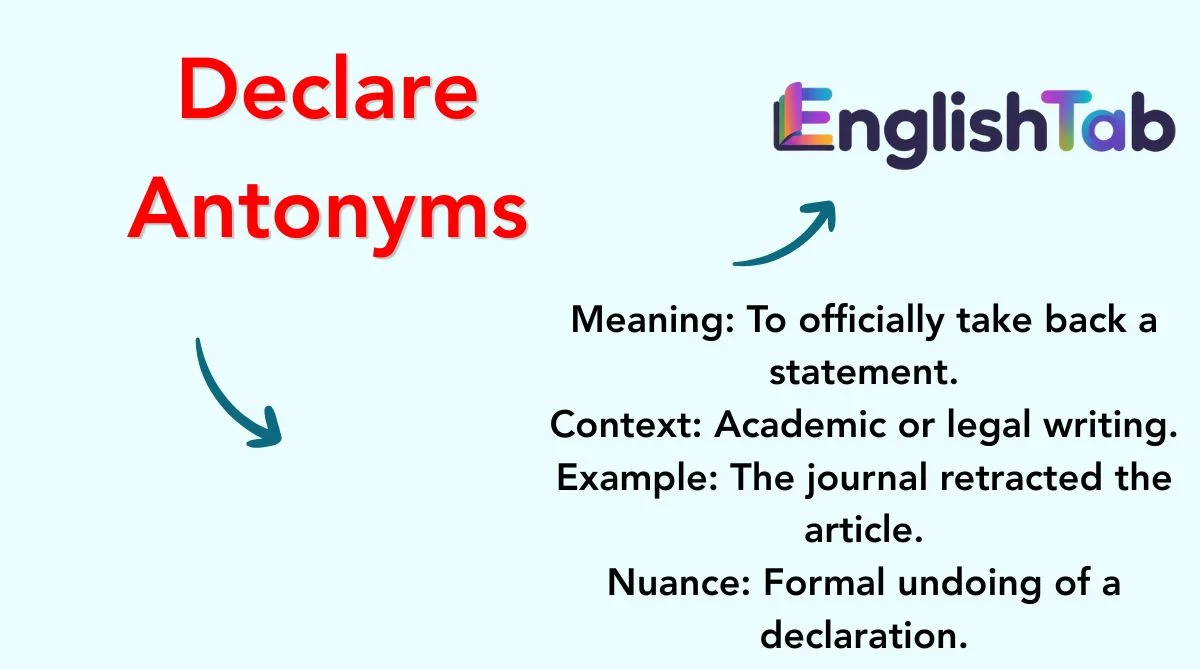
Retract
Meaning: To officially take back a statement.
Context: Academic or legal writing.
Example: The journal retracted the article.
Nuance: Formal undoing of a declaration.
Withhold
Meaning: To keep back information.
Context: Often strategic or legal.
Example: The witness withheld evidence.
Nuance: Suggests deliberate delay.
Silence
Meaning: To stop expression or speech.
Context: Authority preventing announcement.
Example: The critic was silenced.
Nuance: Imposed absence of declaration.
Neglect
Meaning: To fail to mention or address.
Context: Passive opposition.
Example: The report neglected critical data.
Nuance: Lack of declaration due to oversight.
Ignore
Meaning: To pay no attention to.
Context: Avoiding acknowledgment.
Example: Officials ignored the warning signs.
Nuance: Passive avoidance.
Disavow
Meaning: To deny responsibility or connection.
Context: Political or legal distancing.
Example: The leader disavowed previous remarks.
Nuance: Formal separation from a prior declaration.
Repudiate
Meaning: To reject as invalid.
Context: Academic or ideological disputes.
Example: Scholars repudiated the theory.
Nuance: Stronger than reject.
Renounce
Meaning: To give up formally.
Context: Legal or moral contexts.
Example: He renounced his citizenship.
Nuance: Opposes declaration of loyalty or support.
Recant
Meaning: To withdraw a previous belief.
Context: Religious or legal.
Example: The witness recanted his testimony.
Nuance: Suggests regret or pressure.
Oppose
Meaning: To resist or disagree.
Context: Debates and policy arguments.
Example: Citizens opposed the proposal.
Nuance: Challenges declared positions.
Contradict
Meaning: To assert the opposite.
Context: Logical opposition.
Example: Data contradicts the claim.
Nuance: Direct logical conflict.
Refute
Meaning: To prove false.
Context: Academic writing.
Example: The researcher refuted the hypothesis.
Nuance: Evidence-based contradiction.
Reject
Meaning: To refuse to accept.
Context: Applications, theories, proposals.
Example: The board rejected the motion.
Nuance: Formal refusal without necessarily disproving.
Invalidate
Meaning: To make legally or logically void.
Context: Legal or procedural settings.
Example: The court invalidated the contract.
Nuance: Removes authority of a declaration.
Antonym Comparison Table
Word | Strength of Opposition | Formality | Emotional Tone | Common Context
Conceal | Strong | Formal | Neutral | Legal, political
Deny | Strong | Medium | Defensive | Accusations
Retract | Strong | Formal | Regretful | Academic, legal
Suppress | Strong | Formal | Forceful | Political
Ignore | Moderate | Informal | Passive | Daily communication
Refute | Strong | Formal | Analytical | Academic
Renounce | Strong | Formal | Dramatic | Legal, moral
Whisper | Weak | Informal | Soft | Personal
Downplay | Moderate | Informal | Strategic | Media
Academic Writing Examples
Original:
The minister declared the policy effective.
Revised alternatives:
The minister later retracted the policy statement.
The opposition refuted the policy’s effectiveness.
Officials withheld full implementation details.
Critics repudiated the theoretical foundation.
Academic writing often benefits from replacing “declare” when:
- Authority is not absolute
- Evidence is disputed
- Tone needs neutrality
- Formal distance is required
For example:
Instead of “The researcher declared the hypothesis correct,” write:
“The researcher concluded that the hypothesis was supported.”
When Not to Replace the Word
Do not replace “declare” when:
- An official announcement truly occurred
- Legal documentation requires precision
- Military or political declarations are involved
- Formal institutional authority is central
For example:
A government declaring independence cannot be replaced with “suggested independence.”
Replacing it would distort meaning.
Practice Exercises
- Replace “declare” with a stronger antonym:
The company declared the report inaccurate. - Identify the most precise antonym:
The witness later declared the testimony false. - Choose between “deny” and “refute” in this sentence:
The scientist ______ the criticism with evidence. - Rewrite academically:
The president declared the claims untrue. - Which word shows forced prevention of speech?
FAQs
What is the strongest antonym of declare?
Words like retract, repudiate, and invalidate are among the strongest because they directly reverse or cancel a declaration.
Is deny always the opposite of declare?
Not always. Deny rejects a claim, but declare can also mean to announce something positive. Context determines accuracy.
Can imply be an antonym?
Yes, in tone-based contrast. Imply suggests indirectly, while declare states directly.
Which antonym is best for academic writing?
Refute and repudiate are common in scholarly contexts because they signal evidence-based opposition.
What is the difference between retract and recant?
Retract is formal withdrawal of a statement. Recant often suggests regret or pressure behind the withdrawal.
Conclusion
Understanding 19+ declare antonyms deepens writing precision and analytical strength. “Declare” signals authority, certainty, and public expression.
Its opposites remove those elements through secrecy, denial, contradiction, hesitation, or withdrawal.
Writers who master contrast gain control over tone, authority, and credibility. Instead of relying on a single strong verb, they choose words that reflect exact intention.
In 2026 and beyond, linguistic precision will continue to define strong academic and professional communication.
Mastering declare antonyms is not just vocabulary expansion—it is clarity in action.

Dorian Hale is an English language enthusiast and content creator dedicated to making vocabulary and grammar learning simple, engaging, and accessible for everyone.