Opposites shape clarity. In academic writing, the ability to present contrast precisely often determines whether an argument feels sharp or vague.
When we define a concept, we also define what it is not. This boundary-making process strengthens logic, improves analytical depth, and refines persuasive impact.
Among different types of opposites, complementary antonyms hold a special position. They are absolute contrasts.
If one term applies, the other cannot. There is no middle ground. No overlap. No gradual transition.
Understanding complementary antonyms allows writers to:
- Construct precise definitions
- Avoid ambiguity
- Strengthen thesis statements
- Develop rigorous comparisons
- Improve logical coherence
This article offers a comprehensive, structured exploration of 18+ complementary antonyms, complete with definitions, contextual usage, emotional tone analysis, academic examples, and applied exercises.
Definition and Core Meaning of “Complementary Antonyms”
Complementary antonyms are pairs of words that express a binary opposition. The presence of one excludes the possibility of the other.
These opposites function as logical alternatives:
- If something is true, it is not false.
- If a person is alive, they are not dead.
There is no intermediate category in strict logical interpretation.
Core Characteristics
- Mutually Exclusive – Both terms cannot be true simultaneously.
- Exhaustive in Scope – One or the other must apply.
- Non-Gradable – No degrees exist between them (unlike “hot” and “cold”).
For example:
- Pregnant vs. not pregnant — no measurable midpoint.
- Legal vs. illegal — an action cannot be partially lawful in strict definition.
Complementary antonyms are foundational in logic, philosophy, law, linguistics, and academic writing.
Direct Opposites (Clear Contrasts)
Below are 18 of the strongest complementary antonym pairs:
- Alive — Dead
- True — False
- Present — Absent
- Legal — Illegal
- Accept — Reject
- Success — Failure
- Win — Lose
- On — Off
- Married — Unmarried
- Open — Closed
- Pass — Fail
- Inside — Outside
- Agree — Disagree
- Start — Stop
- Public — Private
- Include — Exclude
- Positive — Negative
- Enable — Disable
Each pair represents a clear binary division with no overlapping interpretation under strict definition.
Contextual Opposites
Not all complementary antonyms remain absolute in real-world usage. Context sometimes introduces interpretive flexibility.
For example:
- Open vs. Closed — A store may be “temporarily closed” but operational.
- Public vs. Private — Some institutions operate as public-private partnerships.
- Legal vs. Illegal — Laws vary by jurisdiction.
Contextual forces such as culture, law, and domain knowledge influence how strictly complementary a pair functions.
Thus, writers must consider:
- Field of discourse
- Intended audience
- Legal or technical definitions
- Emotional implication
Complementary antonyms are strongest in formal logic, weaker in conversational language.
Emotional & Tone-Based Opposites
Complementary antonyms can carry emotional weight beyond logical meaning.
Consider:
- Success — Failure
- Accept — Reject
- Win — Lose
These pairs introduce psychological intensity.
Tone Differences
- Win vs. Lose carries competitive emotion.
- Accept vs. Reject implies social inclusion or exclusion.
- Positive vs. Negative influences morale and perception.
The emotional register affects how readers interpret statements. In persuasive writing, selecting a complementary antonym may heighten impact.
Example:
“The policy failed” feels stronger than “The policy was less effective.”
Absolute opposites sharpen rhetorical force.
18+ Antonyms Explained in Detail
Below are detailed explanations of each antonym pair.
Alive
Meaning: Living; possessing biological life.
Opposite: Dead
Context: Used in biology, philosophy, and metaphorical language.
Example: The patient is alive after surgery.
Nuance: “Alive” implies active existence; “dead” signals complete cessation.
True
Meaning: Factually correct; aligned with reality.
Opposite: False
Context: Academic writing, logic, research validation.
Example: The statement is true based on evidence.
Nuance: “False” negates accuracy entirely; no middle ground in strict logic.
Present
Meaning: Existing or occurring in a location or time.
Opposite: Absent
Context: Attendance, documentation, analysis.
Example: All members were present at the meeting.
Nuance: “Absent” signals complete non-participation.
Legal
Meaning: Permitted by law.
Opposite: Illegal
Context: Policy, governance, criminal justice.
Example: The transaction is legal under current regulations.
Nuance: Illegal indicates formal violation.
Accept
Meaning: To receive or approve.
Opposite: Reject
Context: Academic submission, job offers.
Example: The journal accepted the manuscript.
Nuance: Reject signals total denial.
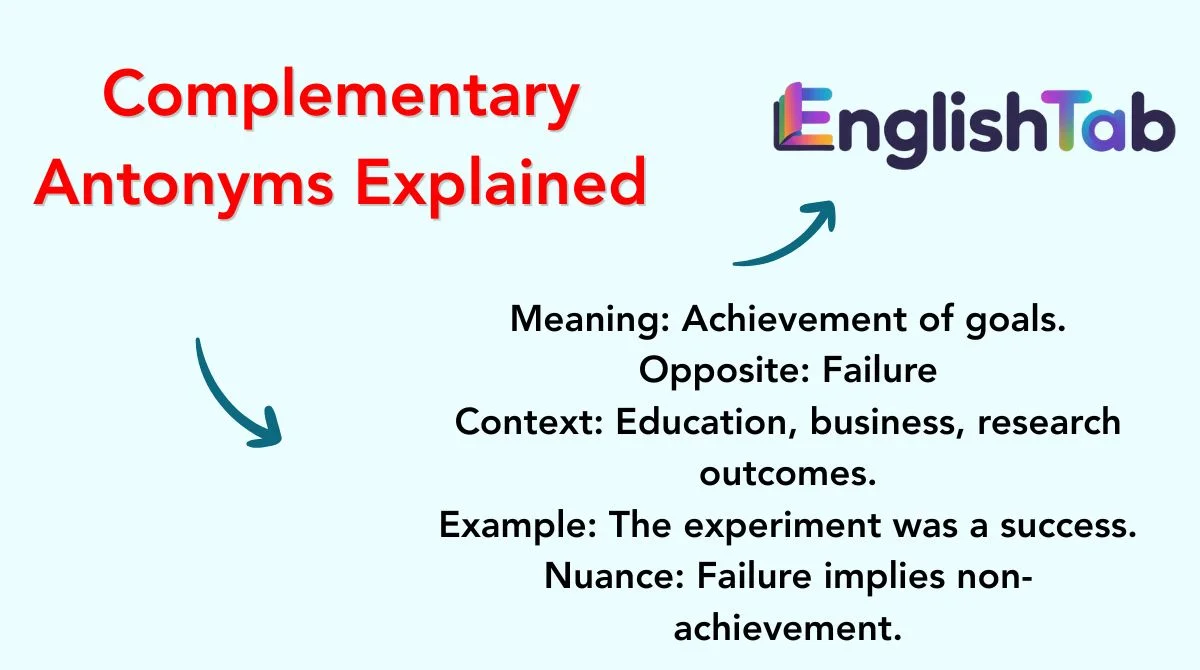
Success
Meaning: Achievement of goals.
Opposite: Failure
Context: Education, business, research outcomes.
Example: The experiment was a success.
Nuance: Failure implies non-achievement.
Win
Meaning: To achieve victory.
Opposite: Lose
Context: Competition, elections.
Example: The candidate won the debate.
Nuance: Lose signals definitive defeat.
On
Meaning: Functioning or activated.
Opposite: Off
Context: Technology, systems.
Example: The device is on.
Nuance: Off implies complete inactivity.
Married
Meaning: Legally united in marriage.
Opposite: Unmarried
Context: Legal, demographic studies.
Example: She is married.
Nuance: Unmarried excludes legal union.
Open
Meaning: Accessible or not closed.
Opposite: Closed
Context: Business, communication.
Example: The store is open.
Nuance: Closed implies full restriction.
Pass
Meaning: To meet required standards.
Opposite: Fail
Context: Education, testing.
Example: He passed the exam.
Nuance: Fail means standards were not met.
Inside
Meaning: Within boundaries.
Opposite: Outside
Context: Spatial, metaphorical.
Example: The files are inside the folder.
Nuance: Outside indicates complete external position.
Agree
Meaning: To share the same opinion.
Opposite: Disagree
Context: Debate, discussion.
Example: Scholars agree on the theory.
Nuance: Disagree indicates intellectual opposition.
Start
Meaning: To begin.
Opposite: Stop
Context: Processes, events.
Example: The program will start at noon.
Nuance: Stop indicates termination.
Public
Meaning: Open to all people.
Opposite: Private
Context: Policy, ownership.
Example: It is a public institution.
Nuance: Private restricts access.
Include
Meaning: To contain as part of a whole.
Opposite: Exclude
Context: Reports, membership.
Example: The list includes all names.
Nuance: Exclude removes entirely.
Positive
Meaning: Affirmative or beneficial.
Opposite: Negative
Context: Feedback, science, emotion.
Example: The results were positive.
Nuance: Negative reverses polarity.
Enable
Meaning: To make possible.
Opposite: Disable
Context: Technology, rights.
Example: The feature enables editing.
Nuance: Disable removes capability.
Antonym Comparison Table
| Word | Opposite | Field of Use | Emotional Weight | Absolute? |
|---|---|---|---|---|
| Alive | Dead | Biology | High | Yes |
| Legal | Illegal | Law | High | Yes |
| Accept | Reject | Academic/Social | Moderate | Yes |
| Success | Failure | Education | High | Yes |
| Public | Private | Governance | Moderate | Contextual |
| Open | Closed | Business | Low | Contextual |
| True | False | Logic | Neutral | Yes |
| Pass | Fail | Education | High | Yes |
| Agree | Disagree | Debate | Moderate | Yes |
Academic Writing Examples
- The hypothesis was proven true, not false.
- The proposal was accepted rather than rejected.
- The experiment resulted in success, not failure.
- The document is public, not private.
- The student passed the assessment instead of failing.
Using complementary antonyms clarifies argumentative position and eliminates interpretive uncertainty.
When Not to Replace the Word
Complementary antonyms should not replace:
- Gradable opposites (hot/cold)
- Context-dependent evaluative language
- Nuanced emotional descriptors
Example:
Incorrect: “The weather is not alive.”
Correct: Use relevant semantic fields.
Avoid forced substitution when logic does not require binary contrast.
Practice Exercises
- Identify the complementary antonym:
The system is either ______ or disabled. - Rewrite using a complementary antonym:
The argument was not successful. - Choose the correct opposite:
The door is (open/closed). - Convert into binary contrast:
The candidate did not win. - Replace with precise antonym:
The data was not included.
FAQs
What makes complementary antonyms different from gradable antonyms?
Complementary antonyms allow no middle degree. Gradable antonyms permit variation.
Are all opposites complementary?
No. Many opposites are relational or gradable rather than absolute.
Can complementary antonyms shift meaning by context?
Yes. Legal and cultural frameworks may introduce nuance.
Why are they important in academic writing?
They provide logical precision and strengthen argument clarity.
Are they used in everyday language?
Yes, but often less strictly than in formal logic.
Conclusion
Complementary antonyms form the backbone of logical contrast. Their binary nature enhances clarity, strengthens academic rigor, and refines argumentative structure.
By mastering 18+ core complementary antonyms, writers gain control over precision and rhetorical sharpness.
In 2K26 and beyond, clarity will remain the foundation of effective communication.
Understanding complementary antonyms is not merely a vocabulary exercise — it is a structural skill that shapes powerful writing.

Dorian Hale is an English language enthusiast and content creator dedicated to making vocabulary and grammar learning simple, engaging, and accessible for everyone.