Clear writing depends on contrast. When we understand not only what a word means but also what it does not mean, our expression becomes sharper, more precise, and more persuasive.
Opposites—also called antonyms—help writers define boundaries, clarify tone, and prevent ambiguity.
The word communication represents connection, exchange, and shared understanding. Its opposites reveal breakdowns, silence, distortion, and division.
By studying communication antonyms in depth, we strengthen analytical writing, rhetorical awareness, and vocabulary control.
This article explores more than 22 communication antonyms through structured contrast, contextual analysis, tone comparison, and academic examples.
Definition and Core Meaning of “Communication”
Communication refers to the deliberate or unconscious exchange of information, ideas, emotions, or meaning between individuals or groups. It involves:
- A sender
- A message
- A medium
- A receiver
- Interpretation
Communication may be verbal, nonverbal, written, visual, digital, or symbolic. Its central purpose is shared understanding.
At its core, communication implies:
- Clarity
- Interaction
- Mutual awareness
- Exchange
- Expression
Its antonyms therefore involve:
- Silence
- Isolation
- Concealment
- Confusion
- Breakdown
- Suppression
- Disconnection
Understanding these contrasts improves argumentative writing and analytical comparison.
Direct Opposites (Clear Contrasts)
The following are the strongest and clearest communication antonyms. These words oppose communication in structure, function, or purpose:
Silence
Isolation
Secrecy
Suppression
Concealment
Withholding
Mute
Shutdown
Censorship
Stonewalling
Avoidance
Disconnect
Miscommunication
Breakdown
Alienation
Obscurity
Confusion
Distortion
Separation
Noninteraction
Incommunicado
Misunderstanding
Each represents a direct contrast to the exchange of meaning.
Contextual Opposites
Some words oppose communication depending on context. They may not always be antonyms, but they become opposites when compared to open exchange.
- Privacy (when used as information restriction)
- Reservation (emotional withholding)
- Guardedness
- Evasion
- Ambiguity
- Indifference
- Passivity
- Monologue (when one-sided)
- Noise (interference in messaging)
- Bureaucracy (when obstructing clarity)
For example, privacy is not inherently negative, but in contexts requiring transparency, it functions as the opposite of communication.
Emotional & Tone-Based Opposites
Communication often carries warmth, clarity, and connection. Emotional antonyms include states that disrupt relational exchange:
Coldness
Hostility
Resentment
Withdrawal
Rejection
Dismissiveness
Apathy
Contempt
Detachment
Isolationism
These do not simply block speech; they block relational exchange.
22+ Antonyms Explained in Detail
Below is a deep analysis of 24 major communication antonyms.
Silence
Meaning: Absence of speech or sound.
Context: Used when no message is conveyed.
Example: His silence during the meeting worried the team.
Nuance: Silence may be intentional or accidental; communication requires active exchange.
Isolation
Meaning: Physical or emotional separation.
Context: Prevents interaction.
Example: Social isolation limits meaningful dialogue.
Nuance: Isolation affects environment, not just speech.
Secrecy
Meaning: Intentional hiding of information.
Context: Opposes transparency.
Example: Corporate secrecy damaged public trust.
Nuance: Secrecy is deliberate; silence may not be.
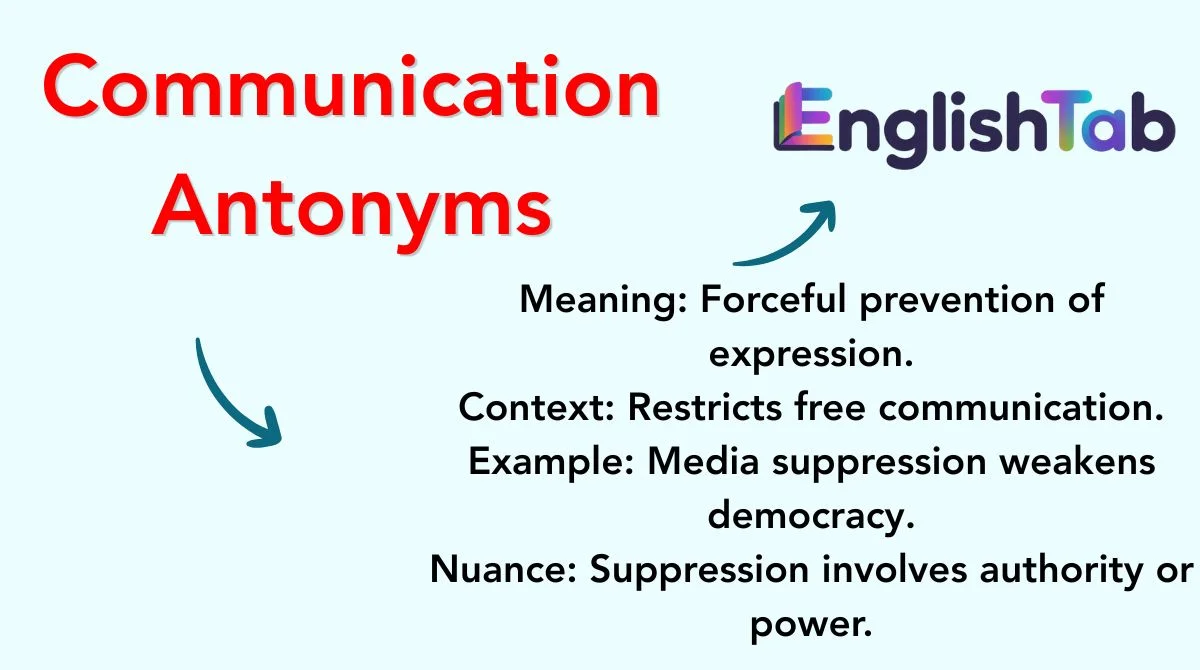
Suppression
Meaning: Forceful prevention of expression.
Context: Restricts free communication.
Example: Media suppression weakens democracy.
Nuance: Suppression involves authority or power.
Concealment
Meaning: Hiding facts or truth.
Context: Opposes open disclosure.
Example: The concealment of evidence delayed justice.
Nuance: More subtle than suppression.
Withholding
Meaning: Refusal to share information.
Context: Personal communication barrier.
Example: Emotional withholding harms relationships.
Nuance: Often interpersonal.
Mute
Meaning: Unable or unwilling to speak.
Context: Blocks verbal exchange.
Example: The witness remained mute.
Nuance: Can be literal or symbolic.
Shutdown
Meaning: Abrupt cessation of interaction.
Context: Emotional or technological.
Example: The server shutdown stopped communication.
Nuance: Implies sudden stoppage.
Censorship
Meaning: Official restriction of speech.
Context: Political or institutional.
Example: Censorship limits journalistic communication.
Nuance: Institutional form of suppression.
Stonewalling
Meaning: Refusal to answer or engage.
Context: Conflict situations.
Example: His stonewalling frustrated negotiators.
Nuance: Active avoidance.
Avoidance
Meaning: Intentional evasion of interaction.
Context: Social communication barrier.
Example: Avoidance prevents conflict resolution.
Nuance: Psychological withdrawal.
Disconnect
Meaning: Lack of understanding or linkage.
Context: Between individuals or ideas.
Example: There is a disconnect between policy and reality.
Nuance: Not silence, but misalignment.
Miscommunication
Meaning: Faulty exchange of information.
Context: Incorrect understanding.
Example: Miscommunication caused delays.
Nuance: Communication exists but fails.
Breakdown
Meaning: Collapse of dialogue.
Context: Relationship or system failure.
Example: Negotiations ended in breakdown.
Nuance: Suggests prior communication existed.
Alienation
Meaning: Emotional estrangement.
Context: Social separation.
Example: Poor leadership creates alienation.
Nuance: Emotional opposite.
Obscurity
Meaning: Lack of clarity.
Context: Message unclear.
Example: Obscurity weakens academic writing.
Nuance: Opposes clarity, not exchange.
Confusion
Meaning: Disorder in understanding.
Context: Receiver fails to interpret.
Example: Confusion followed unclear instructions.
Nuance: Cognitive disruption.
Distortion
Meaning: Alteration of message meaning.
Context: Media or rumor.
Example: Information distortion spreads panic.
Nuance: Message exists but is twisted.
Separation
Meaning: Division between entities.
Context: Physical or relational.
Example: Geographic separation limits communication.
Nuance: Environmental barrier.
Noninteraction
Meaning: Lack of engagement.
Context: Social setting.
Example: Classroom noninteraction reduces learning.
Nuance: Passive absence.
Incommunicado
Meaning: Unable to communicate externally.
Context: Confinement.
Example: The detainee was held incommunicado.
Nuance: Extreme restriction.
Misunderstanding
Meaning: Incorrect interpretation.
Context: Failed comprehension.
Example: A misunderstanding escalated the conflict.
Nuance: Receiver-side failure.
Apathy
Meaning: Lack of interest in interaction.
Context: Emotional disengagement.
Example: Political apathy reduces civic communication.
Nuance: Emotional withdrawal.
Rejection
Meaning: Dismissal of dialogue.
Context: Refusal to engage.
Example: Proposal rejection ended discussions.
Nuance: Active denial.
Antonym Comparison Table
| Antonym | Type of Opposition | Intentional? | Emotional Level | Context |
|---|---|---|---|---|
| Silence | Absence | Sometimes | Neutral | Verbal |
| Secrecy | Concealment | Yes | Controlled | Political/Personal |
| Suppression | Forced blockage | Yes | High | Institutional |
| Isolation | Separation | Sometimes | Moderate | Social |
| Miscommunication | Faulty exchange | No | Neutral | Informational |
| Breakdown | Collapse | No/Yes | High | Negotiation |
| Alienation | Emotional distance | No | High | Relational |
| Distortion | Alteration | Yes/No | Moderate | Media |
| Stonewalling | Refusal | Yes | High | Conflict |
| Obscurity | Lack of clarity | No | Low | Academic |
Academic Writing Examples
Effective academic contrast:
Instead of:
The organization improved communication.
Use contrast:
The organization reduced isolation and eliminated internal secrecy.
Instead of:
Poor communication caused failure.
Use:
Systemic suppression and repeated miscommunication resulted in negotiation breakdown.
Contrast strengthens clarity and analytical depth.
When Not to Replace the Word
Do not replace communication when:
- Discussing technical communication theory.
- Referring to academic disciplines.
- Citing formal research frameworks.
- Describing neutral exchange without contrast.
Replacing unnecessarily may distort precision.
For example, “communication models” cannot become “anti-silence models.”
Practice Exercises
- Replace “communication” with a contrasting antonym:
The committee’s lack of transparency led to public distrust. - Identify whether the antonym is emotional or structural:
Alienation between departments reduced productivity. - Choose the strongest antonym for political control of media:
(a) Silence
(b) Censorship
(c) Isolation - Rewrite:
Communication between partners failed.
→ Use breakdown or misunderstanding appropriately.
FAQs
What is the strongest antonym of communication?
The strongest direct antonym is silence, but in institutional contexts, suppression or censorship may be stronger.
Is miscommunication truly an antonym?
Yes, in functional contrast. It represents failed communication rather than absence.
Can privacy be an antonym?
In contexts requiring openness, yes. Otherwise, privacy is neutral.
Are emotional states antonyms?
Emotion-based opposites like alienation and apathy function as relational antonyms.
Why are antonyms important in academic writing?
They create contrast, clarify boundaries, and strengthen analytical depth.
Conclusion
Understanding 22+ communication antonyms enhances clarity, precision, and rhetorical strength. Communication represents connection and exchange.
Its opposites reveal silence, distortion, suppression, and emotional withdrawal.
In academic and professional writing, mastering these contrasts:
- Prevents vague phrasing
- Improves argument structure
- Strengthens comparative analysis
- Deepens tone control
Opposites do more than negate meaning—they define it.
By analyzing silence against speech, secrecy against transparency, and alienation against connection, writers gain linguistic authority and intellectual precision in 2K26 and beyond.

Dorian Hale is an English language enthusiast and content creator dedicated to making vocabulary and grammar learning simple, engaging, and accessible for everyone.