In academic writing, clarity depends on contrast. Readers understand a concept more deeply when they also understand what it is not.
This is where antonyms become powerful tools. Opposites help writers refine arguments, highlight distinctions, and avoid vague expression.
The phrase central idea refers to the main point or dominant message in a text.
When writers misunderstand or blur this idea, essays become scattered and unclear. Studying central idea antonyms helps students and scholars recognize when a text lacks focus, unity, or purpose.
In this comprehensive guide, we will explore 22+ central idea antonyms, analyze their meanings, compare their nuances, and examine how they function in academic contexts.
By mastering these opposites, you can sharpen analysis, improve thesis clarity, and strengthen argumentative writing.
Definition and Core Meaning of “Central Idea”
Before exploring central idea antonyms, we must understand the root concept clearly.
A central idea is:
- The primary message of a text
- The controlling thought that organizes content
- The unifying principle that guides structure
- The dominant theme around which supporting details revolve
In essays, it functions like a spine. Every paragraph connects back to it. Without a central idea, writing loses coherence.
Key characteristics of a central idea:
- Clear
- Focused
- Unified
- Purpose-driven
- Supported by evidence
Now, let us examine what stands in opposition to this concept.
Direct Opposites (Clear Contrasts)
The following words are the strongest and most direct central idea antonyms. These represent clear absence, disruption, or contradiction of a focused main idea:
- Irrelevance
- Disorganization
- Confusion
- Fragmentation
- Chaos
- Distraction
- Incoherence
- Randomness
- Aimlessness
- Digression
- Misfocus
- Disunity
- Inconsistency
- Contradiction
- Scatter
- Peripheral detail
- Triviality
- Side issue
- Diversion
- Disorder
- Vagueness
- Ambiguity
Each of these words reflects a breakdown in unity or focus, which is essential to the concept of a central idea.
Contextual Opposites
Some words function as central idea antonyms only depending on context. They may not always oppose the concept directly but can weaken or obscure it in certain situations.
Examples include:
- Subplot
- Tangent
- Detail overload
- Expansion
- Elaboration
- Complication
- Multiplicity
- Redundancy
For instance, elaboration can strengthen a central idea when controlled. However, excessive elaboration can blur it. Therefore, contextual opposites depend on how they are used.
Emotional & Tone-Based Opposites
While “central idea” is mostly structural, emotional tone can affect how strongly the main message is communicated.
Tone-based antonyms include:
- Indifference
- Emotional clutter
- Dramatic exaggeration
- Sensationalism
- Overreaction
- Neutral drift
A strong central idea carries confidence and direction. Emotional instability or tonal imbalance can weaken it.
22+ Antonyms Explained in Detail
Below are detailed explanations of 22 major central idea antonyms.
Irrelevance
Meaning: Lack of connection to the main topic.
Context: Appears when details do not support the thesis.
Example: The essay discussed climate change but included irrelevant facts about space travel.
Nuance: Irrelevance removes alignment, not structure.
Disorganization
Meaning: Absence of logical order.
Context: Paragraphs lack clear progression.
Example: The argument jumped between ideas without structure.
Nuance: Unlike confusion, disorganization affects structure more than meaning.
Confusion
Meaning: Lack of clarity in message.
Context: Readers cannot identify the main argument.
Example: The paper’s purpose was unclear.
Nuance: Confusion may stem from unclear wording, not just weak focus.
Fragmentation
Meaning: Breaking into disconnected parts.
Context: Ideas do not connect smoothly.
Example: Each paragraph felt isolated.
Nuance: Fragmentation suggests structural separation.
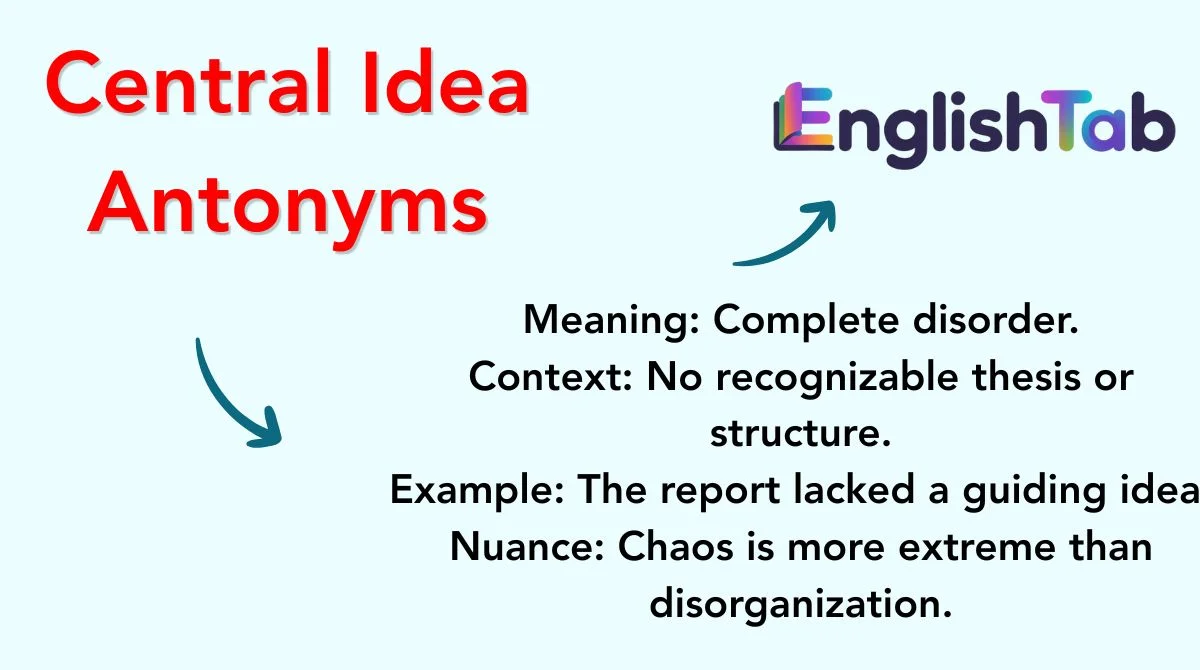
Chaos
Meaning: Complete disorder.
Context: No recognizable thesis or structure.
Example: The report lacked a guiding idea.
Nuance: Chaos is more extreme than disorganization.
Distraction
Meaning: Shift away from main point.
Context: Frequent side topics.
Example: The essay became distracted by minor historical details.
Nuance: Distraction may be temporary, not permanent.
Incoherence
Meaning: Logical inconsistency.
Context: Arguments contradict each other.
Example: Claims did not logically follow.
Nuance: Incoherence damages credibility.
Randomness
Meaning: Lack of deliberate focus.
Context: Ideas appear unrelated.
Example: Paragraphs seemed randomly arranged.
Nuance: Randomness implies absence of planning.
Aimlessness
Meaning: No clear purpose.
Context: No defined thesis.
Example: The discussion wandered without conclusion.
Nuance: Aimlessness reflects motivational absence.
Digression
Meaning: Departure from main topic.
Context: Extended side discussions.
Example: The author digressed into personal anecdotes.
Nuance: Digression can be brief or prolonged.
Misfocus
Meaning: Emphasis on wrong element.
Context: Supporting detail becomes dominant.
Example: The essay misfocused on minor statistics.
Nuance: Central idea exists but is overshadowed.
Disunity
Meaning: Lack of cohesion.
Context: Ideas do not reinforce one theme.
Example: Sections contradicted each other.
Nuance: Disunity damages thematic strength.
Inconsistency
Meaning: Lack of stable direction.
Context: Thesis shifts mid-essay.
Example: The writer changed stance repeatedly.
Nuance: Inconsistency may involve tone or argument.
Contradiction
Meaning: Direct opposition within argument.
Context: Claims conflict internally.
Example: The conclusion contradicted earlier points.
Nuance: Contradiction undermines authority.
Scatter
Meaning: Ideas spread without pattern.
Context: Multiple weak arguments.
Example: The essay scattered attention across topics.
Nuance: Scatter implies diffusion.
Peripheral detail
Meaning: Minor supporting information.
Context: Overshadows main idea.
Example: Excessive statistics hid the thesis.
Nuance: Not inherently negative but harmful when dominant.
Triviality
Meaning: Focus on minor matters.
Context: Important themes ignored.
Example: The paper emphasized trivial formatting issues.
Nuance: Triviality reduces significance.
Side issue
Meaning: Secondary topic.
Context: Replaces main discussion.
Example: The author focused on side issues.
Nuance: Often relevant but not central.
Diversion
Meaning: Intentional redirection.
Context: Argument avoids main question.
Example: The speech diverted attention from criticism.
Nuance: Diversion may be strategic.
Disorder
Meaning: Lack of arrangement.
Context: No thesis structure.
Example: The report was in disorder.
Nuance: Broader than disorganization.
Vagueness
Meaning: Lack of specificity.
Context: Main point unclear.
Example: The thesis was vague.
Nuance: Vagueness weakens authority.
Ambiguity
Meaning: Multiple possible meanings.
Context: Readers interpret differently.
Example: The central claim was ambiguous.
Nuance: Ambiguity can be stylistic but risky academically.
Antonym Comparison Table
| Antonym | Structural Problem | Meaning Problem | Severity |
|---|---|---|---|
| Irrelevance | Low | High | Moderate |
| Disorganization | High | Moderate | High |
| Confusion | Moderate | High | High |
| Fragmentation | High | Moderate | High |
| Chaos | Extreme | Extreme | Severe |
| Digression | Moderate | Low | Moderate |
| Vagueness | Low | High | Moderate |
| Contradiction | Moderate | Extreme | Severe |
| Randomness | High | Moderate | High |
This comparison clarifies how each central idea antonym affects writing differently.
Academic Writing Examples
Example 1:
Strong:
The central idea of the study is that urban green spaces improve mental health.
Weak (Antonym present):
The study includes discussions about architecture styles, park funding politics, and unrelated tourism trends, creating fragmentation and digression.
Example 2:
Strong:
This essay argues that digital literacy is essential in modern education.
Weak:
The paper shifts between praising technology and criticizing its dangers, showing inconsistency and contradiction.
When Not to Replace the Word
Do not substitute “central idea” with its antonyms unless you are intentionally critiquing writing quality.
Avoid replacing when:
- Teaching reading comprehension
- Explaining thesis development
- Summarizing academic texts
- Conducting literary analysis
Antonyms are useful in evaluation, not description.
Practice Exercises
Identify the central idea antonym:
- The essay jumps between unrelated topics without transition.
- The thesis is unclear and open to many interpretations.
- The writer focuses on minor background details instead of argument.
- The introduction promises one argument but the conclusion states another.
- Paragraphs feel disconnected.
Suggested Answers:
- Randomness or Disorganization
- Ambiguity or Vagueness
- Triviality or Misfocus
- Contradiction
- Fragmentation
FAQs
What is the strongest central idea antonym?
Chaos and contradiction are the strongest because they completely undermine unity.
Is digression always negative?
No. Brief digression can add depth, but excessive digression weakens focus.
How do antonyms improve academic writing?
They help writers diagnose structural and conceptual weaknesses.
Are ambiguity and vagueness the same?
No. Vagueness lacks detail. Ambiguity allows multiple meanings.
Can a text have multiple central ideas?
In academic writing, a single dominant idea is preferred for clarity.
Conclusion
Understanding 22+ central idea antonyms allows writers to recognize and correct weaknesses in structure, clarity, and argumentation.
A central idea anchors writing. Its opposites—such as irrelevance, fragmentation, contradiction, and chaos—expose the risks of unfocused composition.
Mastering these contrasts improves analytical reading, academic writing, and rhetorical precision.
In 2026 and beyond, strong writing depends not only on knowing what your main idea is—but also recognizing everything that threatens it.

Dorian Hale is an English language enthusiast and content creator dedicated to making vocabulary and grammar learning simple, engaging, and accessible for everyone.